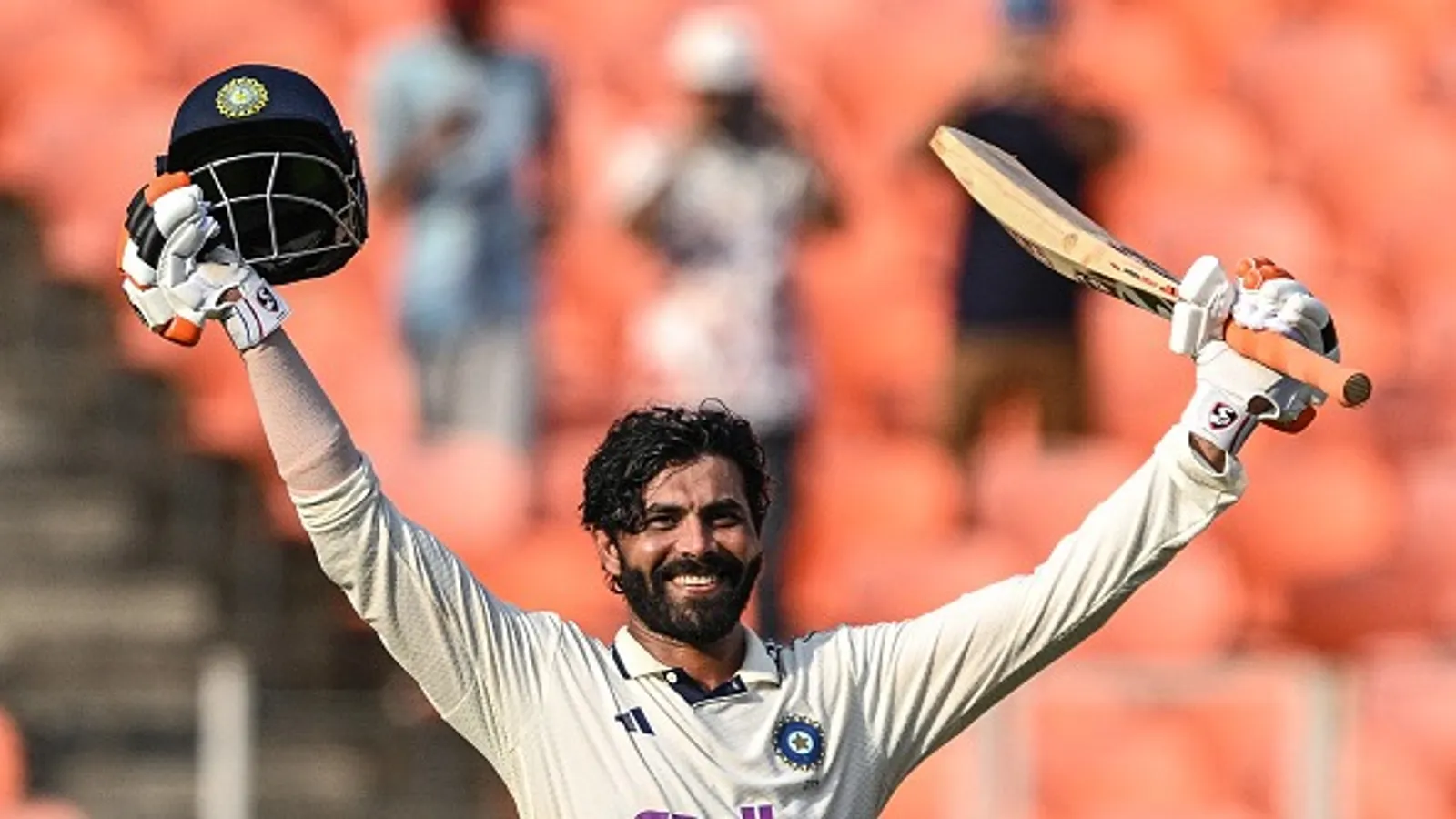
Ravindra Jadeja began his Ranji Trophy 2026-27 campaign with a determined century for Saurashtra, producing a timely reminder of his batting ability ahead of India’s upcoming two-Test series against New Zealand. The left-handed all-rounder scored 102 runs against Chhattisgarh at Niranjan Shah Stadium in Rajkot, reaching his 16th first-class century during the Elite Group B contest.
Jadeja’s innings was particularly significant because it came during a difficult phase for Saurashtra’s lower order. After building a substantial partnership with Prerak Mankad, the team lost several wickets in quick succession. Jadeja continued to fight, reaching three figures before his dismissal brought an end to Saurashtra’s innings at 392.
With India preparing for challenging conditions in New Zealand, the innings offers a useful opportunity for Jadeja to build confidence with the bat. His experience, left-arm spin and ability to contribute in the lower middle order make him an important player to watch ahead of the Test assignment.
Ravindra Jadeja’s century anchors Saurashtra’s innings
Saurashtra finished the opening day of their Ranji Trophy match against Chhattisgarh at 304/4, placing themselves in a strong position. Jadeja resumed on 72 on Day 2, with Prerak Mankad providing support at the other end.
The partnership developed through contrasting batting approaches. Mankad looked to score quickly, while Jadeja concentrated on maintaining his wicket and building his innings. Their fifth-wicket stand helped Saurashtra strengthen their position before Chhattisgarh’s bowlers found a way to break through.
Mankad reached his century from 119 balls and eventually scored 129 from 150 deliveries, striking 15 fours and one six. His dismissal in the 100th over, however, triggered a significant collapse in Saurashtra’s lower order.
Rudra Pratap Dehari broke the partnership, and Saurashtra subsequently lost Samar Gajjar, Arth Yadav and captain Jaydev Unadkat. Chetan Sakariya was dismissed in the 107th over as Dev Aditya Singh completed his five-wicket haul.
At 375/9, Saurashtra had only one wicket remaining. Jadeja responded by taking a more aggressive approach, striking two boundaries across the next two overs as he moved closer to his century.
The left-hander reached three figures from 205 deliveries, demonstrating patience during an innings in which Saurashtra’s lower order struggled to remain at the crease. His century eventually ended when he was caught and bowled by Dharmendrasinh Jadeja, his former Saurashtra teammate.
Jadeja finished with 102 from 209 balls, including seven fours. Saurashtra were bowled out for 392 in 110.4 overs, giving their bowlers a substantial total to defend.
How Jadeja’s innings could help ahead of the New Zealand tour
A century in Domestic Cricket does not automatically guarantee international success, but it can provide valuable preparation before a demanding Test assignment. Jadeja’s innings allowed him to spend an extended period at the crease, manage different phases of an innings and continue batting under pressure after losing partners.
Those skills can be particularly valuable in Test Cricket, where a team may need an established batter to rebuild after a collapse or extend an innings alongside the lower order.
Jadeja’s contribution also illustrates why his value to India goes beyond his bowling. As a left-handed batter, he can help balance the batting order while offering a reliable spin option. His ability to contribute in multiple departments gives the team flexibility when selecting its playing combination.
However, conditions in New Zealand will present a different challenge from domestic cricket in Rajkot. The Ranji Trophy innings provides evidence of his current batting rhythm, but his performances during the international series will ultimately determine how effectively he translates that form to overseas conditions.
Jadeja’s bowling provides another selection consideration
Jadeja did not bowl during the first two sessions of Day 2 against Chhattisgarh. He was introduced in the third session and delivered seven overs, conceding 13 runs without taking a wicket.
His spell included two maiden overs, suggesting that he was able to restrict scoring even without producing a breakthrough. Although the performance was not a major wicket-taking contribution, economical spells can be useful in Test cricket, particularly when a team needs to build pressure from one end.
At stumps on Day 2, Chhattisgarh had reached 122/3 and remained 270 runs behind Saurashtra’s first-innings total. The match situation left Saurashtra with an opportunity to press for an advantage, while Chhattisgarh needed further partnerships to reduce the deficit.
For Jadeja, the domestic fixture offered an opportunity to contribute with both bat and ball. His workload and effectiveness in the remaining stages of the match would provide additional context, although a single domestic appearance should not be treated as a definitive measure of his readiness for international cricket.
When did Jadeja last score a Test century?
Jadeja’s previous Test century came against the West Indies in Ahmedabad in October 2025, according to the supplied match report. He also scored a century against England in Manchester during 2025.
These performances demonstrate that he has continued to contribute substantial runs at the highest level. Nevertheless, the report notes that he had yet to score a half-century in two Test appearances during the current year at the time of writing.
That context makes the Ranji Trophy century a useful confidence-building performance. A long innings gives a batter an opportunity to settle into a rhythm, judge deliveries and spend time negotiating different bowling strategies.
For an experienced international player, domestic cricket can also provide a setting in which to focus on individual aspects of batting without the immediate pressures of a major international series. Whether Jadeja can carry that momentum into New Zealand remains to be seen.
Jadeja’s Test record in New Zealand remains an area to improve
Jadeja’s previous Test performances in New Zealand have not yet produced a half-century. The supplied report records 107 runs from five innings at an average of 35.66, with a highest score of 30 not out. It also lists his bowling record in the country as five wickets at an average of 60.60.
Those figures provide a starting point for assessing the challenge ahead, but they should be interpreted in context. A relatively small number of innings and bowling appearances cannot fully determine how a player will perform during a future series.
New Zealand conditions can create different demands for batters and bowlers, particularly when seam movement and bounce influence the contest. Jadeja’s role will depend on the pitch, the balance of India’s playing XI and the match situation.
His batting could become especially important if India’s top order loses early wickets. A player who can rebuild an innings and later accelerate scoring gives the team an additional route to a competitive total.
With the ball, Jadeja’s control and ability to bowl economical spells could help complement India’s pace attack. His selection would therefore offer the captain more than a specialist spin option, although the extent of his involvement would depend on the conditions at each venue.
Can Jadeja surpass Rohit Sharma’s Test run tally?
Jadeja could also reach a significant career milestone during the New Zealand tour. The supplied figures list his Test record as 4,160 runs from 91 matches at an average of 37.81, including six centuries and 28 half-centuries.
Former India captain Rohit Sharma retired from Test cricket with 4,301 runs from 67 matches. Jadeja would therefore need 142 additional runs to move past Rohit’s total.
KL Rahul is another player within reach of the same milestone. According to the report, Rahul had accumulated 4,288 Test runs from 70 matches at an average of 36.64.
The comparison highlights the value of Jadeja’s batting contributions across a long international career. While he is primarily celebrated for his all-round abilities, his run tally demonstrates that he has also played a substantial role in India’s Test batting efforts.
Whether he passes Rohit during the New Zealand series will depend on his opportunities and performances across the two matches. His century against Chhattisgarh provides encouraging preparation, but domestic runs cannot be directly converted into expectations for an international milestone.
Jadeja approaches another major bowling milestone
Jadeja’s career achievements are not limited to batting. The supplied report credits him with 356 Test wickets at an average of 25.40, including 15 five-wicket hauls.
It also states that he needs seven more wickets to move ahead of former New Zealand spinner Daniel Vettori and former Pakistan all-rounder Imran Khan on the relevant Test wicket list.
That potential milestone adds another point of interest to India’s upcoming assignment. Jadeja’s left-arm spin has long been an important part of his all-round profile, and his ability to contribute wickets while maintaining control can influence how India approaches a Test match.
However, the number of wickets available to a spinner depends on several factors, including the pitch, weather, opposition batting and the number of overs bowled. His progress towards the milestone will therefore depend on match opportunities rather than a guaranteed outcome.
India’s squad selection could depend on conditions and balance
India’s preparations for New Zealand are likely to involve decisions about the balance between pace and spin. The supplied report suggests that a pace-heavy squad could be considered because of the conditions expected in New Zealand.
For Jadeja, the central question is not simply whether he can make the squad, but how the team plans to use his combination of batting and bowling. An all-rounder who can contribute useful runs and provide a spin option may be valuable even when conditions favour seam bowling.
The report also identifies Manav Suthar and Washington Sundar as players relevant to the spin-bowling discussion. It notes Suthar’s recent wicket-taking form and says Sundar had missed a Test series against Sri Lanka because of injury. His availability for the New Zealand tour remained uncertain in the supplied material.
Final selection decisions would need to account for fitness, recent performances, conditions and the team’s preferred combination. Until an official squad is announced, possible selections and changes should be treated as speculation rather than confirmed decisions.
India and New Zealand face important World Test Championship implications
The two-Test series is also significant in the context of the World Test Championship. The supplied report places New Zealand third in the standings, with four wins from six Tests and a points percentage of 72.22. India are listed in fifth position, with five wins from 11 Tests and a points percentage of 51.52.
These figures suggest that the series could have important implications for both teams’ campaigns. A strong result could help a side improve its position, while dropped points could make the remaining fixtures more consequential.
However, standings alone do not determine the final outcome of a championship cycle. Results in other matches and the remaining schedule also influence the eventual table. The series should therefore be viewed as an important part of the campaign rather than a standalone guarantee of qualification.
For India, Jadeja’s ability to contribute with both bat and ball could be particularly useful in a two-Test contest where each match carries substantial importance. His experience may also help the side manage difficult periods during overseas conditions.
New Zealand’s pace-bowling injuries add another storyline
New Zealand are also dealing with injury concerns ahead of the series. The supplied report states that fast bowler Will O’Rourke was ruled out of India’s series while undergoing rehabilitation for left hamstring and calf injuries.
The report says the decision was precautionary, with his workload expected to increase gradually to reduce the risk of aggravating the injuries. It also identifies Ben Sears and Zak Foulkes as unavailable at the time of writing, citing an ankle injury for Sears and a hip flexor injury for Foulkes.
These absences could affect New Zealand’s pace-bowling options, although the eventual impact would depend on squad selection and the availability of replacements. It would be premature to conclude that the injuries alone would determine the result of the series.
For India, the opposition’s bowling resources will be relevant when assessing the challenge facing the batting order. Even without certain players, New Zealand’s final attack will need to be judged on the personnel selected and their performances during the matches.
What Jadeja’s Ranji Trophy century means before the series
Jadeja’s 102 against Chhattisgarh is a timely reminder of his ability to build a long innings under pressure. The century came after Saurashtra lost several wickets and required him to remain at the crease while the lower order struggled.
Its significance lies less in any guarantee of future success and more in the preparation it provides. Jadeja has gained valuable time in the middle, added another first-class century to his record and contributed to a strong Saurashtra total.
The upcoming New Zealand series will present a different examination. His previous record in the country leaves room for improvement, while his broader Test experience gives India an experienced all-round option.
Beyond the immediate contest, the series could offer Jadeja opportunities to reach notable career milestones in both batting and bowling. Whether he achieves them will depend on his performances and opportunities during the matches.
For now, the Ranji Trophy century provides an encouraging beginning to his domestic campaign. India’s preparations, the final squad selection and the conditions encountered in New Zealand will determine how much that performance carries into the international arena.
For breaking news and live news updates, like us on Facebook or follow us on Twitter and Instagram. Read more on Latest Cricket on thefoxdaily.com.






COMMENTS 0