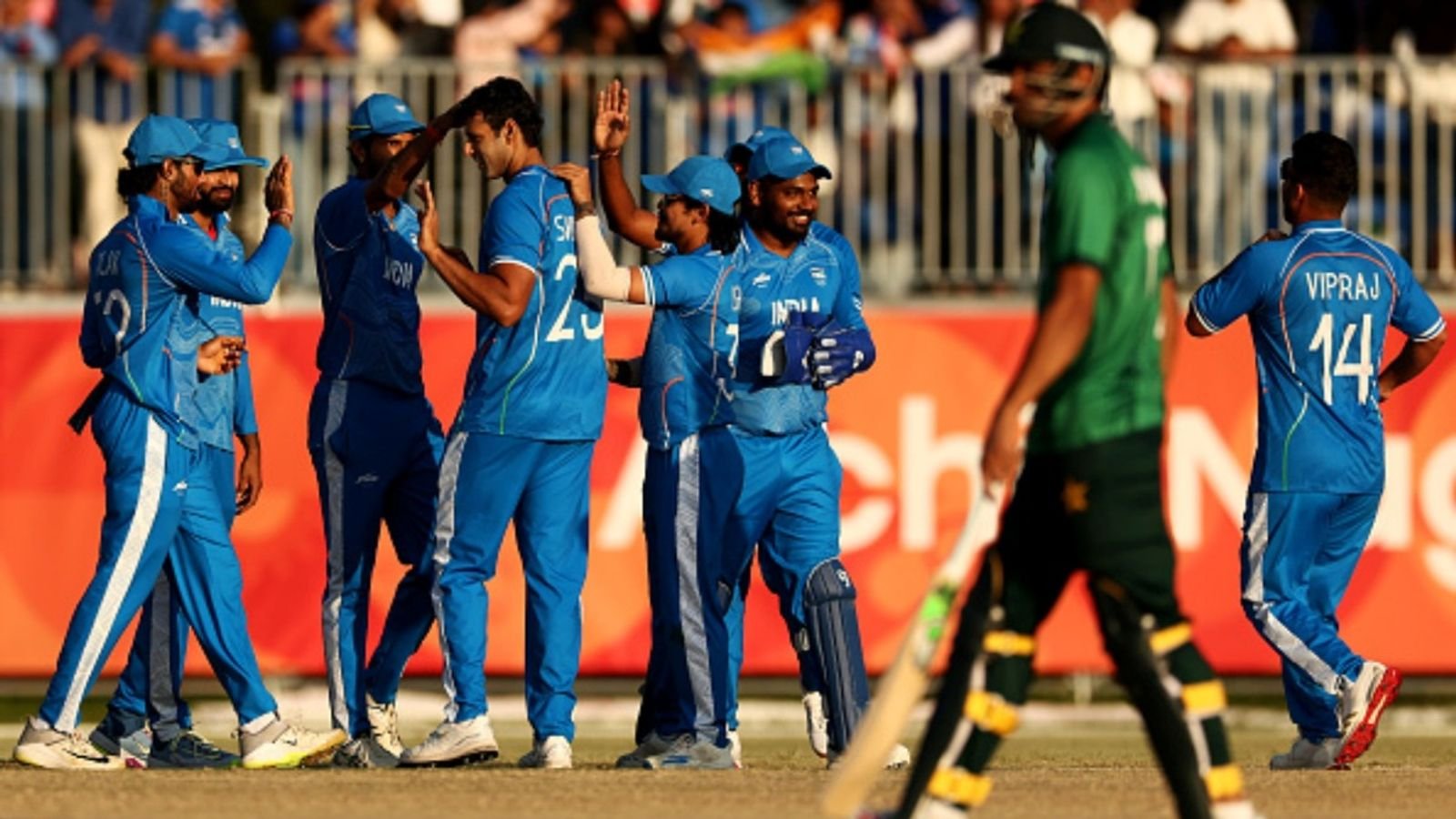
India secured another gold medal in men’s cricket at the Asian Games after defeating Pakistan in a thrilling T20 final at the Korogi Sports Park in Nisshin, Aichi, on October 3, 2026. Led by Shreyas Iyer, India produced a strong all-round performance, posting 211/6 before restricting Pakistan to 192/8.
The victory gave India their second consecutive Asian Games gold medal in men’s cricket. The women’s team had also won gold earlier in the tournament, making cricket another important contributor to India’s medal tally.
India’s victory was built around an explosive start from Abhishek Sharma, a powerful finishing effort from Tilak Varma and Shivam Dube, and a disciplined bowling performance during the crucial final overs.
India’s batting sets the platform for 211
India captain Shreyas Iyer won the toss and elected to bat first, giving his team the opportunity to put pressure on Pakistan with a big total.
Vaibhav Suryavanshi and Abhishek Sharma immediately attacked the Pakistan bowling attack. Suryavanshi struck two consecutive sixes before taking a single, while Abhishek followed with a six and a boundary off the free-hit delivery.
Suryavanshi’s aggressive cameo ended in the third over when Saim Ayub dismissed him. The young batter scored 15 from nine deliveries, but the early attacking intent had already given India momentum.
Abhishek continued the assault. He attacked Ayub with a six and two boundaries in the same over before maintaining India’s scoring rate throughout the powerplay.
Abhishek Sharma produces a spectacular powerplay
Abhishek was the main architect of India’s rapid start. He reached his half-century from just 20 deliveries, using a combination of clean striking and aggressive shot selection.
By the end of the powerplay, India had reached 81/2, putting Pakistan’s bowlers under immediate pressure.
Abhishek eventually fell for an outstanding 61 from 28 balls. His innings included three fours and seven sixes, giving India exactly the type of explosive beginning required in a high-pressure T20 final.
There was also a moment of relief for Abhishek when a catch offered off Abrar Ahmed was dropped by wicketkeeper Usman Khan. The batter was unable to convert the reprieve into a much bigger score, but his contribution had already changed the tempo of India’s innings.
India lose momentum in the middle overs
After Abhishek’s dismissal, India briefly struggled to maintain the same scoring rate. Shreyas Iyer and Ishan Kishan attempted to rebuild the innings but could not produce the same acceleration seen during the powerplay.
Ishan scored 20 from 18 deliveries before Arafat Minhas dismissed him in the 14th over. Iyer followed shortly afterward, falling to Abrar Ahmed after scoring 21 from 24 balls.
With India entering the final stages of the innings, the responsibility shifted to Tilak Varma and Shivam Dube. The pair responded with a powerful finishing assault.
Tilak Varma and Shivam Dube finish strongly
Tilak Varma changed the momentum during the slog overs. In the 18th over, he attacked Sufyan Moqim with a boundary and two sixes.
Dube then joined the attack against Saim Ayub. The left-hander struck two sixes and a four during a costly over, while Varma added another boundary.
Ayub conceded 23 runs in the over, giving India a significant boost heading into the final over.
Dube eventually fell for 27 from 15 balls, but Varma continued attacking. He struck two sixes off Ahmed Daniyal and completed his half-century from only 21 deliveries.
Varma’s unbeaten fifty ensured that India finished with 211/6, giving Pakistan a demanding target in the gold-medal match.
Pakistan’s chase gets off to a difficult start
Pakistan needed a strong beginning to chase 212, but India’s bowlers quickly put the opposition under pressure.
Maad Sadaqat provided some early momentum while Pakistan captain Sahibzada Farhan struggled to accelerate. Washington Sundar eventually removed Farhan, who was caught at deep mid-wicket for 10 from 11 balls.
Axar Patel then dismissed Usman Khan for a single-digit score, leaving Pakistan 39/2 after the powerplay.
Sadaqat continued to contribute before Axar removed him for 23 from 18 deliveries. At that stage, Pakistan needed a substantial partnership to prevent the chase from slipping away.
Hasan Nawaz brings Pakistan back into the contest
Hasan Nawaz became the central figure in Pakistan’s chase. After receiving a reprieve when a catching opportunity was missed following a collision between Indian fielders, Nawaz took advantage of the opportunity.
He attacked India’s spinners and particularly targeted Ravi Bishnoi. Nawaz hit two sixes in the 10th over before continuing his aggressive approach.
He reached his half-century from just 28 balls, keeping Pakistan within reach of India’s imposing total.
At the halfway stage, Pakistan had reached 76/3. The chase remained difficult, but Nawaz’s presence meant India could not afford to relax.
Saim Ayub’s dismissal gives India an opening
Shivam Dube was introduced into the attack and provided an important breakthrough by dismissing Saim Ayub.
Ayub attempted a scoop but was caught after scoring 29 from 22 balls. His dismissal prevented Pakistan from building an even stronger partnership with Nawaz.
Dube’s bowling was not entirely economical, however, and Pakistan continued to collect runs. Axar Patel also conceded 14 runs in his final over, including a six from Nawaz and five wides.
With the required run rate increasing, Pakistan needed a major finish from its remaining batters.
India’s bowlers hold their nerve in the final overs
Washington Sundar produced another important moment in the 18th over when he dismissed Abdul Samad. Pakistan then needed 44 runs from the final two overs.
Saad Masood managed to hit a six, but India largely kept the boundary count under control during the over. The equation moved to 33 runs from the final over after Jasprit Bumrah delivered a crucial penultimate over.
Dube was handed the ball for the final over with Pakistan requiring an unlikely 33 runs. He conceded 13 runs but ended the match with a wicket, completing India’s victory.
Pakistan finished on 192/8, leaving India with a 19-run victory and the Asian Games gold medal.
Hasan Nawaz’s 96 goes in vain
Hasan Nawaz was Pakistan’s outstanding batter during the chase. His 96 came from only 51 balls and included five fours and seven sixes.
Despite his aggressive innings, Nawaz could not take Pakistan over the finish line. India’s ability to remove supporting batters and restrict the scoring during the closing overs ultimately proved decisive.
His innings nevertheless gave Pakistan a realistic chance of completing one of the biggest chases of the tournament.
India complete back-to-back Asian Games gold medals
The victory marked India’s second consecutive men’s cricket gold medal at the Asian Games. The result also continued India’s strong run in the competition after the team progressed through the tournament and defeated Sri Lanka in the semi-final.
The men’s gold followed the women’s cricket team’s success earlier in the Games, giving India two cricket gold medals from the tournament.
For Shreyas Iyer, lifting the gold medal as captain adds another significant achievement to India’s campaign. The final also demonstrated the depth available in the squad, with different players contributing at different stages.
India’s batting depth proved important
India’s total of 211 was not built around one batter alone. Abhishek Sharma provided the explosive foundation, while Tilak Varma and Shivam Dube ensured that the innings finished strongly.
The middle-order contributions were particularly important because India briefly lost momentum after Abhishek’s dismissal. Rather than allowing the run rate to fall significantly, Varma and Dube attacked during the final overs.
This ability to accelerate late in the innings gave India the cushion they needed when Pakistan launched its own counterattack.
Bowling under pressure decided the final
Pakistan’s chase showed why India needed to execute well with the ball. Nawaz’s innings and the partnership involving Saim Ayub brought Pakistan back into contention after the early wickets.
However, India’s bowlers kept taking wickets at important moments. Sundar, Axar and Dube all contributed to breaking partnerships, while the bowling unit managed the closing stages effectively enough to protect the total.
The final two overs were especially important. Pakistan needed 44 runs from 12 deliveries, but India conceded only enough runs to close out the contest without allowing a dramatic finish.
Sri Lanka claim bronze medal
Earlier on the same day, Sri Lanka defeated Bangladesh by 63 runs to win the bronze medal in the men’s cricket competition.
Sri Lanka recovered from a difficult start to post 165 before Bangladesh were bowled out for 102 in 17.3 overs.
Tharindu Ratnayake was the standout performer for Sri Lanka, scoring 65 from 32 deliveries after entering the innings at No. 7. His attacking contribution helped Sri Lanka recover after losing four wickets for only 29 runs during the powerplay.
Ratnayake later contributed with the ball as Sri Lanka’s bowlers dismantled Bangladesh’s chase. Nuwan Thushara, Ratnayake, Vijayakanth Viyaskanth and Wanuja Sahan claimed two wickets each.
India vs Pakistan final: Key performances
| Player | Performance |
|---|---|
| Abhishek Sharma | 61 off 28 balls, including 3 fours and 7 sixes |
| Tilak Varma | Unbeaten fifty from 21 balls |
| Shivam Dube | 27 off 15 balls and the final wicket |
| Hasan Nawaz | 96 off 51 balls, including 5 fours and 7 sixes |
| Saim Ayub | 29 off 22 balls |
India’s gold-medal win in perspective
The Asian Games final highlighted the contrasting nature of T20 cricket. India appeared firmly in control after reaching 81/2 during the powerplay and later pushing the total beyond 200.
Pakistan’s response showed that the match was far from decided. Nawaz’s aggressive innings kept the chase alive and forced India to execute under pressure during the final stages.
Ultimately, India’s ability to produce runs at both ends of the innings and take wickets at crucial moments separated the teams. The bowlers held their nerve when Pakistan still had a mathematical chance of chasing the target.
Final result
India defeated Pakistan by 19 runs in the men’s cricket final at the Asian Games 2026 to win the gold medal. India posted 211/6 after explosive fifties from Abhishek Sharma and Tilak Varma, while Pakistan managed 192/8 despite Hasan Nawaz’s outstanding 96.
The victory gave India another gold medal in cricket and marked back-to-back men’s Asian Games titles. Abhishek’s powerplay assault, Varma’s rapid finishing effort and India’s execution with the ball in the final overs combined to deliver a memorable victory in the gold-medal clash.
For breaking news and live news updates, like us on Facebook or follow us on Twitter and Instagram. Read more on Latest Cricket on thefoxdaily.com.






COMMENTS 0