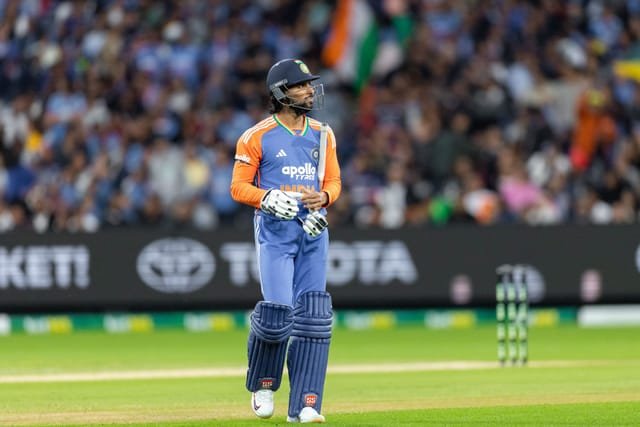
Tilak Varma India vs ireland 2026 criticism has become one of the biggest talking points after India suffered a surprising 2-0 T20I series defeat against Ireland. The loss in Belfast exposed concerns around India’s batting approach, especially during the middle overs, where the team failed to maintain the required scoring rate.
Former Indian captain Kris Srikkanth questioned Tilak Varma’s innings in the second T20I, stating that the batter focused too much on personal survival rather than taking the attacking approach needed in a high-pressure T20 chase. His comments sparked debate among fans and analysts about whether India’s middle-order strategy needs a major change.
India entered the second T20I chasing 155 runs for a series-leveling victory but lost the match by just one run after scoring 153/9. Despite having experienced players and talented youngsters, India failed to accelerate at the right moments, allowing Ireland to create one of the biggest upsets in recent Indian T20 history.
What happened in the Ireland vs India second T20I?
The second T20I between India and Ireland at Belfast on June 28, 2026, turned into a dramatic contest. Ireland posted a competitive total of 154/8 after their 20 overs, giving India a target of 155.
India’s chase started badly as the top order collapsed early, leaving the visitors under pressure at 19/3. With wickets falling around him, Tilak Varma came in with the responsibility of rebuilding the innings.
However, while Tilak tried to anchor the chase, India’s required run rate continued to increase. His innings of 55 runs from 46 balls provided stability but lacked the aggressive intent expected in modern T20 Cricket.
The middle-order combination of Tilak Varma, Shivam Dube, and Axar Patel struggled to find boundaries during the crucial phase of the innings. India went through a long stretch without a boundary, allowing Ireland’s bowlers to maintain control.
| Match | Result | Key Issue |
|---|---|---|
| 1st T20I Ireland vs India 2026 | Ireland won by 34 runs | India’s batting failed to chase under pressure |
| 2nd T20I Ireland vs India 2026 | Ireland won by 1 run | Slow middle-over batting cost India the match |
Kris Srikkanth’s criticism of Tilak Varma’s batting approach
Kris Srikkanth argued that India lost the match during the middle overs rather than the final stages of the chase. According to him, T20 cricket requires batters to balance stability with attacking intent, especially when chasing a target.
“You can’t play the way India did in the middle phase, especially Tilak Varma, Dube and Axar. All their strike rates were poor. You have to stabilize a bit and then start attacking in the middle phase.”
Srikkanth’s main concern was not Tilak’s ability but his approach. The former captain suggested that Tilak focused on taking the game deep instead of increasing the pressure on Ireland’s bowling attack.
In T20 cricket, taking the match close does not always guarantee victory. A team chasing 155 generally needs consistent boundary options, especially between overs 7 and 15, when field restrictions reduce and bowlers often try to control the scoring rate.
Why India’s middle-order batting became the biggest concern
The biggest lesson from the Ireland series was India’s struggle in the middle overs. Modern T20 cricket has changed significantly, with successful teams aiming to dominate this phase through aggressive stroke play.
Teams like England and Australia have built their T20 strategies around attacking from the middle overs instead of depending only on finishers. India’s approach against Ireland appeared more conservative, which allowed the opposition to stay competitive despite having a smaller margin for error.
The importance of strike rate in T20 cricket
Strike rate has become one of the most important measures in T20 cricket because every dot ball increases pressure on the batting side. A batter scoring runs at a slower pace can unintentionally create problems for the players coming later.
Tilak Varma’s innings showed both positives and negatives. He showed maturity under pressure and handled the situation after early wickets, but the lack of acceleration meant India needed a bigger finish than was realistic.
Tilak Varma’s role in India’s future T20 plans
Tilak Varma remains one of India’s highly rated young batters. His ability to play spin, rotate strike, and bat in different positions makes him valuable for the team’s future plans.
However, the Ireland series highlighted an important challenge for young Indian batters: adapting their natural game according to match situations.
A batter in a rebuilding role must know when to absorb pressure and when to shift gears. In T20 cricket, the difference between a winning and losing innings is often decided by a five-over period where the batting side either takes control or loses momentum.
India’s previous dominance over Ireland makes the defeat more surprising
The series result was unexpected because India had dominated Ireland in previous T20 meetings. Before this defeat, India had won all eight of their earlier T20I matches against Ireland.
The whitewash showed that international T20 cricket has become more competitive, and no team can rely only on reputation. Associate teams have improved significantly, with better preparation, stronger domestic structures, and players capable of performing under pressure.
Comparison: India’s approach vs modern T20 batting strategy
India’s middle-order approach in the Ireland series appeared focused on rebuilding and preserving wickets. However, modern T20 teams often prefer calculated aggression.
- Traditional approach: Stabilize first, attack later.
- Modern T20 approach: Maintain scoring pressure throughout the innings.
- Big difference: Teams now value intent even during rebuilding phases.
This does not mean every batter must attack every ball. Instead, successful T20 batting requires constant pressure through singles, doubles, and timely boundaries.
What India needs to improve before future T20 tournaments
The Ireland series has given India several areas to analyse. The biggest improvement needed is creating a stronger middle-order template.
- Middle-order batters need clearer roles during chases.
- Players must identify the right time to increase the scoring rate.
- India needs more boundary-hitting options between overs 7 and 15.
- Batters should avoid leaving too much work for the final overs.
India’s talent pool remains one of the strongest in world cricket, but T20 success depends on execution. A strong lineup can still struggle if the batting plan does not match the demands of the format.
Future outlook: Will this defeat change India’s T20 strategy?
The Ireland series loss is unlikely to create panic, but it provides valuable feedback before bigger tournaments. India will need to balance young talent with experienced players while ensuring every batter understands their role.
For Tilak Varma, the criticism could become a learning point. His ability to adapt his tempo will determine how effectively he handles high-pressure international situations in the future.
Conclusion
The Tilak Varma India vs Ireland 2026 criticism debate is not only about one player’s innings but about India’s wider T20 batting philosophy. Kris Srikkanth’s comments highlighted a major issue: surviving in T20 cricket is not enough; teams must continue creating pressure.
India’s defeat against Ireland showed that even talented batting units need the right strategy. As T20 cricket continues to evolve, the teams that combine smart batting with aggressive intent will have the biggest advantage.
For breaking news and live news updates, like us on Facebook or follow us on Twitter and Instagram. Read more on Latest Sports on thefoxdaily.com.






COMMENTS 0