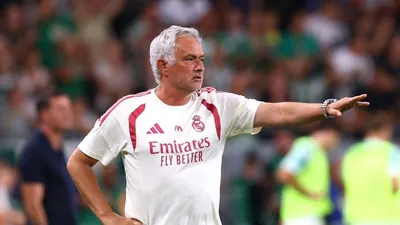
Jose Mourinho Pep Guardiola rivalry has taken another turn after the Portuguese manager used his new Netflix documentary to offer a pointed view on coaching breaks, indirectly taking aim at Guardiola’s decision to step away from club management after his Manchester City tenure.
Mourinho’s three-part documentary, released worldwide on Tuesday, revisits several defining moments from his extraordinary career, including his time at Inter Milan, Real Madrid and Manchester United. But among the most striking revelations was his blunt opinion about managers who choose to take sabbaticals.
Guardiola recently ended a decade-long spell at Manchester City and opted for a break from club management. Mourinho, who is now back at Real Madrid for a second stint, made clear that such a decision does not fit his own philosophy.
The comments are particularly intriguing because Mourinho and Guardiola have one of modern football’s most famous managerial rivalries. Their competition reached its peak during their respective spells at Real Madrid and Barcelona, when tactical battles between the two coaches became a defining feature of Spanish football.
Mourinho says sabbatical means weakness
Mourinho’s comments in the documentary were not subtle.
Discussing the concept of a managerial sabbatical, the Portuguese coach explained that he has never felt the need to temporarily leave football. He went further by saying that the word itself carries a meaning he strongly dislikes.
“Some guys, they need a sabbatical, which is something that I hate. I hate that word. For me, sabbatical means weakness.”
The remark immediately stands out because Guardiola is one of the highest-profile managers to embrace the idea of stepping away after an extended period at one club.
However, Mourinho’s statement is better understood as a reflection of his own mentality rather than simply a criticism of Guardiola.
His career has been built around constant competition, frequent moves and an almost relentless desire to remain on the touchline. For Mourinho, coaching is not merely a profession that he performs for a period before taking time away. It is central to how he defines himself.
Guardiola’s sabbatical philosophy is almost the opposite
Guardiola’s approach to management has historically been different.
After leaving Barcelona, the Spaniard spent time away from club football before taking charge of Bayern Munich. That break came after an intensely demanding period in Spain, where he had guided Barcelona through one of the most successful eras in European football.
His latest decision follows another lengthy commitment, this time at Manchester City.
Guardiola spent 10 years managing City and transformed the club into one of the dominant forces in English and European football. His decision to step away therefore does not necessarily indicate a lack of ambition. It can also be viewed as an attempt to recharge after a decade of sustained pressure.
This is where Mourinho and Guardiola differ most clearly.
Mourinho appears to see continuous competition as part of his identity, while Guardiola has demonstrated a willingness to pause, reflect and return when he feels ready.
Mourinho has rarely stayed away from football for long
Mourinho’s career history supports his argument that sabbaticals are not part of his personality.
Since becoming a major managerial figure with Porto in the early 2000s, he has consistently moved from one major job to another.
One of the longest gaps in his managerial career came after Manchester United dismissed him in December 2018. He returned to management with Tottenham Hotspur in November 2019, meaning the gap was roughly 11 months.
For someone who has managed at some of Europe’s biggest clubs, that is remarkably little time away from the dugout.
Mourinho’s career has instead followed a recurring pattern: win trophies, face intense scrutiny, leave a club, recover quickly and begin another challenge.
That cycle has continued for more than two decades.
Why Mourinho views football as part of his identity
The most revealing part of the documentary may not be the Guardiola reference but Mourinho’s explanation of what football means to him.
He said he cannot imagine when his life in football will end and suggested that he could continue coaching for another decade or potentially even longer.
His motivation, according to his own explanation, is simple: he still enjoys winning.
That distinction matters.
For Mourinho, the desire to compete appears to be connected to the environment surrounding football itself. Stadiums, supporters, trophies and the pressure of major matches remain central to his idea of fulfillment.
He described the experience of entering stadiums filled with tens of thousands of supporters as his world.
That provides important context for his comments about sabbaticals. If football is the environment in which Mourinho feels most complete, stepping away voluntarily would naturally be difficult for him.
“I want to win more titles”: Mourinho’s next motivation
Mourinho’s documentary also makes one thing clear: his ambition has not diminished with age.
Rather than discussing retirement as an approaching reality, the 63-year-old speaks about winning more trophies and creating new challenges.
He wants to win titles in places where he has never won before and repeat successes at clubs where he has already achieved glory.
That mentality has defined much of his career.
From Porto’s historic European success to his triumphs with Chelsea, Inter Milan and Real Madrid, Mourinho has consistently sought environments where expectations are enormous.
The attraction appears to be the challenge itself.
For Mourinho, winning a trophy is not necessarily the end of the story. Once he reaches a certain level, he wants to remain there and compete for more.
The Real Madrid chapter makes the comments even more interesting
Mourinho is now back at Real Madrid for his second stint as head coach.
That makes the documentary particularly relevant because his first spell in Madrid was closely connected to the Guardiola rivalry.
Between 2010 and 2013, Mourinho’s Real Madrid battled Guardiola’s Barcelona during one of the most intense periods in modern Spanish football.
The rivalry was about much more than two managers.
It represented two contrasting football philosophies and personalities. Guardiola’s Barcelona emphasized positional control, possession and technical superiority, while Mourinho built teams around tactical flexibility, defensive organization, transitions and psychological intensity.
The battles between the two sides became global events.
Mourinho’s rivalry with Guardiola was about more than tactics
It would be simplistic to describe the Mourinho-Guardiola rivalry purely as a disagreement over playing style.
Their approaches represented different ideas about how elite teams should operate.
Guardiola’s philosophy emphasized controlling matches through possession and positioning. Mourinho frequently looked to disrupt opponents’ strengths and exploit spaces during transitions.
That contrast created an unusually compelling tactical rivalry.
But there was also a psychological dimension.
Mourinho understood that football at the highest level is partly about creating pressure for the opposition. His comments, press conferences and team selections often became part of the broader contest.
The documentary’s latest remarks fit comfortably within that history.
Is Mourinho really criticizing Guardiola?
The answer is not entirely straightforward.
There is clearly an element of Mourinho’s characteristic competitive personality in the comments. The choice of the word “weakness” makes the statement provocative.
At the same time, Mourinho did not explicitly identify Guardiola while discussing sabbaticals in the quoted passage.
The connection is obvious because Guardiola has recently chosen to take a break after leaving Manchester City, but the broader point appears to be that Mourinho personally does not believe he needs one.
That distinction is important when evaluating the comment.
A manager’s decision to take time away can have many explanations, including fatigue, family considerations, personal priorities or simply the desire to find the right next project.
Mourinho’s preference for continuous work does not automatically make a sabbatical ineffective, just as Guardiola’s decision to rest does not diminish his achievements.
Two elite managers, two different approaches to longevity
| Factor | Jose Mourinho | Pep Guardiola |
|---|---|---|
| Approach to breaks | Prefers continuous involvement in football | Has previously taken time away between jobs |
| Managerial identity | Strongly connected to continuous competition | More comfortable with planned periods away from management |
| Career pattern | Frequent moves between major clubs | Long-term projects followed by breaks |
| Coaching philosophy | Adaptable, pragmatic and opponent-focused | Possession, positional play and control |
| Current situation | Back at Real Madrid | Taking time away after Manchester City |
The bigger debate: Does a manager actually need a sabbatical?
Mourinho’s comments raise a wider question about longevity in elite football.
Modern managers face extraordinary demands. They are expected to handle tactical preparation, player development, recruitment, media responsibilities, boardroom expectations and supporter pressure, often while managing matches every few days.
Taking a break can therefore be a strategic decision rather than a sign of weakness.
On the other hand, some managers thrive on continuous competition and may find that stepping away reduces their motivation.
There is no universal formula.
The careers of Mourinho and Guardiola demonstrate that elite coaching can be sustained through very different methods. One prefers to keep moving from challenge to challenge, while the other has shown that stepping away can precede another successful chapter.
Mourinho’s Manchester United revelation adds another layer
The documentary contains more than commentary on Guardiola.
Mourinho also revealed that he was in line to replace Sir Alex Ferguson at Manchester United in 2013 but ultimately declined the opportunity and chose to return to Chelsea instead.
That decision is significant because Ferguson’s retirement created one of the most difficult managerial vacancies in European football.
Mourinho’s revelation offers another insight into how he has made career decisions throughout his life.
Rather than simply pursuing the biggest available job, he has repeatedly considered the timing, environment and personal connection attached to each challenge.
His decision to return to Chelsea eventually produced another Premier League title, demonstrating why career paths in elite football are rarely as straightforward as they appear from the outside.
What Mourinho’s comments mean for his Real Madrid return
Mourinho’s second spell at Real Madrid now provides a fresh test of his philosophy.
At 63, he remains driven by the same desire that shaped his early career: competing at the highest possible level.
The difference is that the football landscape has changed significantly since his first spell in Madrid.
Modern teams operate with greater data analysis, more specialized coaching departments and increasingly sophisticated tactical systems.
Mourinho’s ability to adapt to that environment will be central to his success.
His refusal to contemplate stepping away suggests that he remains convinced he can continue competing with the best.
Why the Mourinho-Guardiola rivalry still attracts attention
More than a decade after their most intense battles, the Mourinho-Guardiola rivalry continues to generate headlines because it represents two of football’s most recognizable managerial personalities.
The rivalry survived changes in clubs, leagues and generations of players.
Even when the two managers are no longer directly competing against each other every weekend, their contrasting philosophies remain a source of fascination for football supporters.
Mourinho’s latest comments demonstrate why.
A single word such as “sabbatical” becomes enough to reopen a familiar debate about ambition, exhaustion, longevity and what it means to be an elite football manager.
Conclusion: Mourinho’s football obsession remains intact
Jose Mourinho’s latest comments about coaching sabbaticals provide another glimpse into the mentality that has defined his extraordinary career.
While his remarks inevitably invite comparisons with Pep Guardiola’s decision to step away from Manchester City after a decade, the deeper message is about Mourinho himself.
He does not see football as a job from which he needs regular breaks. He sees the stadium, the competition and the pursuit of trophies as an essential part of his identity.
That mindset has kept him moving between elite clubs for more than two decades and has now brought him back to Real Madrid for another major challenge.
Whether Mourinho’s approach to continuous work proves more sustainable than Guardiola’s willingness to take breaks remains impossible to predict.
But one thing is clear: Mourinho does not appear ready to slow down.
At an age when many managers would be discussing retirement, the Portuguese coach is talking about winning more trophies, taking on new challenges and remaining in football for another decade or longer.
For Mourinho, the game is not simply where he works. It is where he believes he belongs.
For breaking news and live news updates, like us on Facebook or follow us on Twitter and Instagram. Read more on Latest Football on thefoxdaily.com.




COMMENTS 0