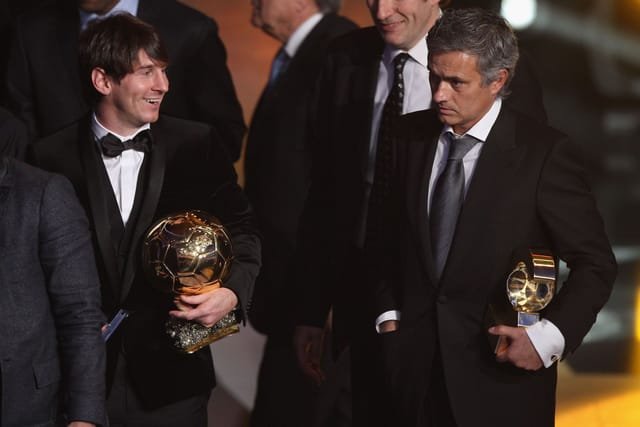
Jose Mourinho Lionel Messi rivalry has returned to the spotlight after the Real Madrid coach reflected on one of the most demanding periods of his managerial career in a new three-part Netflix documentary series. Mourinho recalled the enormous challenge of trying to contain Messi and Guardiola’s Barcelona while attempting to restore Real Madrid’s supremacy in Spanish football.
Mourinho’s first spell at the Santiago Bernabeu, from 2010 to 2013, coincided with one of Barcelona’s strongest periods under Guardiola. Real Madrid were facing a team that had developed an exceptionally effective possession-based style, while Messi was becoming the decisive attacking force around whom Barcelona’s football was increasingly built.
Rather than attempting to imitate Barcelona, Mourinho concluded that Real Madrid needed to develop a different identity. His approach combined tactical pragmatism, physical intensity, emotional motivation and a fierce competitive mentality.
The strategy eventually helped Madrid win the 2011-12 LaLiga title with a record 100-point tally, but Mourinho’s comments show that the challenge was about much more than winning a trophy. Messi’s ability to change matches created a tactical problem that even one of football’s most accomplished managers described as a nightmare.
Why Mourinho described facing Messi as a nightmare
Mourinho’s recollection offers an insight into how managers prepare to face exceptional players. In the documentary, he explained that he was constantly asking what Real Madrid could do to stop Messi.
The concern was not simply about Messi scoring goals. His movement could alter defensive structures, create numerical advantages and force opponents into decisions they would normally avoid.
For Mourinho, the problem became particularly difficult because Barcelona were not dependent on Messi alone. Guardiola’s team had an established tactical system built around possession, movement and technical quality.
Trying to beat Barcelona by playing exactly the same way would therefore have meant competing on their strongest terms.
Mourinho recognized that quickly.
His conclusion was straightforward: Real Madrid had to be different.
Mourinho’s biggest tactical realization against Barcelona
One of the most significant points from Mourinho’s comments was his belief that Real Madrid could not simply try to become a copy of Barcelona.
That idea shaped his entire approach to the rivalry.
Barcelona’s football during Guardiola’s era was heavily associated with controlled possession, short passing and positional rotations. Real Madrid had extraordinary attacking talent of their own, but Mourinho understood that matching Barcelona possession for possession could reduce the advantage Madrid’s squad had in other areas.
Instead, Mourinho emphasized transition play, defensive organization and direct attacking threats. Cristiano Ronaldo provided explosive finishing and speed, while players such as Xabi Alonso, Mesut Ozil and Sami Khedira helped Madrid transition between defensive and attacking phases.
The result was a tactical contrast rather than a tactical imitation.
Barcelona wanted to control games through possession. Madrid increasingly looked to exploit moments when Barcelona lost their structure.
This difference became one of the defining tactical battles of that era.
How Mourinho turned rivalry into motivation
Mourinho’s approach was not purely tactical. He also understood the psychological dimension of the rivalry.
He described Real Madrid and Barcelona as football enemies in the competitive sense, with both teams fighting for the same league title, domestic trophies and Champions League ambitions.
That distinction matters because Mourinho has historically used rivalry and pressure as motivational tools.
Rather than attempting to minimize the hostility between the clubs, he embraced the competitive tension. The objective was to create a mentality in which Madrid’s players viewed every encounter as a chance to challenge Barcelona’s dominance.
There was a risk involved. Rivalries can motivate players, but excessive emotional intensity can also lead to disciplinary problems, distractions and unnecessary conflict.
Mourinho’s Madrid era experienced both sides of that equation.
Nevertheless, the psychological battle became an important component of a broader attempt to change the balance of power in Spanish football.
The 100-point LaLiga season proved Mourinho’s approach could work
The strongest evidence supporting Mourinho’s strategy came during the 2011-12 LaLiga season.
Real Madrid won the league title with 100 points, setting a remarkable benchmark at the time. The achievement was particularly significant because it came against a Barcelona team that had dominated Spanish football under Guardiola.
Madrid also produced a prolific attacking campaign, combining Ronaldo’s goalscoring with an effective transition-based style.
The title represented more than a trophy for Mourinho. It showed that Barcelona’s dominance could be challenged without Real Madrid abandoning its own identity.
It also demonstrated one of Mourinho’s most consistent managerial principles: a team does not necessarily have to play the same football as its strongest opponent to defeat it.
Sometimes, the advantage comes from forcing the opponent to solve a different problem.
Messi was the central problem in Mourinho’s Barcelona puzzle
Barcelona’s overall quality made them difficult to defeat, but Messi represented a particularly complicated tactical challenge.
The Argentine could influence matches from multiple positions and did not need constant touches inside the penalty area to create danger.
His movement between midfield and attack could pull defenders out of position, while his acceleration and close control made isolated defensive situations extremely difficult.
That created a dilemma for opposing managers.
If a defender followed Messi too aggressively, space could open elsewhere. If the defense held its shape, Messi could receive the ball in dangerous areas.
Adding Barcelona’s other technical players to the equation made the problem even harder.
Mourinho’s comments therefore provide a useful reminder of why Messi’s peak years were so difficult for elite opponents. The challenge was not simply stopping one goalscorer. It was preventing one exceptional player from exploiting weaknesses created by the entire attacking structure.
Why Mourinho refused to copy Barcelona
The rivalry also illustrates a broader principle in elite football: tactical imitation does not always produce the best results.
Barcelona had spent years developing a distinctive footballing culture. Their players were comfortable controlling possession under pressure, rotating positions and patiently moving opponents around the pitch.
Real Madrid possessed different strengths.
The club had speed, physicality, attacking transition ability and players capable of turning small spaces into immediate scoring opportunities.
Mourinho’s decision to embrace those characteristics rather than attempt to reproduce Barcelona’s model allowed Madrid to build a competitive alternative.
This approach is particularly relevant to modern football because tactical systems are often judged in isolation. Mourinho’s Barcelona battles demonstrate that the right system is not necessarily the most fashionable one. It is the system that best fits the players available and creates problems the opponent struggles to solve.
Mourinho and Messi almost worked together at Chelsea
The relationship between Mourinho and Messi could have taken a completely different direction several years later.
According to transfer information discussed by Gianluca Di Marzio in his book Grand Hotel Calciomercato, Mourinho and Chelsea were reportedly involved in an ambitious attempt to sign Messi in 2014.
The reported situation emerged during a period when Messi and his family were facing scrutiny from Spanish authorities over tax matters.
Reports surrounding the proposed Chelsea move claimed that the Premier League club was prepared to activate Messi’s €250 million release clause and offer a huge salary package.
However, the reported transfer never happened.
Messi remained at Barcelona, meaning Mourinho never got the opportunity to coach the player who had caused him so many tactical headaches during the Real Madrid-Barcelona rivalry.
If the move had happened, it would have created one of football’s most fascinating managerial-player combinations: Mourinho coaching Messi after spending years trying to devise ways of stopping him.
What a Mourinho-Messi partnership could have looked like
The hypothetical Chelsea move raises an intriguing tactical question.
Mourinho had built teams around defensive structure and rapid transitions, while Messi was capable of becoming the creative center of almost any attacking system.
Rather than asking Messi to change completely, Mourinho could potentially have built the attack around his strengths while using a structured defensive system behind him.
That combination could have produced a fascinating hybrid: a team with Mourinho’s defensive discipline and Messi’s extraordinary attacking freedom.
But this remains hypothetical. The reported transfer never materialized, and Messi continued his career at Barcelona before later moving to Paris Saint-Germain and then Inter Miami.
Mourinho’s return to Real Madrid makes the old rivalry relevant again
Mourinho is now back at Real Madrid for a second stint as head coach, creating a new chapter in his relationship with the club.
The circumstances are obviously different from his first tenure. The Barcelona side that dominated Spanish football during Guardiola’s era is no longer the same team, while modern Real Madrid operate in a very different tactical and squad environment.
Nevertheless, the fundamental challenge remains familiar.
Real Madrid expect to compete for every major trophy, and Barcelona remain their most important domestic rival.
The latest Madrid era has also arrived after the club went trophyless in each of the previous two seasons, while Barcelona and Hansi Flick have dominated LaLiga.
That makes Mourinho’s comments about his first battle with Barcelona particularly relevant.
Real Madrid’s 2026-27 challenge is different from Mourinho’s first era
The current situation should not be treated as a direct repeat of the early 2010s.
Modern Real Madrid have different players, tactical expectations and competitive challenges. Barcelona’s squad has also evolved significantly since the Guardiola era.
One major difference is that the present-day game is increasingly influenced by high pressing, positional flexibility, athleticism and rapid transitions. Managers must also manage congested schedules and squad rotation in ways that were already important but have become even more demanding.
Mourinho’s task will therefore involve adapting his principles rather than simply replaying his old blueprint.
The most relevant lesson from his previous Madrid spell may not be a particular formation or defensive plan. It may be the principle that Real Madrid should identify what makes them different and use those qualities to challenge their strongest rivals.
Mourinho’s first Real Madrid spell compared with his current challenge
| Factor | First Real Madrid spell | Current challenge |
|---|---|---|
| Main domestic rival | Guardiola’s Barcelona | Hansi Flick’s Barcelona |
| Major individual threat | Lionel Messi | A different generation of Barcelona attackers |
| Mourinho’s objective | Break Barcelona’s dominance | Restore Real Madrid’s domestic momentum |
| Major achievement | 2011-12 LaLiga title with 100 points | Future results yet to be determined |
| Key challenge | Compete without copying Barcelona | Build a competitive identity for the modern squad |
Why Mourinho’s Messi comments still matter
It might seem strange that Mourinho is discussing Messi years after their most intense rivalry, but the comments reveal how managers think about elite opponents.
The best players do not simply force tactical adjustments. They can influence the identity of an entire team.
Messi’s presence required Mourinho to reconsider how Madrid defended, how aggressively they pressed and how they attacked after recovering possession.
That type of influence is one reason the greatest players leave such a lasting mark on football history.
Mourinho’s admission that he was having a “nightmare” thinking about how to stop Messi also shows how difficult the task was from the perspective of one of the game’s most experienced tactical managers.
The unique lesson from Mourinho’s battle with Messi
The most valuable insight from the documentary may be Mourinho’s conclusion that Real Madrid had to be different.
That idea applies far beyond the Barcelona rivalry.
In elite sport, teams often become obsessed with copying the champion. But copying a successful opponent can sometimes eliminate the very strengths that make a challenger dangerous.
Mourinho instead attempted to create a style that attacked Barcelona’s weaknesses while maximizing Madrid’s own strengths.
The approach did not eliminate Barcelona’s influence overnight, but the 2011-12 title proved that the power balance could shift.
That is perhaps the most important strategic lesson from the era.
When will Real Madrid begin the 2026-27 LaLiga season?
Real Madrid are scheduled to begin their 2026-27 LaLiga campaign against Espanyol on August 22.
The fixture will offer the first competitive opportunity to assess Mourinho’s new domestic project and determine whether Madrid can immediately establish momentum after two trophyless seasons.
The result will not provide a complete answer about the new era, but the opening weeks should offer clues about Mourinho’s tactical priorities, squad selection and approach to controlling matches.
The pressure will be significant because expectations at Real Madrid rarely allow managers much time to settle.
Conclusion: Mourinho’s Messi nightmare became part of Real Madrid history
Jose Mourinho’s memories of Lionel Messi provide a fascinating look back at one of the defining tactical rivalries of modern football. During his first Real Madrid spell, Mourinho faced the enormous challenge of competing with Guardiola’s Barcelona and finding a way to limit Messi’s influence.
His solution was not to copy Barcelona. Instead, he believed Real Madrid needed to be different both tactically and psychologically.
The strategy eventually helped Madrid win LaLiga with a record 100 points in 2011-12, proving that Barcelona’s dominance could be challenged.
The irony is that Mourinho later reportedly came close to bringing Messi to Chelsea, which would have transformed their relationship from opponents into manager and player. That move never happened, leaving their rivalry as one of the great “what if” stories in football.
Now, with Mourinho back at Real Madrid, the lessons of that period could become relevant again. Barcelona remain Madrid’s greatest domestic rival, and the Portuguese manager once again has the responsibility of building a team capable of challenging them.
The players and tactics may have changed, but Mourinho’s central principle remains as relevant as ever: to defeat a dominant opponent, sometimes the smartest move is not to become more like them, but to become something they cannot easily handle.
For breaking news and live news updates, like us on Facebook or follow us on Twitter and Instagram. Read more on Latest Football on thefoxdaily.com.





COMMENTS 0