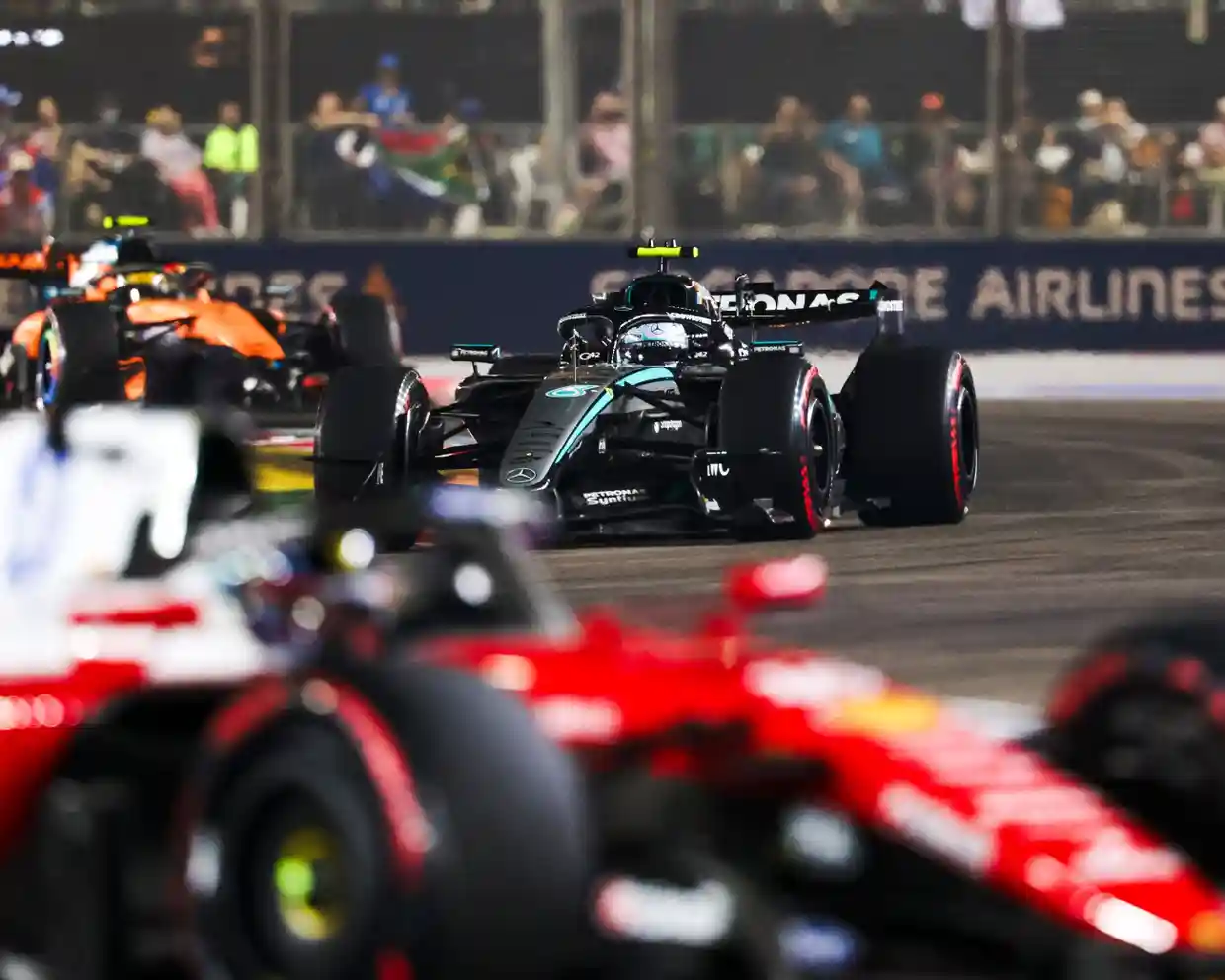
The 2026 United States Grand Prix could mark a defining moment in Kimi Antonelli’s Formula One career, with the Mercedes driver closing in on his maiden world championship. However, while the young Italian has an opportunity to secure the title in Austin, the weekend carries implications that extend well beyond the drivers’ championship. For Mercedes, the performance of its latest upgrades could provide crucial evidence about the direction of development for the 2027 season.
Antonelli enters the race with a commanding 102-point lead over teammate George Russell. The 20-year-old has been exceptional during his second season in Formula One, establishing himself as one of the sport’s leading drivers. Yet Mercedes can no longer rely on the overwhelming performance advantage it enjoyed during the opening half of the campaign.
With Red Bull recovering its competitiveness, Ferrari closing the gap and McLaren preparing further upgrades, the United States Grand Prix represents an important test of Mercedes’ development strategy. The result could help determine whether the team can maintain its position at the front of the grid when the championship battle begins again in 2027.
Kimi Antonelli Closes In on His Maiden Formula One Championship
For Antonelli, the immediate objective is straightforward: turn his remarkable season into a first Formula One world championship. Winning the title would fulfil a childhood ambition and establish the Italian as one of the youngest champions in the sport’s history.
Antonelli holds a 102-point advantage over Russell heading into the United States Grand Prix. He would become Formula One’s youngest world champion if he wins in Austin, Russell finishes ninth or lower, and Ferrari’s Lewis Hamilton finishes fifth or lower.
That combination of results is possible, although it requires several circumstances to fall into place. If Antonelli cannot complete the job in Texas, Mexico offers another opportunity a week later. Given his substantial points advantage, the championship increasingly appears to be a question of when rather than whether he will secure it.
His position reflects more than the benefits of driving a competitive car. Antonelli has delivered performances that have helped him build a substantial lead over an experienced teammate. Consistency, race execution and the ability to capitalise on opportunities have all contributed to his championship campaign.
Nevertheless, the competitive strength of the Mercedes car has played an important role. During the first half of the season, the team possessed a machine that was exceptionally difficult for its rivals to match. That advantage has diminished as other manufacturers have improved their cars and found performance in the new regulatory environment.
Antonelli may therefore be approaching the defining moment of his season just as Mercedes faces one of its most important technical assessments of the year.
Mercedes No Longer Has the Same Performance Advantage
Mercedes began the season with a clear competitive advantage, but the balance of power has shifted as its rivals have introduced upgrades and addressed weaknesses in their cars.
Red Bull has made particularly significant progress. Max Verstappen has won the past two races after the team’s upgrades unlocked performance that it believed was available but had not previously been able to extract consistently.
That improvement is important because it demonstrates how quickly the competitive picture can change. A team that struggles to realise its car’s full potential can return to contention when technical changes improve its balance and performance.
Ferrari has also moved closer to Mercedes. The Italian team is now capable of challenging for victories, and a package of aerodynamic upgrades is scheduled to arrive in Austin. Those developments could make the battle at the front more competitive, particularly if the new components perform as expected.
McLaren remains another threat. Although the team has fallen back slightly in recent races, it has repeatedly demonstrated that it can match or defeat the championship leaders. Further upgrades are planned for the upcoming triple-header in the United States, Mexico and Brazil, giving McLaren additional opportunities to close the gap.
For Mercedes, this creates a more demanding environment than the one it enjoyed earlier in the campaign. The team must continue to deliver strong results while ensuring that its technical development remains competitive against rivals who are improving rapidly.
The distinction matters because a championship-winning car at one stage of a season is not necessarily the best car by the end of it. Development has become a decisive part of the competition, and the teams that interpret their technical data most effectively can gain a substantial advantage.
Why Mercedes’ Latest Upgrades Have Raised Questions
Mercedes’ recent development programme has not delivered the results the team expected. Its second and final major upgrade package, introduced at the Bahrain Grand Prix according to the supplied report, was expected to provide a performance improvement of as much as three-tenths of a second per lap.
Instead, the changes proved disappointing. The anticipated lap-time gains failed to materialise, while the car became more difficult to drive. Rather than making the Mercedes consistently faster and more predictable, the new specification introduced additional challenges that complicated the team’s efforts to extract its potential.
The central problem involved the car’s handling characteristics. The Mercedes became less forgiving, with the balance switching between understeer and oversteer within a narrow operating window. It also placed greater demands on the tyres.
Understeer occurs when a car does not turn into a corner as sharply as the driver intends, causing it to run wider than the desired line. Oversteer occurs when the rear loses grip relative to the front, making the car rotate more sharply than expected. A car that switches unpredictably between these behaviours can be difficult to drive consistently, particularly through sequences of corners that require precise balance.
Tyre management adds another layer of complexity. If a car places excessive stress on its tyres, the driver may struggle to maintain grip over a race stint. Even when the car has strong underlying pace, inconsistent handling and declining tyre performance can undermine lap times and race strategy.
For a team fighting for victories, these problems are particularly costly. Drivers need confidence in how their cars will respond when braking, turning and accelerating. If the handling characteristics change significantly across different corners or operating conditions, drivers may have to compromise their approach to avoid mistakes.
The experience also illustrates a fundamental challenge in Formula One development: an upgrade that appears promising in simulations or initial analysis does not automatically translate into improved performance on the circuit.
Russell and Antonelli Tested Different Mercedes Specifications
The discrepancy between Mercedes’ expectations and the results on track became significant enough to prompt a change in its testing approach.
After Malaysia, the team reverted to the older specification on Russell’s car while continuing with the newer version on Antonelli’s. The decision allowed Mercedes to compare the two configurations and better understand what had gone wrong with the upgrade package.
Running different specifications provides engineers with a useful comparison, particularly when a development change produces unexpected results. By examining how each car behaves under comparable conditions, the team can investigate whether the new components are responsible for particular handling problems or whether other factors are contributing to the performance deficit.
Such comparisons are not always straightforward. Differences in driver feedback, track conditions, tyre behaviour and setup can complicate the analysis. Nevertheless, a controlled comparison can help engineers identify which changes are producing benefits and which require further investigation.
At the following Singapore Grand Prix, Antonelli reported that the newer specification had improved. That feedback offered some encouragement, suggesting that the package might still have useful performance to deliver.
However, a perceived improvement is not the same as confirmation that the upgrade has achieved its original objectives. Mercedes still needs to establish whether the revised car can provide consistent pace, predictable handling and a clear advantage over the previous specification.
That is one reason Austin matters. A convincing performance would strengthen the case for the current development direction. Another disappointing weekend could force the team to reconsider aspects of its approach before the 2027 car takes shape.
Toto Wolff Explains Why Austin Is So Important
Mercedes team principal Toto Wolff has acknowledged that the latest upgrades have not yet delivered everything the team expected. His comments following the Singapore Grand Prix highlighted both the progress made and the work that remains.
“Was it an easy car like the previous one? I don’t think it was. Does it have the performance that we were hoping the upgrade would bring? I don’t think so yet. But it was a step in the right direction,” Wolff said.
Wolff’s assessment reflects a measured position. Mercedes has identified signs of improvement, but it cannot yet claim that the package has delivered its intended performance gain. The next race must provide further evidence that the team is moving in the right direction.
He also made clear that the importance of Austin extends into the next championship cycle.
“In Austin, we should see whether we can continue to consolidate that and whether it has more performance, because it’s crucial for the development direction for the next year.”
This is the central technical issue facing Mercedes. The team is not simply trying to extract a few additional points from the remaining races. It is also evaluating the effectiveness of its development philosophy and determining which lessons should influence the next car.
Formula One teams must make decisions about where to direct engineering resources, which aerodynamic concepts to pursue and how to balance immediate performance against longer-term development. A successful upgrade can validate an approach and encourage further investment in it. A disappointing one can reveal that the team has misunderstood a weakness or pursued a concept that does not work as intended.
With the 2027 season approaching, the consequences of those decisions could extend well beyond Austin.
Why the Circuit of the Americas Offers a Valuable Test
The characteristics of the Circuit of the Americas make it a particularly useful venue for Mercedes to assess its car. Unlike a circuit that presents an unusual set of demands, Austin features a flowing layout with medium- and high-speed corners, where a well-balanced car can make a significant difference.
Such a circuit can expose weaknesses that might be less obvious elsewhere. A car needs to respond predictably to changes in direction, maintain grip through longer corners and allow the driver to carry speed without placing excessive stress on the tyres.
When a car has a narrow operating window, these demands become more difficult to manage. A setup that works well through one sequence of corners may compromise performance elsewhere. Drivers can also find themselves adjusting their approach to compensate for unpredictable handling rather than attacking the circuit with confidence.
For Mercedes, Austin offers an opportunity to establish whether the recent improvements have made the car more consistent and whether the new specification can deliver the performance gains that were originally anticipated.
The circuit is also relevant because Mercedes has enjoyed considerable success with balanced, competitive machinery during the season. If the car performs strongly in Austin, the team may gain confidence that it has recovered some of the qualities that made it so effective earlier in the year.
However, the result must be interpreted carefully. A strong weekend would not automatically guarantee that the upgrade has solved every problem, just as a difficult race would not necessarily mean the entire development programme has failed. Engineers will need to examine performance across practice, qualifying and the race to distinguish between a genuinely improved package and a result influenced by individual circumstances.
Mercedes Must Avoid Repeating Its Recent Development Mistakes
The difficulties surrounding the latest upgrades may also revive uncomfortable memories within Mercedes. Over the previous four years, several development packages have failed to deliver the expected gains, with some changes even setting the team back.
That record stands in contrast to the period between 2014 and 2020, when Mercedes established itself as Formula One’s dominant force. During those years, the team was exceptionally difficult to beat, and technical missteps were relatively uncommon compared with the consistency of its results.
As rivals gradually closed the gap during that dominant era, Mercedes could often afford to redirect resources towards the following season. The team had established a sufficiently strong position to make longer-term development a priority without immediately sacrificing its competitiveness.
The current situation is different. Mercedes remains quick and has a formidable championship lead, but it no longer enjoys the same clear separation from its rivals. Red Bull, Ferrari and McLaren are all capable of challenging it, and each is developing its car at a rapid pace.
This tighter competition reduces the margin for error. When several teams are separated by relatively small performance differences, a successful upgrade can transform a weekend, while an ineffective one can allow competitors to move ahead.
Mercedes must therefore balance two objectives: preserving its current results and making the correct technical decisions for 2027. The challenge is particularly demanding because the team cannot rely on a comfortable advantage to compensate for mistakes.
There is also a broader lesson for the organisation. A successful development process depends not only on producing new components but on understanding why they work, how they interact with the rest of the car and whether the expected gains can be repeated across different circuits.
The 2027 Formula One Season Is Already Influencing Decisions
The close competition at the front of the grid makes the direction of Mercedes’ 2027 development especially important. Teams are still learning how to extract the maximum performance from the current regulations, and the competitive order remains more fluid than it was during Mercedes’ years of dominance.
Red Bull’s recent recovery is a clear illustration of how quickly a team can improve when its development programme begins producing the expected results. Its recent victories show that an early-season performance deficit does not necessarily determine the outcome of an entire campaign.
Ferrari’s planned aerodynamic upgrades and McLaren’s forthcoming development packages add further uncertainty. If these teams continue to find performance, Mercedes may need more than small incremental gains to maintain its position at the front.
Technical development is also cumulative. A team that identifies the right concept can build on it through successive upgrades, gradually creating a more competitive car. Conversely, a team that follows an ineffective direction can spend valuable time and resources trying to correct weaknesses that originate in an earlier decision.
That makes the Austin weekend valuable even if the championship outcome appears increasingly predictable. Mercedes needs evidence that its current technical direction is sound, that the car’s balance can be improved and that the lessons learned from the latest package can be applied to the next season.
The team does not need to abandon its development philosophy after one disappointing upgrade. However, it must be prepared to distinguish between a concept that needs refinement and one that is fundamentally failing to deliver the desired results.
What Austin Could Mean for Mercedes’ Championship Ambitions
Mercedes’ immediate championship position remains strong. Antonelli’s 102-point advantage gives him a substantial cushion, and the Italian is well placed to secure the drivers’ title in Austin or Mexico. The team also retains a formidable position in the broader championship picture, although it cannot clinch the constructors’ championship this weekend.
Yet the strength of its current results should not obscure the importance of its technical challenges. Winning a championship and establishing long-term competitive superiority are related but separate objectives.
Antonelli’s potential title would confirm the effectiveness of Mercedes’ season and represent a major personal achievement for the driver. The team’s performance in Austin, meanwhile, could reveal whether it has found a reliable way to improve the car without compromising its handling characteristics.
A strong showing would provide reassurance that the latest upgrades are moving in the right direction. It could also help Mercedes identify which elements of its current package deserve further development as the team prepares for 2027.
A weaker performance would not necessarily threaten Antonelli’s championship hopes, given his points advantage. It would, however, increase the pressure on the engineers to understand why the expected gains have not materialised and whether the same issues could affect next season’s car.
In a closely matched field, the ability to respond intelligently to technical setbacks can be just as important as producing an initially fast car. Mercedes must ensure that the lessons from its recent struggles translate into a more effective development process.
Conclusion: Austin Is About More Than Antonelli’s First F1 Title
Kimi Antonelli arrives at the United States Grand Prix on the verge of a landmark achievement. His commanding points lead puts him in an excellent position to become Formula One’s youngest world champion, potentially bringing a childhood dream within reach at just 20 years old.
For Mercedes, however, the weekend presents a more complicated challenge. Its early-season advantage has narrowed, rival teams are finding performance, and recent upgrades have not delivered the improvements engineers expected. The handling difficulties experienced with the latest specification have made it essential to assess whether the team’s development direction is correct.
Austin provides a valuable opportunity to conduct that assessment on a circuit where balance, predictable handling and tyre management are important. Toto Wolff has already stressed that the results will help shape Mercedes’ development direction for 2027.
Antonelli’s championship may be close to being decided, but Mercedes’ longer-term position is not. The team must use the remaining races to learn as much as possible, improve its current car and make informed decisions about its successor.
Ultimately, the United States Grand Prix could be remembered for Antonelli’s title triumph. It could also prove to be a crucial checkpoint in Mercedes’ attempt to remain a championship-winning team. The Italian’s immediate future looks promising; whether Mercedes can reproduce its success in 2027 may depend on what it discovers in Austin.
For breaking news and live news updates, like us on Facebook or follow us on Twitter and Instagram. Read more on Latest Sports on thefoxdaily.com.






COMMENTS 0