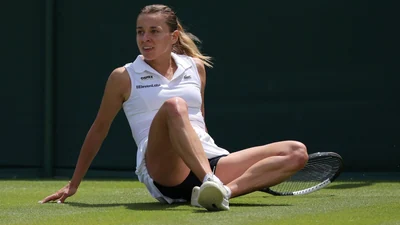
Maja Chwalinska Wimbledon exit became one of the biggest opening-round stories at the All England Club after the Polish qualifier sensation suffered a dramatic defeat against Thailand’s Mananchaya Sawangkaew on Monday. The 20th seed entered Wimbledon with huge expectations following her remarkable French Open run, but her grass-court campaign ended in disappointment after an ankle injury during a crucial moment changed the direction of the match.
Chwalinska, who had captured global attention with a surprise run to the French Open final weeks earlier, appeared on course to secure victory after dominating the opening set. However, Sawangkaew produced a stunning turnaround, winning 2-6, 7-5, 6-2 to claim one of the biggest victories of her career.
The match highlighted the unpredictable nature of Grand Slam tennis, where momentum, surface conditions and physical fitness can completely transform a contest within minutes.
Maja Chwalinska’s Wimbledon 2026 journey ends in heartbreaking fashion
The Polish player arrived at Wimbledon carrying confidence from her extraordinary performance at Roland Garros. Her French Open journey had been described as a breakthrough moment, especially because she entered the tournament as a qualifier and managed to reach the final stage against rising star Mirra Andreeva.
However, Wimbledon presented a completely different challenge. Unlike the slower clay courts of Paris, grass requires faster reactions, lower movement patterns and greater adjustment from players. Chwalinska struggled to maintain her early advantage once the match shifted into a physical battle.
After comfortably taking the first set 6-2, she looked in control. But Sawangkaew refused to surrender and began applying pressure, forcing longer rallies and testing Chwalinska’s movement.
How an ankle injury changed the match
The turning point came during the second set when Chwalinska had a match point opportunity. While attempting to convert the chance, she fell and injured her ankle.
The Polish player later explained that the injury affected her ability to continue at full intensity. Despite discomfort, she decided not to retire from the match because of the importance of competing at Wimbledon.
“I fell and I felt my ankle. I wanted to continue, but it definitely didn’t help me later on.”
Her decision showed determination, but the physical impact became visible as the match progressed. She struggled with movement, experienced cramps and was unable to maintain the level that helped her win the opening set.
Mananchaya Sawangkaew completes biggest win of her career
While much of the attention focused on Chwalinska’s injury, Sawangkaew’s performance was equally significant. The Thai player, ranked outside the top 150, stayed mentally strong after losing the first set and took advantage of the changing momentum.
Winning a Grand Slam match against a seeded player requires more than technical ability. Players must handle pressure, crowd atmosphere and the emotional swings that define major tournaments.
Sawangkaew showed patience throughout the match, waiting for opportunities rather than forcing unnecessary risks. Her victory represents a major milestone in her professional career and highlights the depth of talent emerging from global tennis.
French Open success could not be repeated on Wimbledon grass
Chwalinska’s sudden rise at Roland Garros created expectations that she could continue her dream run across the tennis season. However, the transition from clay to grass is one of the toughest adjustments in the sport.
| Factor | Clay Court (French Open) | Grass Court (Wimbledon) |
|---|---|---|
| Playing style | Long rallies and defensive strength | Fast reactions and aggressive attacking |
| Movement | Sliding is common | Quick balance changes required |
| Match rhythm | More time to build points | Shorter points and faster decisions |
| Physical demand | Endurance-focused | Explosive movement-focused |
The challenge for many players after a breakthrough tournament is maintaining consistency. A deep Grand Slam run can bring attention, pressure and higher expectations, all while opponents begin studying their game more closely.
Why Chwalinska’s rise remains important despite Wimbledon defeat
Although the result was disappointing, Chwalinska’s recent performances have changed the perception of her career. Before her French Open breakthrough, she was known mainly among tennis followers as a talented player working toward a major breakthrough.
Her Roland Garros campaign demonstrated her ability to compete against elite opponents and handle the pressure of major matches.
The Wimbledon defeat may become a learning experience rather than a setback. Many successful players experience difficult transitions after breakthrough moments because maintaining confidence becomes as important as improving technique.
The bigger impact on women’s tennis
The result also reflects a wider trend in women’s tennis: emerging players are increasingly capable of defeating established names. Rankings are becoming less predictable, and players from different countries are challenging traditional tennis powers.
Grand Slam tournaments have become platforms where lesser-known athletes can quickly become global names. Sawangkaew’s victory over a recent Grand Slam finalist demonstrates how competitive the women’s game has become.
What’s next for Maja Chwalinska?
The immediate priority for Chwalinska will be recovery and ensuring that the ankle issue does not become a long-term problem. Managing injuries after intense tournament schedules is one of the biggest challenges for professional athletes.
Her focus will likely shift toward rebuilding confidence, adapting her game for different surfaces and using her French Open experience as a foundation for future success.
A single early Wimbledon exit does not erase the progress made in Paris. Instead, it provides another chapter in a developing career that has already produced one of the biggest stories of the tennis season.
Conclusion: Maja Chwalinska’s Wimbledon defeat tells a bigger story
The Maja Chwalinska Wimbledon exit was a heartbreaking moment for the Polish star, but it also highlighted the unpredictable beauty of Grand Slam tennis. A player can move from reaching a major final to facing an early elimination within weeks, proving how small the margins are at the highest level.
While injury and changing conditions ended her Wimbledon campaign, Chwalinska’s recent achievements have established her as a player to watch. The next challenge will be turning a breakthrough season into long-term success.
For breaking news and live news updates, like us on Facebook or follow us on Twitter and Instagram. Read more on Latest Sports on thefoxdaily.com.



COMMENTS 0