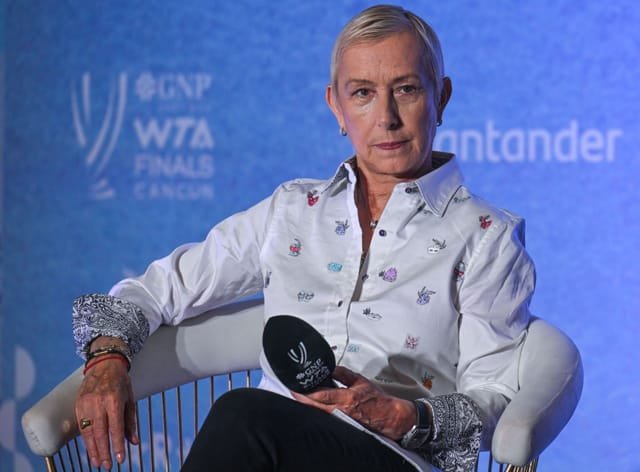
Martina Navratilova’s response to Natasha Cloud has added another prominent voice to a wider debate involving transgender inclusion, womenâs sports and the role of athletes in social issues. The former tennis champion reacted after WNBA player Natasha Cloud publicly expressed support for the trans community following a heated incident involving former NBA player Enes Kanter Freedom.
The controversy developed during a WNBA game between the Indiana Fever and Chicago Sky on August 23, 2026. Freedom attended the contest while supporting Fever player Sophie Cunningham and wore a shirt expressing a view about the definition of women. A verbal confrontation involving Freedom and Cloud later occurred during the game, after which Freedom was escorted from the arena.
Cloud subsequently posted a message supporting transgender people. Navratilova acknowledged the supportive language in Cloud’s statement but objected to the participation of transgender women in women’s sporting categories.
The exchange illustrates how the debate has moved beyond sporting regulations and into questions about identity, inclusion, fairness and the responsibilities of athletes who use their platforms to discuss controversial subjects.
What Happened Between Natasha Cloud and Enes Kanter Freedom?
The immediate controversy began at the Chicago Sky’s Wintrust Arena during the WNBA matchup involving the Sky and Indiana Fever.
Freedom, a former NBA player known for his outspoken political and social commentary, was in attendance to support Cunningham. His clothing became part of the discussion because it displayed a message defining the word “woman” in biological terms.
During the third quarter, Freedom and Cloud became involved in a verbal exchange. Freedom was subsequently removed from the arena.
The incident quickly spread across social media because it brought together several subjects that have generated significant debate in professional sports: transgender participation, women’s sports, freedom of expression and the treatment of athletes and spectators during sporting events.
Cloud later addressed transgender people directly on social media, emphasizing that they belong and should feel supported.
That statement prompted Navratilova to respond.
Martina Navratilova’s Response to Natasha Cloud
Navratilova did not reject the general message of supporting transgender people. Instead, she separated that issue from her longstanding position regarding competitive women’s sports.
Her response argued that support and inclusion should not automatically mean allowing male bodies into women’s sporting categories.
The distinction is important because the debate over transgender participation in sport is not limited to one question. It involves separate discussions about personal dignity, social inclusion, competitive categories, eligibility rules and the purpose of sex-based sporting classifications.
Navratilova has consistently argued that women’s sports require protected competitive categories. Her latest comments therefore fit into a position she has expressed publicly for years.
Why Navratilova’s Opinion Carries Weight in Women’s Sport
Navratilova is not simply a former professional athlete commenting from outside the sporting world.
She is one of the most accomplished players in tennis history and spent decades competing at the highest level of women’s sport.
Her career included 18 Grand Slam singles titles, 31 women’s doubles major titles and 10 mixed doubles major titles. She also spent 332 weeks ranked No. 1 in women’s singles.
Because of that background, her comments about women’s sporting categories receive considerable attention.
At the same time, her experience as a former athlete does not automatically settle the scientific, regulatory or ethical questions surrounding transgender participation. Those questions are addressed differently by governing bodies, researchers, athletes and advocacy organizations.
The Larger Debate Is Bigger Than One WNBA Incident
The Cloud-Freedom dispute should be viewed as part of a much broader conversation rather than an isolated argument at a basketball game.
Women’s sports have increasingly become a focal point in debates about transgender participation. Sporting organizations have attempted different approaches, ranging from open eligibility policies to sex-based restrictions and sport-specific regulations.
The challenge for governing bodies is that different sports place different physical demands on athletes.
Basketball, tennis, swimming, athletics and contact sports do not necessarily face identical competitive considerations. As a result, a single policy may not provide an easy answer for every discipline.
This is one reason the issue remains contentious.
Why Women’s Sports Categories Exist
Sex-based sporting categories were developed to create competitive opportunities for female athletes in organized sport.
Physical characteristics can influence performance in many sports, including factors such as strength, speed, endurance and body size. However, the relevance of those factors varies depending on the sport and event.
That creates a difficult policy question: how should sporting organizations balance inclusion with the objective of maintaining meaningful competitive categories?
There is no universally accepted answer across all sports.
Different governing bodies have therefore adopted different eligibility frameworks, and those policies can also change over time as scientific evidence, legal requirements and sporting priorities evolve.
Natasha Cloud’s Position Represents a Different Priority
Cloud’s message focused primarily on belonging and acceptance.
That approach emphasizes the social experience of transgender people rather than the technical question of competitive eligibility.
For athletes and supporters who prioritize inclusion, statements like Cloud’s can be viewed as important reassurance to transgender fans and young people who may feel excluded from sports communities.
That perspective does not necessarily answer the separate question of how elite competition should be regulated.
This distinction is often lost when discussions on social media become highly polarized.
Navratilova and the WNBA Have Clashed Over Similar Issues Before
The latest comments are not the first time Navratilova has criticized messaging from the WNBA.
She previously reacted to welcoming messages directed toward transgender fans by the New York Liberty.
The team had used supportive language aimed at trans fans, emphasizing that they were welcome and valued.
Navratilova criticized the messaging, arguing that the league’s approach represented a major change from the environment she remembered from earlier periods of professional women’s sports.
Her reaction demonstrated the difference between two conversations that frequently overlap: welcoming transgender people as spectators and determining eligibility for participation in women’s competitions.
Inclusion and Competitive Eligibility Are Separate Questions
One useful way to understand the disagreement is to separate three concepts: belonging, participation and competition.
- Belonging: Whether transgender people should feel welcome and respected within sporting communities.
- Participation: Whether transgender athletes should be allowed to participate in recreational or organized sports.
- Competitive eligibility: Which rules should determine participation in elite women’s categories.
These questions can produce different answers.
An organization may welcome transgender fans while maintaining particular eligibility requirements for elite competition. Likewise, an organization may support broader participation while applying different rules to different levels of sport.
Recognizing those distinctions can make the discussion more precise and less dependent on social-media arguments.
Why the Enes Kanter Freedom Incident Became a Flashpoint
The involvement of Freedom made the controversy more visible because he has previously used his public platform to express strong political and cultural opinions.
His presence at a WNBA game, combined with the message on his shirt and subsequent interaction with Cloud, transformed a basketball contest into a wider public discussion.
The incident also demonstrates how quickly individual moments inside sporting venues can become national or international conversations once they are shared online.
For professional leagues, that creates a complicated environment. Athletes, spectators and organizations can all become part of a debate that extends far beyond the original event.
The Role of Athletes in Social Debates
Modern athletes are increasingly expected to have opinions on social issues.
Social media has removed many of the traditional barriers between athletes and their audiences. A player can now communicate directly with millions of followers without relying on a press conference or newspaper interview.
That creates opportunities for athletes to advocate for causes they believe in, but it also increases the possibility of controversy.
Cloud used her platform to offer support to a community. Navratilova used hers to challenge one aspect of that message.
Neither response exists in isolation. Both contribute to a continuing public discussion about the boundaries of inclusion and competitive fairness.
How the Debate Could Affect Women’s Sports
The most important long-term consequence may not involve this particular WNBA incident at all.
The larger issue is how professional sports organizations establish rules that athletes can understand and trust.
Clear policies are particularly important because eligibility disputes can affect athletes’ careers, competitive opportunities and public reputations.
Sporting bodies may increasingly need policies that explain the evidence and reasoning behind their eligibility requirements rather than relying only on broad statements about inclusion or fairness.
Transparent decision-making could help reduce confusion even when people strongly disagree with the final policy.
Social Media Has Made the Debate More Polarized
Another important factor is the speed of online discussion.
A short statement from an athlete can be interpreted in dramatically different ways depending on the audience reading it. Supporters may see a message of solidarity, while critics may interpret the same statement as dismissing competitive concerns.
The reverse can happen as well.
That is why complex questions surrounding transgender participation are difficult to resolve through short social-media posts.
Sport involves medical, scientific, legal, ethical and competitive considerations that generally require considerably more explanation than a single sentence can provide.
Navratilova’s Sporting Legacy Remains Central to the Conversation
Regardless of whether people agree with her current position, Navratilova’s history in women’s sport explains why she remains a prominent participant in this discussion.
Her career stretched across one of the most competitive periods in tennis history. She won major championships in singles, doubles and mixed doubles and maintained the No. 1 ranking for hundreds of weeks.
Her experience gives her a personal connection to questions surrounding the preservation of women’s sporting categories.
However, the modern debate is occurring under circumstances that are different from those of her playing career, with new policies, scientific research and legal developments influencing how sports organizations approach eligibility.
What Happens Next?
The immediate controversy is likely to continue generating discussion because the underlying issue remains unresolved across the sporting world.
The WNBA and other professional leagues will continue to face questions about inclusion, eligibility and the treatment of transgender athletes and fans.
Meanwhile, athletes such as Cloud and Navratilova are likely to remain influential voices because of their ability to reach large audiences directly.
The most constructive path forward may require separating personal respect from competitive-policy disagreements. Supporting someone’s dignity does not automatically answer every question about sporting eligibility, just as advocating for sex-based categories does not require hostility toward transgender people.
Conclusion
Martina Navratilova’s reaction to Natasha Cloud has brought renewed attention to the complicated debate surrounding transgender inclusion and women’s sports.
The disagreement emerged after an incident involving Cloud and Enes Kanter Freedom during a WNBA game, but the underlying issues extend far beyond one confrontation.
Cloud emphasized support and belonging for transgender people, while Navratilova argued that inclusion should be considered separately from eligibility for women’s sporting competition.
The controversy highlights the difficult balance sporting organizations must navigate between inclusion, competitive fairness, athlete rights and clearly defined categories.
As the debate continues, the most valuable discussions will likely be those that distinguish social acceptance from competitive regulations and examine each sporting context on its own merits rather than reducing a complex issue to competing slogans.
For breaking news and live news updates, like us on Facebook or follow us on Twitter and Instagram. Read more on Latest Sports on thefoxdaily.com.






COMMENTS 0