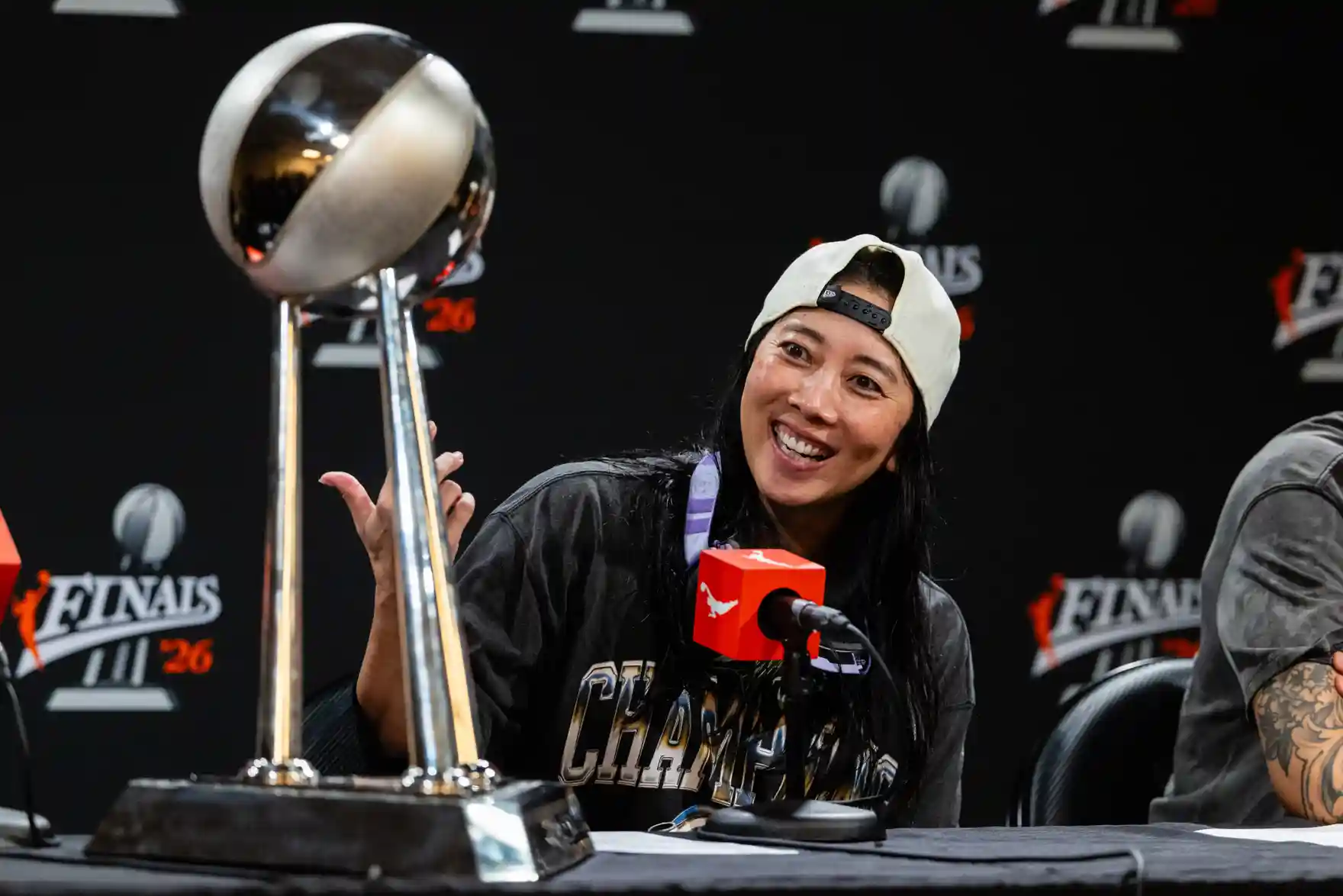
The Golden State Valkyries have made history by winning their first WNBA championship, completing an extraordinary journey from their first game to a title in just 534 days. Led by head coach Natalie Nakase, Golden State defeated the Atlanta Dream 68-63 in a dramatic Game 7 on Saturday night to become champions in only their second season of existence.
The victory was more than a remarkable achievement for a new franchise. It was the result of a team-building philosophy centred on trust, opportunity, hard work and collective responsibility. Many of the players who helped Golden State lift the trophy had previously been overlooked, released by other teams or forced to fight for a place in the league.
Nakase understood that journey better than most. Her own basketball career was built through unexpected opportunities, persistence and a determination to prove herself. From earning a scholarship after joining UCLA as a walk-on to becoming the first woman to lead a team in Japan’s top professional men’s basketball league, she had spent years showing what belief and opportunity could achieve.
That experience helped her create a culture in Golden State where players were trusted to contribute, regardless of their previous reputations or place in the rotation. The result was a championship-winning team that reached the summit far sooner than anyone could have expected.
Golden State Valkyries defeat Atlanta Dream in historic WNBA Finals
The Valkyries secured the championship with a 68-63 victory over the Atlanta Dream in Game 7 of the WNBA Finals. The deciding game at Chase Center delivered a tense finish, with Golden State completing a comeback and making history in front of a packed home crowd.
The victory made the Valkyries the fastest expansion team in major North American professional sports history to win a championship, achieving the milestone just 534 days after playing their first game. They had also entered the season as 45-1 preseason longshots, making their title run even more remarkable.
Golden State’s championship was built through a series of difficult games against Atlanta. The seven-game series featured momentum swings, dominant performances and important adjustments from Nakase as she searched for the combinations that could deliver victories.
2026 WNBA Finals results:
- Game 1 – October 17: Golden State Valkyries 68, Atlanta Dream 64
- Game 2 – October 19: Atlanta Dream 79, Golden State Valkyries 65
- Game 3 – October 21: Atlanta Dream 97, Golden State Valkyries 71
- Game 4 – October 24: Golden State Valkyries 67, Atlanta Dream 62
- Game 5 – October 26: Golden State Valkyries 64, Atlanta Dream 55
- Game 6 – October 29: Atlanta Dream 80, Golden State Valkyries 69
- Game 7 – October 31: Golden State Valkyries 68, Atlanta Dream 63
After falling behind 2-1 in the series, Golden State responded by winning Games 4 and 5. Atlanta forced a deciding contest with its Game 6 victory, but the Valkyries delivered when the championship was on the line.
Natalie Nakase’s emotional championship message
Following the final victory, Nakase celebrated with her players and supporters during the trophy ceremony at Chase Center. Her emotional words captured the close relationships she had built within the organisation and the belief that had carried the team throughout the season.
“We have unconditional love that’s fucking unbreakable, guys,” Nakase said during the trophy ceremony.
She also dedicated the championship to people who had experienced being overlooked or misunderstood, connecting the team’s achievement to the difficult journeys of several players on the roster.
“This is for all the people that have been underrated, misunderstood,” she said. “This is for all y’all, because this is proof: if you put all your heart and all your soul, you fucking win championships!”
Her message reflected the identity of a team that had been built without relying on a roster of established superstars. Instead, Golden State brought together players who had something to prove and gave them the support and responsibility to show what they could do.
Nakase’s approach was demanding as well as supportive. Players were expected to defend, compete, accept different roles and put the team’s needs ahead of individual recognition. The message of unconditional love came with a clear expectation: everyone had to contribute to winning.
Overlooked players become championship winners
One of the defining features of Golden State’s championship roster was the number of players who had experienced setbacks before finding an important role with the Valkyries. Their stories demonstrated how the right environment could transform careers.
Veronica Burton, Golden State’s starting point guard, had been waived by the Dallas Wings two years earlier. After returning home to Massachusetts, she worked out at the West Suburban YMCA in Newton with her high school coach while waiting for another opportunity.
Connecticut later signed Burton, but she was left unprotected in the expansion draft. Golden State gave her a fresh opportunity, and she went on to become the WNBA’s Most Improved Player.
Kaila Charles also experienced a difficult path. She had been waived five times across five seasons and was back at her parents’ home, training with her brother while considering her professional future. She was preparing to visit Trinidad for her grandmother’s 94th birthday when the Valkyries offered her a seven-day hardship contract. She eventually became a starting player in the WNBA Finals.
Kayla Thornton’s journey was similarly defined by persistence. She went undrafted, was released by two teams and spent years establishing herself as a reliable supporting player. At 32, she became a first-time All-Star with Golden State.
Cecilia Zandalasini also found a larger role with the franchise. Before joining the Valkyries, she had started only six WNBA games. She went on to make 44 starts across the team’s first two seasons.
Rookie Kaitlyn Chen, a relatively unheralded third-round draft pick, became an important part of the rotation as Burton’s backup and a contributor to the team’s positive bench atmosphere.
Tiffany Hayes brought another significant personal story to the championship. A former Sixth Woman of the Year, she had played more WNBA games without winning a title than anyone else in league history before Golden State’s victory.
These players were not simply given places on a roster. They were given opportunities to take on meaningful responsibilities and demonstrate their abilities in important situations.
Gabby Williams leads Golden State to championship glory
While the Valkyries’ success was built on collective contributions, Gabby Williams delivered an outstanding individual performance in the deciding game. She scored 28 of her 30 points after half-time, producing the highest-scoring half in WNBA playoff history.
Her performance made her the clear choice for WNBA Finals MVP and gave Golden State the offensive spark it needed to finish the championship series.
Williams credited Nakase’s guidance and the trust between them for helping her deliver when the pressure was highest.
“Nat told me to stay patient. I trust her with my life,” Williams said.
Williams also explained how joining Golden State had changed her experience in the WNBA. She arrived at a team where relationships and a shared culture were already developing, and said the welcoming environment had changed the direction of her career.
“I showed up new to the team, the team already had a culture and relationships established but I walked into a group full of love and that just changed the entire trajectory of my career,” she said.
Her basketball journey had also taken a different route, with a decorated career in Europe and for France alongside interrupted periods in the WNBA with Chicago and Seattle. Williams said the difficult route had helped shape her character and brought her to a group of people she valued deeply.
She also rejected the suggestion that Golden State lacked the star power or talent required to compete for a championship.
“All it took was good people,” Williams said. “All we heard last year was we don’t have no stars. We don’t have no talent. Yeah, right! We got good people. We got good people. We got winners.”
How Natalie Nakase built her basketball career
Nakase’s coaching philosophy was shaped by a basketball journey that involved several major setbacks and unexpected opportunities. Standing 5ft 2in, she grew up in a basketball-focused Japanese-American family in Southern California and developed ambitions of playing at the highest level.
She turned down a scholarship offer from UC Irvine to walk on at UCLA, the university she had always dreamed of attending. A torn anterior cruciate ligament delayed her start, but she eventually earned a scholarship, became a starter and captained the Bruins for three seasons.
Despite her college success, Nakase never secured a place on a WNBA roster. Phoenix released her in 2007, and another knee injury while playing in Germany brought her playing career to an end.
Rather than leaving basketball behind, she moved into coaching. She began with the Wolfenbüttel Wildcats in Germany’s Damen-Basketball-Bundesliga before moving to Japan and finding an opportunity through the Tokyo Apache organisation.
Nakase prepared a scouting report that helped her earn a volunteer assistant position under former NBA coach Bob Hill. That opportunity eventually led to a historic coaching appointment with the Saitama Broncos, where she became the first woman to lead a team in Japan’s top professional men’s league.
Her career then brought her back to California, where she secured an internship in the Los Angeles Clippers’ video department. She spent a decade with the organisation, progressing through video, player development and coaching roles.
In 2022, Becky Hammon brought Nakase to the Las Vegas Aces. Working as a bench coach, she became part of a successful team that won two championships and gave her valuable experience of operating within a championship organisation.
That experience helped prepare her for the opportunity to build a new franchise in Golden State.
Nakase’s demanding coaching style and personal challenges
Nakase is known for her intensity and relentless commitment to basketball. Her approach has helped establish high standards within the Valkyries, but the same drive has also pushed her close to her physical limits.
During the closing minute of the first-round deciding game against Dallas, she nearly fainted. The incident prompted her to pay closer attention to rest, hydration and nutrition.
She also took the unusual step of giving herself an entire day off during the semi-finals. For a coach who regularly encouraged players to give everything they had and “empty the tank”, recognising her own limits became an important part of managing the demands of the season.
Nakase has linked her work ethic and commitment to developing people to the influence of her late father.
“He’s the reason why I’m built the way I am. I am crazy. I am obsessive. I am a workaholic,” she said. “But it’s more just pouring into people, believing in people, helping people, that’s all come from my dad.”
Her emphasis on believing in people became a central part of the Valkyries’ identity. She wanted players to feel valued while also understanding that the team’s success depended on their willingness to work for one another.
Team chemistry and trust become Golden State’s biggest strengths
Building a group of players with different backgrounds and experiences required more than choosing talented individuals. Nakase and general manager Ohemaa Nyanin placed considerable importance on competitiveness, character and the ability to accept a team role.
They studied how potential players behaved during games, including how they reacted when they were substituted or returned to the bench. The goal was to find individuals who wanted to improve their own careers while remaining committed to the team’s wider objectives.
The organisation also invested time in developing relationships away from basketball. During an early two-week road trip, the Valkyries arranged team dinners and activities that encouraged players to discuss personal experiences and answer open questions.
Basketball was deliberately not the main subject of those conversations. Nakase wanted to understand the people she was coaching so she could build stronger relationships and know how to challenge each player when necessary.
“I love to learn about people, so I can push their buttons and go crazy when I have to,” Nakase said.
Williams remembered the experience as an important moment in the development of the team, recalling evenings when nobody wanted the conversations to end. She said she recognised that the group had something special during that trip.
That connection eventually translated into performances on the court. The players understood their responsibilities, trusted their coach and accepted that their individual roles could change depending on what the team needed.
Why Nakase’s rotations made a difference in the WNBA Finals
Two of Nakase’s recurring messages were “Strength in numbers” and “Empty the tank”. She backed those ideas with a rotation that gave opportunities to players beyond the starting lineup.
Golden State’s coach was willing to trust the eighth or ninth player in the rotation during important stretches, rather than relying exclusively on the biggest names. That approach helped the team maintain its defensive intensity and gave more players a chance to influence the outcome of games.
The depth of the roster was especially important during the Finals. Nakase demonstrated that a player’s role was determined by the team’s needs rather than reputation or previous status.
After Golden State fell behind Atlanta 2-1, she made significant changes to the starting lineup. Kaila Charles and Tiffany Hayes moved into starting positions, while Thornton and Zandalasini shifted to the bench.
The adjustment worked. Golden State won the next two games, limiting Atlanta to 62 points in Game 4 and 55 points in Game 5. The defensive performances helped the Valkyries take control of the series before Atlanta forced a deciding seventh game.
The changes also demonstrated the trust within the roster. Players who had started games were willing to accept different roles, while those promoted into the starting lineup were ready to take responsibility.
Even in an elimination game, Nakase was prepared to trust rookie Chen in the closing stages while starting point guard Burton watched from the bench. It was another example of her belief that the best decisions should be based on what the game required.
Joe Lacob’s investment helped create a championship organisation
Golden State’s success was not built on coaching and player relationships alone. The organisation also benefited from ownership that provided resources and established a clear expectation of winning.
During Nakase’s interview for the coaching position, owner Joe Lacob made his ambition clear: the person appointed to the role would be expected to win a championship within five years.
Nakase delivered the title in two seasons, beating the original timeline by a considerable margin. She later described herself as impatient and obsessive, while also acknowledging the pressure and motivation created by Lacob’s expectations.
She also highlighted the importance of having an owner who consistently showed up and invested in Women’s Basketball. In her view, the championship demonstrated what could happen when an organisation provided the resources needed for success.
Lacob credited three women for making the achievement possible: Nakase, general manager Ohemaa Nyanin and team president Jess Smith. His comments recognised the leadership and work behind the franchise’s rapid rise.
The Valkyries’ supporters also played an important role in creating a sense of belonging. According to the supplied report, the team sold out all 53 of its home games, including its 53rd home appearance on championship night. Chase Center, which has a capacity of 18,064, was packed for the celebration.
Investment in women’s basketball delivers results
Golden State’s championship adds to a wider trend in the WNBA, where investment in facilities, player support and organisational resources has become an increasingly important part of building successful teams.
The Las Vegas Aces invested in a $40m training facility and brought Becky Hammon from the NBA with a reported salary of $1m a year. The New York Liberty also experienced a revival after Joe and Clara Wu Tsai took ownership, moved the team to Brooklyn and invested in recruitment, nutrition and other areas of player support.
Golden State followed a similar approach by giving its players the facilities, support and expectations associated with a championship organisation. The team’s success demonstrated how financial backing and a strong culture can work together.
The Valkyries also became the first women’s professional sports team to exceed $100m in annual revenue, according to Sportico, as reported in the supplied article. Their commercial performance reflected the growing demand for women’s professional basketball.
Interest in the championship series was also evident in ticket prices. According to ticketing analyst Keith Smith, the cheapest available ticket for Game 7 on the secondary market was $364 approximately 24 hours before tip-off. The reported price was higher than the cheapest tickets available for every NFL and college football game that weekend.
The figures highlighted the commercial opportunities available to teams that invest in women’s sports and build strong connections with supporters.
Golden State Valkyries’ championship marks a new chapter
The Valkyries’ first WNBA title was the result of several parts of the organisation working towards the same goal. Ownership provided financial backing and championship expectations, the front office identified players with the potential to grow, and Nakase created an environment where those players could develop and trust one another.
The supporters also embraced the franchise before it had even played its first game, helping establish a strong connection between the team and the Bay Area. That support was visible throughout the season and reached its peak during the championship celebration at Chase Center.
Nakase’s own journey made her particularly suited to leading a team built around overlooked talent. She understood what it meant to be underestimated, to wait for an opportunity and to prove that ability could not always be measured by reputation or conventional credentials.
Her coaching approach gave players the chance to do exactly that. Burton, Charles, Thornton, Zandalasini, Chen and Hayes all found meaningful opportunities within a team that valued collective success.
The Valkyries completed their remarkable rise by defeating Atlanta 68-63 in Game 7, winning the championship just 534 days after their first game. For Nakase, the title was not simply a personal milestone. It was the reward for building a group of players who believed in one another and were prepared to work for a shared purpose.
Golden State’s achievement has established an extraordinary beginning for the franchise and provided another example of the growing potential of women’s professional basketball. The Valkyries did not need a roster filled with established superstars to become champions. They needed good people, a clear identity, strong investment and a coach who knew how to turn opportunity into success.
How to watch the WNBA Finals
The supplied broadcast information lists the following viewing options for the WNBA Finals:
- United States: NBC, USA Network and CNBC, with games streaming on Peacock.
- United Kingdom: Sky Sports.
- Australia: WNBA League Pass, with selected coverage also available through ESPN.
Broadcast and streaming availability may vary by region and subscription. Viewers should check local listings and their providers for access details.
For breaking news and live news updates, like us on Facebook or follow us on Twitter and Instagram. Read more on Latest Sports on thefoxdaily.com.






COMMENTS 0