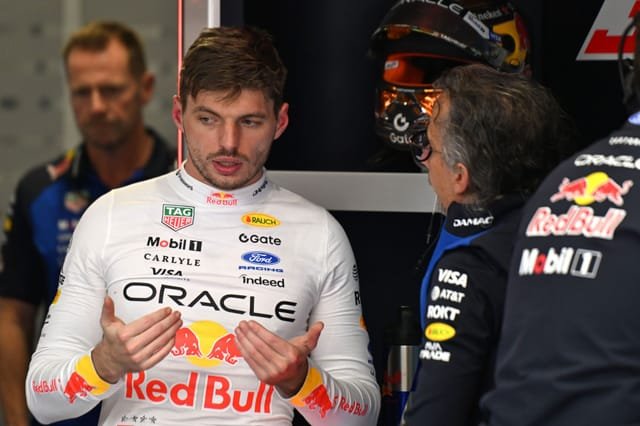
The 2026 Hungarian Grand Prix qualifying exposed the growing frustrations inside the Red Bull Racing garage as Max Verstappen and Team Principal Laurent Mekies shared a tense exchange over team radio following a disappointing Q3 session. The four-time Formula 1 World Champion spun at the final corner during his last flying lap and immediately blamed the RB22‘s handling, describing the car as “undriveable” and criticizing its aerodynamic performance.
While emotional radio messages are nothing new in Formula 1, the conversation between Verstappen and Mekies has attracted significant attention because it reflects the mounting pressure on Red Bull during a season in which the team has struggled to consistently match its previous dominance. The qualifying setback not only left Verstappen starting further down the grid than expected but also intensified discussions about Red Bull’s technical direction and the Dutch driver’s long-term future.
A Disappointing End to Qualifying for Verstappen
Qualifying at the Hungaroring was expected to be a crucial opportunity for Verstappen to challenge the front runners. Instead, the session ended in frustration when he lost control of the RB22 at the final corner during his last attempt in Q3.
The spin prevented any possibility of improving his lap time and underlined the balance issues that had troubled him throughout the weekend. Although he managed to secure a place inside the top ten, the result fell well below Red Bull’s usual expectations.
For a driver accustomed to fighting for pole position, finishing several places behind the leaders represented another difficult chapter in an increasingly challenging campaign.
The Team Radio Exchange That Drew Attention
Immediately after the incident, Verstappen voiced his frustration over the radio, once again insisting that the RB22 was extremely difficult to drive. Rather than focusing solely on the spin, he suggested the handling problems had been building throughout the weekend.
Recognizing the disappointment, Laurent Mekies addressed Verstappen directly over team radio, acknowledging the team’s struggles and assuring him that engineers would work to improve the situation before Sunday’s race.
Verstappen’s response was equally candid, explaining that the car felt virtually impossible to drive and emphasizing just how severe the handling issues had become from his perspective.
Why Verstappen Described the Car as “Undriveable”
Following qualifying, Verstappen elaborated on the problems affecting the RB22. According to the reigning champion, the rear of the car lacked stability, making it increasingly difficult to maintain confidence through high-speed corners.
Modern Formula 1 cars depend heavily on aerodynamic balance. When rear grip becomes inconsistent, drivers are often forced to make constant steering corrections, reducing confidence and increasing the likelihood of mistakes.
Verstappen indicated that this unpredictable behavior worsened as qualifying progressed, making each subsequent lap more difficult than the previous one.
Understanding Aerodynamic Balance in Formula 1
A Formula 1 car generates most of its performance through aerodynamic downforce. When airflow remains stable, drivers can carry remarkable speed through corners while maintaining control.
If that aerodynamic balance changes unexpectedly, however, the rear of the car can become unstable, particularly during direction changes and corner exits. Even the world’s best drivers struggle to compensate when aerodynamic performance fluctuates unpredictably.
| Technical Term | What It Means |
|---|---|
| Aerodynamic Balance | The distribution of downforce between the front and rear of the car. |
| Rear Instability | Loss of grip causing the rear of the car to slide unexpectedly. |
| Oversteer | The rear rotates more quickly than intended during cornering. |
| Driver Confidence | The ability to consistently attack corners without unexpected handling changes. |
Laurent Mekies Faces His Biggest Challenge Yet
As Red Bull’s Team Principal, Laurent Mekies faces the difficult task of maintaining confidence within the team while addressing technical problems on the circuit.
His calm response over team radio reflected an effort to reassure Verstappen despite the disappointing qualifying result. Team principals often serve as both technical leaders and motivators, particularly during weekends when performance falls short of expectations.
The exchange demonstrated that while frustration exists, communication between driver and team remains active as engineers search for solutions.
Red Bull’s Technical Problems Continue
The Hungarian Grand Prix has highlighted several issues affecting Red Bull’s competitiveness. Rather than a single isolated problem, Verstappen suggested that each race weekend seems to introduce a different challenge, making long-term development increasingly complicated.
When technical issues vary from circuit to circuit, engineers face a more difficult task because identifying a consistent root cause becomes significantly harder.
That inconsistency may explain why Verstappen referred to the RB22’s performance as becoming progressively worse throughout qualifying.
Why the Hungaroring Is Such a Tough Test
The Hungaroring rewards cars with excellent mechanical grip, aerodynamic efficiency, and predictable balance. Its long sequence of technical corners leaves very little room for handling imperfections.
Unlike circuits dominated by long straights, Budapest forces drivers to rely heavily on confidence through continuous cornering. Any instability at the rear can cost valuable time across an entire lap.
This makes qualifying at the Hungarian Grand Prix one of the clearest indicators of a car’s overall balance.
| Hungaroring Characteristic | Effect on Performance |
|---|---|
| Technical Corner Sequence | Requires consistent aerodynamic balance. |
| Limited Overtaking Opportunities | Makes qualifying position extremely valuable. |
| Medium and Slow-Speed Corners | Expose handling weaknesses. |
| High Driver Workload | Rewards stable and predictable cars. |
Growing Questions About Verstappen’s Future
The difficult qualifying session has inevitably renewed speculation surrounding Verstappen’s long-term future. Whenever performance declines at a front-running team, rumors regarding driver contracts naturally become more prominent.
While reports continue to discuss potential contractual scenarios, neither qualifying frustrations nor emotional team radio exchanges alone determine a driver’s future. Decisions involving elite Formula 1 drivers are typically influenced by multiple sporting, technical, and competitive factors over an extended period.
For now, Verstappen’s primary focus remains extracting the maximum performance from the RB22 while Red Bull continues developing the car.
Can Red Bull Recover Before Race Day?
Formula 1 teams routinely analyze telemetry overnight in search of setup improvements before the Grand Prix. Although major design changes cannot be introduced between qualifying and the race, engineers can adjust suspension settings, aerodynamic balance, tyre strategy, and race preparation.
If Red Bull identifies the source of the instability, Verstappen could still become a significant factor during Sunday’s race despite his disappointing qualifying position.
Race pace, tyre management, and strategic execution often provide opportunities that qualifying alone cannot guarantee.
Why Team Radio Matters in Modern Formula 1
Team radio conversations offer rare insight into the pressure experienced by drivers and engineers during competition. While emotional reactions often generate headlines, they also reveal the challenges teams face when solving complex technical problems under intense scrutiny.
For Red Bull, the exchange between Verstappen and Mekies demonstrated both the driver’s determination to compete at the highest level and the team’s commitment to finding immediate improvements despite a frustrating weekend.
Conclusion
Max Verstappen’s tense exchange with Laurent Mekies following Hungarian Grand Prix qualifying captured the growing frustration surrounding Red Bull’s 2026 campaign. After spinning in Q3 and criticizing the RB22’s handling, the reigning world champion made it clear that the team still has significant work to do before returning to its usual level of competitiveness.
Although qualifying proved disappointing, Formula 1 weekends are rarely decided on Saturday alone. With engineers working overnight to improve the RB22 and Verstappen determined to recover positions on race day, the Hungarian Grand Prix remains an important opportunity for Red Bull to demonstrate resilience. Whether the team can translate those efforts into a stronger race performance will be one of the weekend’s biggest storylines.
For breaking news and live news updates, like us on Facebook or follow us on Twitter and Instagram. Read more on Latest Sports on thefoxdaily.com.






COMMENTS 0