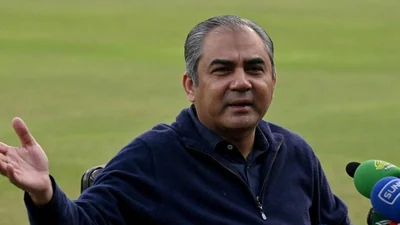
Mohsin Naqvi Women’s Asia Cup final has emerged as a major talking point ahead of the tournament’s climax, with reports indicating that the Pakistan Cricket Board chairman and Asian Cricket Council president could attend the closing ceremony on September 13.
His expected presence matters because of what happened during the previous men’s Asia Cup. India’s men’s team declined to accept the trophy from Naqvi after defeating Pakistan in the final, creating an unusual post-match presentation that dominated headlines long after the cricket had finished.
Now, with India’s women’s team among the leading contenders for the Women’s Asia Cup title, attention has shifted toward the possibility of another trophy presentation involving Naqvi.
There has been no confirmed public indication from the Board of Control for Cricket in India about how the women’s team would respond if it wins the tournament and Naqvi is involved in the presentation. That leaves an important question hanging over the final: could the trophy ceremony become another major storyline after the cricket ends?
Why Mohsin Naqvi’s Presence Is Significant
According to the report, Naqvi is expected to serve as the chief guest during the Women’s Asia Cup closing ceremony. His position in Asian cricket administration gives him a formal connection to the tournament, but his recent history with India’s men’s team makes his potential role especially sensitive.
Naqvi is chairman of the Pakistan Cricket Board and has also served as president of the Asian Cricket Council. His involvement in the previous men’s Asia Cup trophy presentation became controversial when India chose not to receive the silverware directly from him.
The upcoming women’s final could therefore create a similar situation, although it would be inappropriate to assume that the Indian women’s team will automatically make the same decision.
Players and teams can make their own choices, and the circumstances surrounding the upcoming final could be different from those of the previous tournament.
What Happened in the Previous Asia Cup Trophy Presentation?
The previous men’s Asia Cup final created an unusual scene after India defeated Pakistan to win the tournament.
The match itself ended with India celebrating victory, but the trophy presentation did not immediately follow. The ceremony was delayed for more than an hour as discussions surrounding the presentation continued.
India ultimately decided not to accept the trophy from Naqvi. The team celebrated on the podium without the silverware, creating one of the most memorable off-field moments of that tournament.
The trophy was subsequently reported to have remained at the ACC office in Dubai rather than being immediately handed to the winning Indian team.
The episode became a symbol of the wider tension surrounding India-Pakistan cricket at the time.
Why India-Pakistan Cricket Remains Highly Sensitive
Matches between India and Pakistan carry an unusual level of sporting and political attention. Even routine cricketing events can become major news stories because of the wider relationship between the two countries.
The previous men’s Asia Cup took place amid heightened tensions, adding another layer to the tournament narrative. Naqvi’s public role as both a cricket administrator and Pakistani government minister further complicated perceptions around his presence.
For the Women’s Asia Cup, the priority remains the competition itself. However, if India reaches the final and Naqvi participates in the closing ceremony, the trophy presentation will inevitably attract attention.
The situation demonstrates how sporting ceremonies can sometimes become almost as significant as the match when political sensitivities are involved.
India Women’s Team Has Started the Tournament Strongly
India’s women’s team has given itself an excellent opportunity to reach the final after a strong group-stage campaign.
Led by Harmanpreet Kaur, India qualified for the semi-finals without losing a match. The team’s results have placed it among the leading contenders for the tournament title.
India opened its campaign against Thailand before recording further victories over Hong Kong and Pakistan. The unbeaten run has provided the team with considerable momentum heading into the knockout stage.
The dominant result against Pakistan was particularly notable. India restricted Pakistan to just 55 before completing a seven-wicket victory.
Such performances have strengthened India’s status as one of the favourites, although knockout cricket can produce different challenges from the group stage.
India’s Victory Over Pakistan Added More Attention
The seven-wicket victory over Pakistan was one of India’s most emphatic performances in the tournament so far.
Pakistan were bowled out for 55, leaving India with a straightforward chase. The result not only improved India’s tournament position but also added another chapter to the long-running sporting rivalry between the two nations.
Because of the rivalry, every major India-Pakistan result tends to attract attention beyond the points table. The possibility of the teams meeting again in the knockout stages would therefore bring additional interest to the competition.
However, India’s immediate objective remains reaching the final and winning the tournament rather than becoming distracted by events surrounding the presentation ceremony.
Smriti Mandhana Has Also Made History
India’s tournament has produced an important individual milestone as well. Smriti Mandhana became the leading run-scorer in women’s international cricket, moving beyond the previous record associated with Mithali Raj.
The achievement adds another historic dimension to India’s campaign.
Mandhana has been one of the most influential batters in women’s cricket for years, and surpassing Mithali’s international run tally represents a significant moment for Indian cricket.
Her milestone also illustrates the broader strength of the Indian women’s side. While the team is pursuing another Asia Cup title, individual achievements are adding further historical significance to the campaign.
Will India Accept the Trophy From Naqvi?
This is the question likely to generate the most discussion before the final.
At present, there is no publicly confirmed decision from the BCCI regarding what India’s women’s team would do if it wins the tournament and Naqvi is involved in the trophy presentation.
It is therefore important not to assume that the women’s team will repeat the men’s team’s decision.
The final outcome could depend on the arrangements made by the ACC, the officials present at the venue and the protocol followed after the match.
If Naqvi is indeed the person handing over the trophy, the winning team’s response could become one of the biggest post-match talking points. Conversely, a routine presentation would allow the sporting achievement to remain the centre of attention.
The Difference Between the Two Situations Matters
Although the previous men’s Asia Cup provides the obvious comparison, the upcoming women’s final should be viewed on its own terms.
The players are different, the tournament is different and the circumstances surrounding the final may not be identical. A previous team’s decision does not automatically determine what another team will do.
That distinction is particularly important because speculation about a trophy ceremony can easily overshadow the actual competition.
For Harmanpreet Kaur and her players, the immediate task is to complete their knockout campaign and give themselves the best possible chance of lifting the Asia Cup.
Harmanpreet Kaur’s Leadership Will Be Central
Harmanpreet Kaur leads an Indian team that has already shown considerable consistency during the tournament.
Her leadership will become increasingly important as India enters the knockout stage. Unlike the group phase, where one poor result can sometimes be overcome, the semi-finals and final leave little room for mistakes.
The captain will need to keep the team’s focus on cricket while external attention grows around the competition.
If India reaches the final, the players will face questions about the trophy presentation in addition to questions about tactics, selection and performance. Managing that attention will be part of the broader challenge surrounding the tournament’s climax.
Why the Trophy Ceremony Could Become a Major Story
Modern sports events often generate significant media attention around moments outside the actual contest. Trophy presentations are particularly important because they represent the official conclusion of a tournament.
In an India-Pakistan context, however, symbolism can become even more powerful.
The previous men’s Asia Cup showed how a presentation disagreement could dominate the post-match narrative. The cricket had already produced a winner, but the absence of a conventional trophy handover became the defining image of the ceremony.
If a similar situation occurs in the women’s tournament, it could once again shift attention from the players’ achievement to the administration surrounding the event.
Potential Scenarios for September 13
| Scenario | Possible Outcome | Impact |
|---|---|---|
| India wins and accepts the trophy | Routine closing ceremony | Cricket remains the main focus |
| India wins and Naqvi is not involved in the handover | Another official could present the trophy | Could avoid a repeat of the previous controversy |
| India wins and declines the trophy from Naqvi | Presentation becomes a major talking point | Could revive memories of the previous men’s Asia Cup |
| Another team wins | The trophy question involving India becomes irrelevant | Focus shifts entirely to the new champion |
Why India Is Among the Tournament Favourites
India’s unbeaten group-stage record provides a strong foundation for its title ambitions. The team’s victories over Thailand, Hong Kong and Pakistan demonstrate its ability to control matches against different opponents.
The seven-wicket victory over Pakistan was particularly convincing because India restricted its rival to a very low total before completing the chase comfortably.
However, knockout matches often bring different pressures. A strong group-stage record guarantees nothing once the semi-finals begin.
India will therefore need to maintain its discipline, adapt to the conditions and execute its plans under pressure if it wants to reach the September 13 final.
What This Means for the Asian Cricket Council
The reported presence of Naqvi also puts the Asian Cricket Council in a position where presentation protocol could attract unusual attention.
The ACC’s responsibility is to organise and promote the regional competition while ensuring that the focus remains on the participating teams and the tournament itself.
After the previous men’s Asia Cup presentation became controversial, another high-profile trophy ceremony involving an Indian team would naturally be watched closely.
A clear and well-managed presentation process could help prevent unnecessary confusion after the final.
The Bigger Story Is Still India’s Cricketing Campaign
Despite the focus on Naqvi, the most important sporting story should remain India’s performance in the Women’s Asia Cup.
The team has already qualified for the semi-finals unbeaten and has produced one of the tournament’s strongest performances against Pakistan. Mandhana’s record-breaking achievement has also added historical value to India’s campaign.
If India reaches the final, the players will have an opportunity to turn their strong group-stage form into another major title.
That should remain the central focus regardless of who eventually presents the trophy.
What to Watch Before the Final
Several developments will determine whether the trophy issue becomes a genuine storyline or simply remains a pre-final talking point.
First, India must complete the semi-final stage successfully. Second, the official arrangements for the closing ceremony will need to become clearer. Third, the BCCI and the Indian team may eventually indicate whether they have any specific position regarding the presentation.
Until those developments occur, speculation should be treated cautiously.
The previous men’s Asia Cup provides context, but it does not guarantee that history will repeat itself.
Conclusion
Mohsin Naqvi Women’s Asia Cup final is already attracting attention because the PCB chairman is reportedly set to attend the September 13 closing ceremony as chief guest.
His expected presence brings back memories of the previous men’s Asia Cup, when India’s victorious team declined to receive the trophy directly from Naqvi after beating Pakistan in the final.
This time, India’s women’s team could find itself at the centre of a similar discussion if it reaches the final and Naqvi participates in the trophy presentation. However, there is currently no confirmed indication that Harmanpreet Kaur’s team will follow the same approach as the men’s side.
For now, India’s unbeaten campaign and Smriti Mandhana’s historic run-scoring milestone remain the strongest sporting stories. If India reaches the final, the cricket itself will decide the champion, while the trophy presentation could become a separate story once the last ball has been bowled.
For breaking news and live news updates, like us on Facebook or follow us on Twitter and Instagram. Read more on Latest Cricket on thefoxdaily.com.






COMMENTS 0