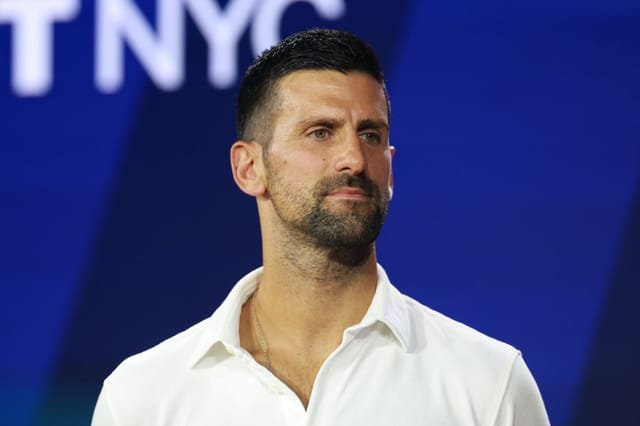
Novak Djokovic has spent more than two decades making the impossible look routine on a Tennis court, but a recent claim from sports content creator Francis Ellis has given fans a very different kind of Djokovic conversation.
Ellis, host of the Son of a Boy Dad podcast, suggested that if he played Djokovic for a full set, he could win at least one point in every game in which he served. The comment came during a discussion about whether tennis or golf is harder to break into and was shared by Barstool Sports on X.
“I think that if I played Novak Djokovic in a full set of tennis, on my serve, I might win one point per game,” Ellis said.
The statement immediately attracted attention because Djokovic is not simply an elite professional. He is one of the most accomplished players in tennis history, with 24 Grand Slam singles titles and a career built around exceptional return skills, defensive movement, anticipation and mental resilience.
That is why the reaction from tennis fans was so strong. Some interpreted Ellis’ statement as obvious content designed to generate engagement, while others appeared genuinely surprised that anyone would believe an amateur could consistently win points against Djokovic.
Why the Novak Djokovic claim shocked tennis fans
The key phrase in Ellis’ statement was “one point per game” on his own serve.
At first glance, that may sound modest. Ellis did not claim that he could defeat Djokovic or even hold serve comfortably. He suggested only that he could win one point during each service game across a full set.
But tennis fans immediately focused on the enormous difference between playing recreational tennis and competing against a player with Djokovic’s level of anticipation, ball striking and return ability.
The difficulty is not merely that Djokovic hits the ball harder than an average player. His greatest advantage is how quickly he processes what is happening on court. He reads positioning, recognizes patterns and can turn defensive situations into attacking opportunities within a few shots.
Against an elite returner, an amateur server would also face a completely different level of pressure. A serve that feels effective during a casual match can become predictable when an opponent has the experience to identify its direction and timing.
Winning one point is not the same as winning a game
There is an important distinction that makes Ellis’ comment more interesting.
Winning one point in a game against Djokovic is technically a much smaller challenge than winning a game. A player could lose a game 15-40, 30-40 or 40-advantage without holding serve.
However, the problem for an inexperienced player is getting even those isolated points consistently.
Djokovic’s return game has historically been one of the defining features of his career. He does not need to hit an outright winner on every return. Instead, he can neutralize the server, extend rallies and force opponents to create something special under pressure.
For an amateur, that pressure can quickly turn a supposedly comfortable service point into a defensive battle.
In other words, Ellis’ statement sounds modest only when viewed through the lens of ordinary tennis. Against Djokovic, even a single point can require an extraordinary sequence of events.
Why Djokovic is such a difficult opponent for an amateur
There are several reasons a match against Djokovic would be dramatically different from playing a strong club-level opponent.
Elite return quality
Djokovic has long been regarded as one of the greatest returners in tennis. His ability to read serves and immediately put the server under pressure means that simply starting a point does not guarantee an amateur any meaningful advantage.
Unusual court coverage
Djokovic’s movement allows him to reach balls that many players would consider winners. His balance and ability to slide into defensive positions give him additional opportunities to extend rallies.
Rally tolerance
An amateur may try to end points quickly because prolonged exchanges against Djokovic would be uncomfortable. But attacking a player of Djokovic’s caliber creates another problem: the margin for error becomes extremely small.
Point construction
Djokovic is not dependent on one spectacular shot. His game is built around patterns. He can move an opponent around the court, identify weaknesses and wait for an opening.
Mental pressure
The psychological side may be the biggest difference. Standing across the net from a 24-time Grand Slam champion is not the same as playing a friend or recreational opponent. Every mistake becomes more noticeable, and hesitation can affect shot selection.
Tennis fans were quick to challenge Francis Ellis
Ellis’ comment generated a wide range of reactions online.
Some fans suggested that he may have been deliberately exaggerating his ability to create a viral moment. Others argued that the statement was simply unrealistic unless Ellis had an unusually high level of competitive tennis experience.
One response called the belief “embarrassing” if Ellis genuinely meant it, while another described the take as “insane.” Other fans focused on the wording and noted that Ellis used the phrase “I might,” giving himself some room for uncertainty.
That distinction is worth remembering. Ellis did not confidently predict that he would win a point every service game. He said he might do so.
Still, the reaction shows how strongly tennis fans view the gap between professional and amateur competition. In many sports, spectators can imagine occasionally getting a touch or scoring a point against a professional. Tennis is different because the contest is so directly dependent on individual technique.
The hidden difficulty of playing against a professional tennis player
One reason these hypothetical matchups are often misunderstood is that professional tennis is difficult to appreciate from television alone.
Viewers can see the speed of a serve and the direction of a forehand, but they cannot fully experience the weight of the ball, the amount of spin, the speed of recovery or the precision required to repeatedly hit within the lines.
A professional’s consistency can also be deceptive.
When Djokovic sends a ball back deep into the court repeatedly, it can look ordinary on television. For an opponent, however, dealing with that ball over and over can be exhausting. The margin becomes smaller with every exchange.
That is one reason elite players can make experienced opponents look surprisingly ordinary. Their skill is not always expressed through spectacular winners. Often, it appears through the absence of mistakes and the ability to make difficult shots seem routine.
Could Ellis actually win a point?
Technically, yes. Tennis contains enough randomness and variation that predicting an absolute zero-point result in a single set is difficult without knowing the exact circumstances.
A net cord, a mishit, an unusual bounce or an unforced error could theoretically give an amateur a point.
But that is different from believing that an amateur could reliably manufacture one point per service game against Djokovic.
The more realistic question is whether Ellis could create a point through his own shot-making rather than waiting for Djokovic to make an error. That is where the challenge becomes dramatically larger.
Against a player of Djokovic’s quality, the amateur would need to execute serves, groundstrokes and movement patterns with extraordinary precision while simultaneously dealing with pressure from the other side of the net.
Djokovic himself is trying to rethink traditional tennis
Interestingly, the viral Ellis debate comes at a time when Djokovic himself has been challenging traditional assumptions about how tennis should be played.
The Serbian recently proposed significant changes to the scoring format, suggesting that sets should be played to four games instead of six and that the advantage rule at 40-40 could be removed.
Djokovic suggested that matches could consist of three shortened sets and argued that the format could help keep matches within roughly two hours.
His proposal generated a different type of debate because it concerned the structure of professional tennis rather than the ability of an amateur to compete against him.
Why Djokovic wants shorter tennis matches
Djokovic’s proposed changes reflect an ongoing discussion about the future of professional tennis.
Traditional Grand Slam tennis can produce matches lasting several hours, especially when players are evenly matched. While long matches can create unforgettable sporting moments, they can also create challenges for scheduling, television audiences, players and younger fans.
A shorter format could make matches easier to consume and potentially reduce physical demands.
But there is a trade-off.
Long matches are also part of tennis’ identity. Five-set battles have produced some of the sport’s most famous moments, and reducing the number of games could fundamentally change how momentum, endurance and strategy influence a match.
Not everyone agrees with Djokovic’s proposed rule changes
Djokovic’s ideas have not received universal support.
Former world No. 1 Kim Clijsters and Portuguese rising star Joao Fonseca were among those who expressed opposition to the concept, while American player Ben Shelton offered a more measured response and pointed toward the practical difficulty of implementing such major changes.
The disagreement highlights a larger tension within tennis.
Players and administrators increasingly want the sport to become more accessible and efficient, but fans also want to preserve the characteristics that make tennis unique.
That tension is likely to continue as the sport searches for ways to attract younger audiences without sacrificing its history.
What Djokovic’s return means for the Cincinnati Open
On the competitive side, Djokovic is preparing to return to action in Cincinnati after reaching the Wimbledon semifinals.
His withdrawal from the Canadian Open meant fans had to wait longer for his next tournament appearance, making his Cincinnati return particularly significant as the hard-court season progresses toward the US Open.
At this stage of Djokovic’s career, every tournament carries additional interest. The Serbian has already achieved virtually everything possible in men’s tennis, so the question is no longer whether he can establish himself as an all-time great.
That part of the discussion is settled.
The intrigue now centers on how long he can continue competing at the highest level and whether he can add more major titles to his record.
Why the Ellis debate says more about Djokovic than Ellis
The funniest part of the viral discussion may be that the controversy ultimately reinforces Djokovic’s reputation.
Fans were not shocked because Ellis suggested he could beat Djokovic. He did not. They were shocked because even winning one point per service game is viewed as an ambitious target against a player of Djokovic’s caliber.
That reaction illustrates the extraordinary gap between an elite professional and an ordinary player.
It also shows why hypothetical professional-versus-amateur debates are so popular online. They give fans a way to imagine what would happen if the invisible boundary between professional sport and everyday competition disappeared for one match.
Comparison: What makes Djokovic different?
| Area | Elite professional like Djokovic | Typical recreational player |
|---|---|---|
| Serve return | Reads pace, direction and spin at an elite level | Usually reacts rather than anticipates |
| Movement | Exceptional recovery and court coverage | More limited positioning and recovery |
| Consistency | Can sustain high-level execution under pressure | Higher error rate during long rallies |
| Point construction | Uses patterns to create openings | Often relies on individual shots |
| Mental pressure | Extensive experience in elite competition | Little or no experience against top professionals |
What happens next for Novak Djokovic?
Djokovic’s immediate focus will be competitive rather than social-media controversy. His return in Cincinnati provides another opportunity to assess his form ahead of the US Open.
The larger question is whether he can continue to compete consistently against a younger generation that includes players such as Jannik Sinner, Carlos Alcaraz and other emerging stars.
His proposed scoring changes also suggest that Djokovic is thinking about the future of tennis beyond his own playing career. Whether those ideas ever become part of the official rules remains uncertain, but the debate itself reflects the sport’s willingness to reconsider long-established traditions.
Conclusion: The viral Novak Djokovic claim highlights an enormous skill gap
Francis Ellis’ claim that he might win one point per service game against Novak Djokovic has gone viral because tennis fans understand just how enormous the gap is between recreational tennis and the highest level of professional competition.
Ellis did not claim he could defeat Djokovic, and his use of “might” leaves plenty of room for interpretation. But the reaction demonstrates how difficult even a single successful point can be against a player with Djokovic’s return ability, movement, consistency and experience.
At the same time, Djokovic is generating serious discussion of his own by proposing changes that could fundamentally alter the traditional scoring structure of tennis.
That combination makes the current Djokovic conversation particularly interesting. One debate asks whether an ordinary player could survive a few points against him, while another asks how the sport itself should evolve.
For now, the answer to the first question remains the subject of online jokes. The second could become a genuine discussion about tennis’ future.
For breaking news and live news updates, like us on Facebook or follow us on Twitter and Instagram. Read more on Latest Sports on thefoxdaily.com.




COMMENTS 0