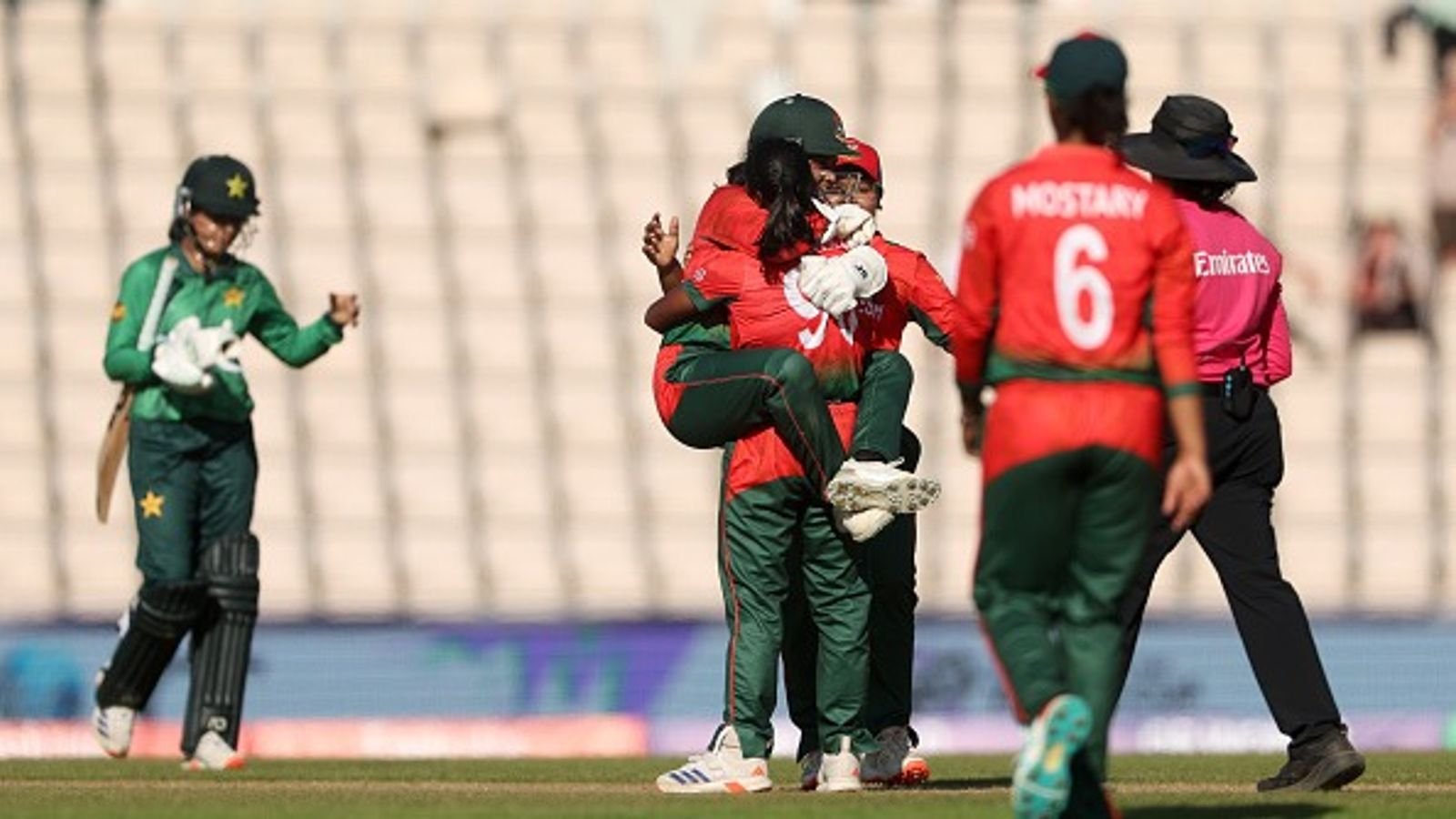
Pakistan’s campaign at the Women’s T20 World Cup 2026 is on the brink of collapse after suffering a shocking 23-run defeat against Bangladesh in a match they appeared destined to win. Chasing a modest target of 124, Pakistan found themselves cruising at 70/2 and firmly in control before producing one of the most dramatic batting collapses of the tournament.
The defeat not only damaged Pakistan’s chances of reaching the semifinals but also exposed recurring issues that have troubled the side in major ICC events. While qualification remains mathematically possible, their fate is now largely dependent on results elsewhere, leaving them with little control over their own destiny.
For Bangladesh, however, the victory represents far more than just two points. It showcased resilience, tactical discipline, and the growing maturity of a team determined to challenge established powers in women’s cricket.
A Match That Changed in Two Dramatic Phases
The contest can effectively be divided into two distinct halves. The first belonged to Pakistan’s bowlers, who dominated Bangladesh early and appeared to have restricted them to a below-par total. The second belonged entirely to Bangladesh’s bowlers, who produced a masterclass in pressure bowling to script an unforgettable turnaround.
Few matches in recent Women’s T20 World Cup history have witnessed such a dramatic shift in momentum.
Bangladesh Recover From Early Disaster
After winning the toss and choosing to bat, Bangladesh endured a nightmare start. Pakistan captain Fatima Sana struck twice in the opening over, removing key batters and immediately placing Bangladesh under immense pressure.
When another wicket fell shortly afterward, Bangladesh were struggling at 13/3 and staring at the possibility of being bowled out for a very low total.
At that moment, the focus shifted from acceleration to survival.
Captain Nigar Sultana Joty played a crucial leadership role, anchoring the innings and preventing a complete collapse. Her composed approach allowed Bangladesh to rebuild while preserving wickets for the later stages of the innings.
Supporting contributions from the middle order ensured Bangladesh remained competitive despite Pakistan maintaining pressure throughout most of the innings.
Shorna Akter’s Late Blitz Proved Decisive
While Bangladesh’s recovery was important, the innings truly gained momentum during the closing overs.
Shorna Akter delivered a game-changing cameo that ultimately separated the two teams. Her unbeaten knock transformed what looked like an underwhelming total into a genuinely competitive target.
The aggressive finish provided several benefits:
- Boosted Bangladesh’s confidence heading into the innings break
- Placed additional scoreboard pressure on Pakistan
- Allowed bowlers more flexibility with field placements
- Shifted momentum after Pakistan’s dominant start
- Created a psychological advantage before the chase began
In T20 cricket, even an additional 15 to 20 runs can significantly alter the complexion of a match. Bangladesh’s late surge proved exactly why finishing strongly remains one of the most valuable skills in the format.
Pakistan’s Chase Started Perfectly
When Pakistan began their pursuit of 124, there appeared little reason for concern. The target was manageable, the required run rate remained under control, and the top order looked comfortable against Bangladesh’s bowling attack.
Early contributions from the opening batters ensured Pakistan stayed ahead of the game. The batting unit displayed patience without sacrificing scoring opportunities, steadily moving toward what seemed an inevitable victory.
By the halfway stage of the innings, Pakistan required only a routine finish to secure a vital win.
At 70/2 after 11 overs, most observers would have expected Pakistan to complete the chase comfortably.
The Collapse That Could Define Pakistan’s Tournament
Cricket matches often turn on a single wicket, and Pakistan experienced precisely that scenario.
The dismissal of Muneeba Ali dramatically altered the direction of the chase. Until that moment, Pakistan appeared composed and in control. Once she departed, panic began to creep into the innings.
What followed was a collapse that will likely be analyzed extensively by coaches and analysts.
Pakistan lost six wickets while adding only a handful of runs, transforming a winning position into a near-impossible situation. Batters struggled to rotate strike, boundaries became increasingly difficult to find, and pressure mounted with every passing delivery.
The collapse highlighted several concerns:
- Lack of middle-order stability
- Difficulty handling scoreboard pressure
- Limited ability to rebuild after losing wickets
- Overreliance on top-order contributions
- Struggles against disciplined spin bowling
For a team competing at a global tournament, such weaknesses can prove fatal.
Bangladesh’s Spinners Delivered a Tactical Masterclass
While Pakistan’s collapse will dominate headlines, Bangladesh deserve enormous credit for creating the conditions that led to it.
The spin attack executed its plans with exceptional discipline. Rather than chasing wickets through risky deliveries, Bangladesh focused on building pressure through accuracy, intelligent field placements, and consistent control.
The result was a sustained squeeze that slowly strangled Pakistan’s chase.
Bangladesh’s spinners effectively removed scoring options, forcing batters into mistakes. Every dot ball increased pressure, and every wicket intensified the sense of panic within the Pakistani lineup.
Their strategy reflected a growing sophistication within Bangladesh women’s cricket, demonstrating an understanding that T20 matches can be won as much through control as through aggression.
Why This Result Matters Beyond the Points Table
Major tournaments are often remembered for defining moments rather than final standings. This match has the potential to become one of those moments.
For Bangladesh, the victory represents evidence that the gap between traditional cricket powers and emerging nations continues to narrow. Successes like these provide confidence, belief, and valuable tournament experience.
For Pakistan, however, the defeat raises difficult questions.
The team has shown flashes of quality throughout recent international competitions, but consistency remains elusive. Too often, strong positions have been undermined by sudden collapses or periods of poor execution.
Addressing these issues will be essential if Pakistan hopes to become a genuine contender in future ICC events.
The Growing Importance of Mental Strength in T20 Cricket
One of the most overlooked aspects of modern T20 cricket is the role of mental resilience.
Technical skills remain important, but the shortest format increasingly rewards teams that can handle pressure during critical moments. Bangladesh demonstrated this quality brilliantly.
After falling to 13/3, many teams would have continued losing wickets and struggled to post a competitive total. Instead, Bangladesh remained calm, trusted their process, and gradually rebuilt the innings.
Pakistan experienced the opposite trajectory. They controlled the chase for more than half the innings but struggled once momentum shifted against them.
This contrast ultimately decided the match.
Women’s T20 World Cup 2026: What This Means for the Semifinal Race
| Team | Impact of Result |
|---|---|
| Bangladesh | Major boost to semifinal ambitions and confidence |
| Pakistan | Qualification hopes now depend heavily on other results |
| India | Position strengthened as group dynamics shift |
| South Africa | Opportunity to capitalize on Pakistan’s setback |
The result significantly reshapes the group standings and increases pressure on every remaining fixture. Teams can no longer afford mistakes as the race for semifinal qualification intensifies.
What Pakistan Must Learn From This Defeat
While the loss is painful, it also presents valuable lessons.
Successful teams often emerge stronger after confronting uncomfortable truths. Pakistan’s coaching staff will likely focus on strengthening the middle order, improving game management, and developing greater resilience under pressure.
The tournament may still offer opportunities, but future success will require addressing the weaknesses exposed by Bangladesh.
Bangladesh’s Victory Signals a New Era of Competitiveness
Women’s cricket continues to evolve rapidly, and Bangladesh’s performance serves as another reminder that established hierarchies are becoming increasingly fragile.
Their victory was not built on individual brilliance alone. It was the result of collective effort, strategic discipline, and unwavering belief even after a disastrous start.
Such performances are often the foundation upon which successful tournament campaigns are built.
Conclusion: A Collapse That Could Change the Course of the Tournament
Pakistan entered the chase needing 124 runs and appeared firmly on course for victory. Yet within the span of a few overs, the match transformed into one of the most surprising results of the Women’s T20 World Cup 2026.
Bangladesh demonstrated resilience when under pressure, composure when rebuilding, and ruthless efficiency when defending their total. Pakistan, by contrast, failed to capitalize on a winning position and now face the possibility of an early tournament exit.
As the competition moves toward its decisive phase, this result could be remembered as a turning point. For Bangladesh, it may mark the beginning of a breakthrough campaign. For Pakistan, it could become the moment that defined a tournament filled with missed opportunities.
Either way, the match delivered a powerful reminder of why T20 cricket remains one of the most unpredictable and captivating formats in world sport.
For breaking news and live news updates, like us on Facebook or follow us on Twitter and Instagram. Read more on Latest Sports on thefoxdaily.com.






COMMENTS 0