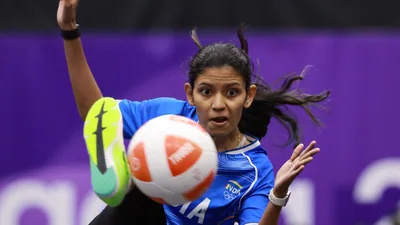
Quimcy DSouza came within touching distance of an Asian Games medal in teqball, capping a remarkable journey from an interrupted football dream to becoming one of India’s leading players in the emerging sport.
The 24-year-old Bengaluru-based Decathlon test engineer narrowly missed out on a podium finish at the Nagoya City Higashi Sports Center, but her run highlighted both the growth of teqball in India and her own resilience after an injury ended her football ambitions.
Quimcy DSouza’s Asian Games Teqball Run
Quimcy DSouza entered the Asian Games 2026 competition with an opportunity to create a significant moment for Indian teqball. A seven-time national champion, she has been part of a small group of athletes helping establish the sport in the country.
Her individual campaign began impressively. Quimcy defeated Japan’s top seed Yuina Sakamoto before overcoming Cambodia’s Koemyean Dy in straight sets. Those victories helped her finish at the top of her group and secure direct passage to the semifinals.
However, the semifinal stage brought a setback. Quimcy lost to Indonesia’s Sumaya on Saturday, sending her into the bronze medal playoff and leaving her one victory away from a podium place.
Her bronze medal opponent was familiar. Quimcy once again faced Japan’s Sakamoto, whom she had already defeated earlier in the competition.
This time, however, the Japanese player managed to reverse the result. Quimcy was unable to beat Sakamoto for a second time, ending her hopes of securing India’s first teqball medal at the event.
Mixed Doubles Adds Another Challenge
Quimcy’s Asian Games campaign did not end with the singles-style competition. She also competed in mixed doubles alongside Mohamed Anas Imran Beg.
The match brought another difficult moment as Quimcy picked up an injury. She and Beg eventually finished on the losing side, bringing an emotionally demanding campaign to a close.
Although she did not leave with a medal, Quimcy’s performances demonstrated her ability to compete against established players from countries where teqball has developed more significantly.
How Quimcy DSouza Found Teqball
Quimcy’s path to the Asian Games was not originally supposed to involve teqball. Born in Mumbai, she first pursued athletics before moving into football.
She competed as a middle-distance runner and later represented Maharashtra at the Under-19 football level. Football eventually became her main sporting ambition, with the dream of representing India at the international level.
That ambition was interrupted by a ligament injury. During her recovery in 2022, Quimcy was looking for a way to remain connected to sport and continue pursuing her competitive ambitions.
Her introduction to teqball came unexpectedly through Instagram videos featuring Brazilian football legend Ronaldinho.
Seeing Ronaldinho play the sport immediately caught her attention. What began as curiosity eventually developed into a new sporting career and ultimately took her to the Asian Games.
From Football Injury to a New Sporting Opportunity
Quimcy’s story is closely connected to the way teqball combines elements of football with the precision and structure associated with table tennis.
Her football background provided a natural foundation for the sport. Ball control, movement, speed and coordination are important in teqball, allowing her previous experience to become an advantage rather than something left behind.
The injury that disrupted her football ambitions therefore became a turning point. Instead of abandoning competitive sport, Quimcy discovered an emerging discipline that offered another route toward representing India.
Her progress also shows how athletes can sometimes find unexpected opportunities after an initial sporting path is interrupted.
Who Is Quimcy DSouza?
Quimcy is a Bengaluru-based test engineer working with Decathlon while competing in teqball. Balancing professional responsibilities with elite sport has been an important part of her journey.
She belongs to a relatively small group of first-generation competitive Indian teqball players. Because the sport is still developing in India, athletes such as Quimcy have often had to contribute beyond simply competing.
She founded the Teqball Club of Bangalore and has been involved in building awareness and a community around the sport. Many Indian players are largely self-taught, making the development of local knowledge and training opportunities particularly important.
Her seven national titles underline her position within Indian teqball and provide context for why her Asian Games campaign carried significant expectations.
What Is Teqball?
Teqball is a football-based sport played on a specially designed curved table. It combines football skills with elements associated with table tennis and requires players to control and return the ball using permitted parts of the body.
The table resembles a table-tennis table but has a distinctive curved playing surface. A solid net runs across the centre, and the shape of the table influences how the ball rebounds.
Players cannot use their hands, while physical contact with the table or opponent is not allowed. The rules place a strong emphasis on touch, timing, ball control and movement.
The unusual equipment is one of the most recognizable features of teqball. The curved surface was designed to create predictable ball movement while still demanding considerable technical ability from players.
The Origins of Teqball
The concept of teqball originated in Hungary and was developed in the early 2010s by former Hungarian footballer Gabor Borsanyi, computer scientist Viktor Huszar and businessman Gyorgy Gattyan.
Borsanyi had grown up playing football on concrete table-tennis tables in Ujpest. The flat surface did not produce the kind of rebound he wanted, helping inspire the idea of a specially shaped playing table.
The group began developing the sport in 2012. Creating the curved table involved extensive testing because the equipment needed to provide a consistent ball rebound while remaining practical to manufacture, transport and assemble.
The result was a sport built around football technique but played in a format that requires players to anticipate unusual ball trajectories.
Ronaldinho Helped Put Teqball on the Map
Ronaldinho played an important role in introducing teqball to a much wider audience. In 2016, the Brazilian football icon appeared at an event in Budapest and demonstrated the sport on its distinctive curved table.
His involvement helped bring attention to a sport that was still relatively unfamiliar to global football audiences.
For Quimcy, however, Ronaldinho’s influence was more personal. She discovered teqball years later through social media videos of the football legend playing it.
That chance encounter eventually changed the direction of her sporting career.
Why Quimcy’s Football Background Matters
Teqball requires players to demonstrate many of the technical qualities associated with football. Accurate touches, controlled movement and the ability to predict the ball’s trajectory can all make a difference.
Quimcy’s experience in football therefore gave her a useful foundation when she transitioned into teqball.
Her speed and ball-control skills helped her adapt to a sport that demands precision while offering very little room for mistakes. Her previous experience also meant she was already comfortable reading the movement of a football.
That combination helped Quimcy develop into one of India’s strongest teqball competitors.
India’s Growing Teqball Community
Quimcy’s journey also reflects the early stages of teqball’s development in India. Unlike established Olympic and Asian Games sports with large domestic systems, Indian teqball is still building its competitive structure.
First-generation players have played an important role in this process. Alongside training and competing, athletes have had to help introduce the sport to new players, establish clubs and build awareness.
Quimcy’s work with the Teqball Club of Bangalore is an example of that wider contribution.
Her Asian Games appearance could also provide greater visibility for the sport among Indian sports fans, particularly those who are already familiar with football but have never encountered teqball.
A Medal Miss, But a Significant Milestone
Missing the bronze medal after reaching the playoff stage will naturally make the result difficult to accept, particularly after Quimcy had already defeated Sakamoto earlier in the competition.
However, her overall journey remains significant. She entered teqball after an injury disrupted her football ambitions, developed into a seven-time national champion and then competed at the Asian Games against leading international players.
The experience also provides a foundation for future international competitions. At 24, Quimcy still has time to continue developing her game and contribute to the growth of teqball in India.
What Comes Next for Quimcy DSouza?
The immediate disappointment of missing the podium will likely remain part of Quimcy’s Asian Games experience, but the campaign also gives her valuable international exposure.
Her performances against Japan’s top seed and Cambodia’s Koemyean Dy demonstrated that she can compete at a high level. The bronze medal defeat showed how fine the margins can be at the latter stages of an international tournament.
Her mixed doubles experience, including the injury she suffered during the match with Mohamed Anas Imran Beg, adds another lesson to a demanding competition.
For Indian teqball, having an athlete with Quimcy’s competitive experience and commitment could also be valuable as more players discover the sport.
Final Verdict
Quimcy DSouza’s Asian Games 2026 campaign ended just short of a medal, but her story is bigger than the final result. The Mumbai-born athlete moved from athletics to football, saw her football ambitions interrupted by injury and then found a new sporting opportunity through teqball.
Her introduction to the sport through Ronaldinho videos on Instagram eventually led to seven national titles, the creation of the Teqball Club of Bangalore and an Asian Games appearance.
Although she lost the bronze medal playoff to Japan’s Yuina Sakamoto and later suffered an injury during the mixed doubles event, Quimcy’s journey represents an important chapter in the development of Indian teqball.
The podium may have eluded her in Nagoya, but the experience has given Quimcy another international milestone to build on. For a sport still establishing itself in India, her journey could also help introduce teqball to a much wider audience.
For breaking news and live news updates, like us on Facebook or follow us on Twitter and Instagram. Read more on Latest Sports on thefoxdaily.com.






COMMENTS 0