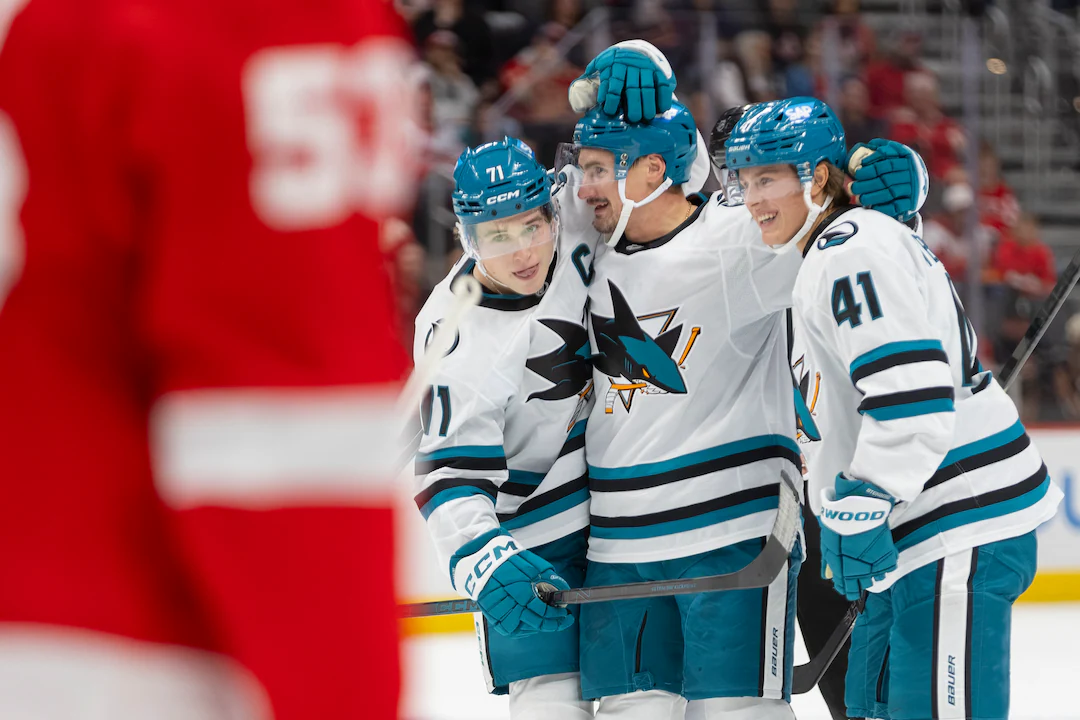
The Detroit Red Wings produced a dramatic late comeback to defeat the San Jose Sharks 4-3 in a shootout on Saturday, October 17, after Lucas Raymond delivered the decisive goal in the tiebreaker. Alex DeBrincat scored with just 1:33 remaining in regulation to force overtime, rescuing Detroit after the Sharks had built a two-goal lead in the third period.
The hard-fought victory showcased Detroit’s resilience, as the Red Wings refused to surrender despite trailing 3-1 late in the contest. Justin Faulk and Emmitt Finnie also scored in regulation, while goaltender John Gibson made 31 saves to keep Detroit within reach throughout the game.
San Jose had several standout performers of its own. Rising star Macklin Celebrini recorded a goal and two assists, while Dmitry Orlov and Ivar Stenberg scored power-play goals. Alex Nedeljkovic stopped 24 shots, but the Sharks could not protect their advantage as Detroit mounted its late comeback before winning the shootout.
The result highlighted the importance of persistence in a closely contested NHL matchup. Detroit faced a difficult situation after conceding twice in the opening two periods and falling further behind early in the third, but a timely response from Finnie and DeBrincat changed the momentum before Raymond sealed the victory.
Justin Faulk Opens the Scoring for Detroit
The Red Wings struck first during the opening period, taking advantage of their first power-play opportunity with 7:15 remaining. With San Jose forward Mason Marchment serving an interference penalty, Detroit moved the puck into position for defenseman Justin Faulk to unleash a shot from just inside the blue line.
Faulk’s attempt deflected off a defender’s skate and slipped past Sharks goaltender Alex Nedeljkovic, giving Detroit a 1-0 lead. Emmitt Finnie and Michael Rasmussen received assists on the goal, which rewarded the Red Wings for applying pressure during the man advantage.
The opening goal gave Detroit an early opportunity to dictate the tempo. Scoring first can be particularly valuable in a game between teams capable of generating offense through their power plays, as it allows the leading side to manage its approach while forcing the opponent to respond.
However, San Jose did not take long to answer. The Sharks continued pressing and eventually earned a power-play opportunity of their own, setting the stage for the first of several momentum shifts during the contest.
Dmitry Orlov Levels the Game on the Power Play
San Jose equalized with 2:01 remaining in the first period after Detroit defenseman Ben Chiarot was sent to the penalty box for holding. The Sharks used the extra skater effectively, with Dmitry Orlov scoring on a shot from the point to make it 1-1.
Ivar Stenberg and Macklin Celebrini collected the assists, contributing to a well-executed power-play sequence that erased Detroit’s early advantage.
Orlov’s goal demonstrated San Jose’s ability to capitalize on special-teams opportunities. After conceding the opening goal while shorthanded, the Sharks responded by converting their second power play of the period.
The equalizer also restored balance heading into the first intermission. Neither team had managed to establish sustained control, and both sides had already shown that their power plays could influence the outcome.
Detroit had taken the lead through Faulk, but San Jose’s response ensured that the contest remained wide open. The first period ended with the score tied at 1-1, setting up an increasingly competitive battle in the middle frame.
Macklin Celebrini Gives the Sharks the Lead
The Sharks moved ahead early in the second period after capitalizing on a costly Detroit turnover. At 4:55, Red Wings defenseman William Wallinder lost possession in his own zone, giving San Jose an opportunity to attack in a dangerous area.
Celebrini took advantage, scoring his third goal with a slapshot from the slot to put the Sharks ahead 2-1. Will Smith and Michael Kesselring provided the assists on the play.
The goal underlined Celebrini’s growing importance to San Jose’s offense. The young forward demonstrated his ability to recognize a scoring opportunity and finish quickly when the opposition made a mistake.
Celebrini was influential throughout the game, finishing with one goal and two assists. His contribution helped San Jose generate offense in both even-strength situations and on the power play, making him one of the Sharks’ most dangerous players.
For Detroit, the turnover was a reminder of how quickly defensive mistakes can change the course of a game. The Red Wings had started strongly and scored first, but losing possession in their own zone allowed San Jose to seize the advantage.
Both teams subsequently killed off a pair of penalties later in the second period, preventing either side from adding another goal before the intermission. San Jose carried its 2-1 lead into the final period, leaving Detroit with work to do.
Ivar Stenberg Extends San Jose’s Lead in the Third Period
San Jose strengthened its position early in the third period when Stenberg scored to make it 3-1. The goal arrived at 2:48, with Detroit defenseman Andreas Englund serving a tripping penalty.
Stenberg finished from in front of the net after receiving a feed from Alexander Wennberg. Celebrini recorded the secondary assist, adding to his already impressive offensive contribution.
The power-play goal appeared to put the Sharks in control. With a two-goal advantage and much of the third period remaining, San Jose had an opportunity to protect its lead and move closer to victory.
Stenberg’s finish also gave the Sharks a second power-play goal, highlighting their effectiveness with the man advantage. Orlov had scored earlier in the game, and the second conversion further increased the pressure on Detroit.
However, the Red Wings responded quickly. Rather than allowing the deficit to grow, Detroit found a way to score just over two minutes later and begin its comeback.
Emmitt Finnie Sparks Detroit’s Comeback
Detroit cut the deficit to 3-2 when Finnie scored just over two minutes after Stenberg’s third-period goal. The young forward tapped the puck into the net following a shot attempt by Michael Brandsegg-Nygard, giving the Red Wings renewed hope.
The goal proved important because it reduced San Jose’s advantage to a single goal and shifted some of the pressure back onto the Sharks. Detroit now needed only one more goal to draw level, while San Jose had to prevent the home side from building further momentum.
Finnie had already contributed an assist on Faulk’s opening goal, making his performance particularly valuable to Detroit. His third-period finish demonstrated his ability to make an impact at an important moment and helped keep the Red Wings in contention.
Detroit continued searching for an equalizer, increasing its urgency as the clock moved toward the final minutes. The Red Wings had already shown that they could generate scoring opportunities, but they needed one more successful attack to avoid defeat in regulation.
San Jose attempted to protect its narrow advantage, but Detroit’s pressure eventually produced the decisive late opportunity. With time running out, the Red Wings made a bold move that paid off.
Alex DeBrincat Forces Overtime With a Late Equalizer
With just 1:33 remaining in regulation, DeBrincat scored to tie the game at 3-3 and send the contest into overtime. Detroit had pulled Gibson from the net to add an extra skater, committing additional players to the attack in search of a last-minute goal.
The strategy proved successful. DeBrincat redirected the puck into the net, finishing a play created by Viktor Arvidsson and Moritz Seider. The goal completed Detroit’s comeback from a two-goal deficit and sent the home crowd into celebration.
DeBrincat’s equalizer was the defining moment of regulation. With San Jose leading 3-2 and less than two minutes remaining, the Sharks appeared close to securing the win. Instead, Detroit’s extra-attacker strategy created the opportunity needed to extend the game.
The goal also rewarded the Red Wings for maintaining their attacking pressure despite facing a difficult situation. Rather than settling for the possibility of a narrow defeat, Detroit continued to push forward and was rewarded with a crucial finish.
For San Jose, the late concession was a painful setback. The Sharks had held a two-goal advantage in the third period and were just minutes away from victory, but they could not prevent DeBrincat from finding the equalizer.
His goal ensured that both teams earned at least a point from the game and set up an overtime period in which one mistake could prove decisive.
Detroit Survives Overtime Penalty Before Winning Shootout
Overtime offered both teams another opportunity to secure the victory, but neither could find the winning goal during the extra period. Detroit also had to overcome a difficult moment when Andrew Copp was penalized, forcing the Red Wings to kill off a penalty before the game could proceed to a shootout.
Successfully defending that situation was important for Detroit. A late penalty in overtime can quickly end a game, particularly when the opposing team has an additional skater and space to create scoring opportunities.
The Red Wings remained organized, prevented San Jose from converting the advantage and preserved the 3-3 score. Their penalty kill helped ensure that the comeback would not be undone before the shootout.
With neither team able to break the deadlock in overtime, the game moved to a shootout to determine the winner. After an entertaining contest featuring several lead changes and a dramatic late equalizer, the result came down to individual execution.
Detroit delivered when it mattered most. Lucas Raymond scored the only goal of the shootout, giving the Red Wings a 4-3 victory and completing their comeback.
Raymond’s decisive effort capped a resilient team performance. Detroit had recovered from a 3-1 deficit, survived an overtime penalty and then found the finish needed to claim the extra point.
John Gibson’s 31 Saves Help Keep Detroit Alive
While Detroit’s comeback was powered by timely goals, Gibson played a significant role in keeping the Red Wings within reach. The goaltender made 31 saves against San Jose, helping his team withstand sustained pressure throughout the contest.
Gibson faced several dangerous opportunities, including San Jose’s power-play attacks and Celebrini’s scoring chance from the slot. Although he conceded three goals during regulation, his saves helped prevent the deficit from becoming too large for Detroit to overcome.
His performance became especially valuable as the Red Wings attempted to mount their late comeback. A team cannot realistically recover from a multi-goal deficit if its goaltender continues to concede, and Gibson’s work gave Detroit the opportunity to remain competitive.
Pulling Gibson for an extra attacker in the closing stages was a calculated risk. Detroit temporarily left its net empty in exchange for an additional offensive player, hoping that the extra pressure would produce an equalizer.
DeBrincat’s late goal justified that decision, while Gibson’s earlier saves had helped keep the game close enough for the strategy to work.
San Jose’s Nedeljkovic also produced a solid performance, finishing with 24 saves. However, the Sharks’ inability to protect their third-period lead meant his efforts were not enough to secure the victory.
Macklin Celebrini Leads the Sharks’ Offensive Effort
Despite the defeat, Celebrini was one of the game’s most productive players. The San Jose forward recorded a goal and two assists, contributing directly to the Sharks’ offensive success and helping create scoring opportunities throughout the contest.
His assist on Orlov’s first-period power-play goal helped San Jose level the score, while his second-period strike gave the Sharks a 2-1 advantage. He later collected another assist on Stenberg’s third-period goal, extending the lead to 3-1.
Celebrini’s performance showed how influential he can be when San Jose creates opportunities in dangerous areas. He combined accurate passing with a willingness to shoot, making him a central figure in the Sharks’ offensive approach.
However, individual production could not compensate for the team’s late defensive difficulties. San Jose scored three times and held a two-goal lead in the third period, but the Sharks failed to close out the game after Detroit increased its attacking pressure.
The defeat will likely leave the team focusing on how it managed the final minutes. Preventing DeBrincat’s equalizer would have allowed San Jose to avoid overtime and potentially claim the win in regulation.
Instead, the Sharks left Detroit with a single point after losing the shootout, while the Red Wings secured the extra point through Raymond’s decisive goal.
Key Takeaways From the Red Wings’ Shootout Victory
Detroit’s 4-3 win offered several important lessons about resilience, special teams and the importance of maintaining concentration late in a game.
- Detroit refused to give up: The Red Wings recovered from a 3-1 deficit in the third period, demonstrating persistence when the game appeared to be slipping away.
- DeBrincat delivered under pressure: His equalizer with 1:33 remaining forced overtime and gave Detroit another chance to win.
- Raymond decided the shootout: The forward scored the only shootout goal to complete the comeback and secure the victory.
- Special teams shaped the contest: Faulk scored on Detroit’s first power play, while Orlov and Stenberg converted for San Jose.
- Gibson made crucial saves: His 31-save performance helped Detroit remain within reach before the late rally.
- San Jose must protect leads: The Sharks were unable to preserve a two-goal advantage in the third period, allowing Detroit to force overtime.
The game demonstrated that a strong start and multiple scoring contributions do not guarantee victory. Teams must maintain defensive discipline until the final whistle, especially when facing an opponent capable of generating late pressure.
Conclusion: Red Wings Complete Dramatic Comeback Against Sharks
The Detroit Red Wings secured a thrilling 4-3 shootout victory over the San Jose Sharks on Saturday after overcoming a two-goal deficit in the third period. Lucas Raymond scored the decisive shootout goal, while DeBrincat’s late equalizer forced overtime and kept Detroit’s hopes alive.
Faulk and Finnie also scored in regulation, and Gibson’s 31 saves provided an important foundation for the comeback. Celebrini led San Jose with a goal and two assists, while Orlov and Stenberg scored power-play goals. Nedeljkovic made 24 saves, but the Sharks could not protect their advantage.
Detroit’s ability to recover from 3-1 down highlighted the team’s resilience and determination. The Red Wings continued pressing, capitalized on a late opportunity with an extra attacker and successfully killed off a penalty in overtime before winning the shootout.
For San Jose, the result will be frustrating after holding a two-goal lead early in the third period. The Sharks showed their offensive potential but will need to improve their defensive execution in the closing stages of games.
Ultimately, Raymond’s shootout finish gave Detroit the final say in an entertaining matchup. The Red Wings turned what could have been a damaging defeat into a memorable comeback victory, proving that persistence and timely execution can make the difference when a game hangs in the balance.
For breaking news and live news updates, like us on Facebook or follow us on Twitter and Instagram. Read more on Latest NHL on thefoxdaily.com.






COMMENTS 0