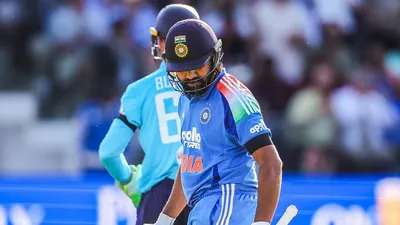
Few cricketers understand pressure quite like Rohit Sharma. Across a career spanning nearly two decades, the Indian opener has faced scrutiny over form, fitness, leadership, and longevity. Yet time and again, he has responded in the way great players often do—with runs.
His century in the third ODI against England at Lord’s was not merely a personal achievement. It arrived at a moment when questions about his future had reached unprecedented levels. Reports suggesting uncertainty about his place in India’s long-term ODI plans dominated cricket discussions before the match. By the end of the day, however, the narrative had shifted dramatically.
Former India head coach Ravi Shastri summed up the mood perfectly when he declared that Rohit Sharma had “shut everybody up.” While India ultimately lost the match and the series, Rohit’s innings ensured that debates about his future would become significantly more complicated for selectors and team management.
Why Rohit Sharma’s Lord’s Century Was Bigger Than a Hundred
Not all centuries carry the same weight.
Some are statistical milestones, some are match-winning masterpieces, and others become defining statements. Rohit’s hundred at Lord’s belonged to the third category.
The innings arrived against a backdrop of intense speculation regarding his international future. Questions were being asked about whether India should begin planning for the 2027 ODI World Cup without one of its most successful white-ball players.
Instead of responding through press conferences or social media posts, Rohit chose the traditional route. He let his bat do the talking.
Scoring a century at Lord’s, one of cricket’s most iconic venues, added even greater significance to the performance. For many players, success at Lord’s becomes part of their legacy. For Rohit, it became a reminder that class remains permanent even when doubts emerge.
Ravi Shastri’s Strong Defence of Rohit Sharma
Ravi Shastri has worked closely with Rohit Sharma and understands both his strengths and his mindset better than most observers.
Following the innings, Shastri argued that players of Rohit’s stature should not be forced to repeatedly justify their place through external narratives.
The former India coach emphasized an important point: elite cricketers who have consistently delivered for their country deserve the opportunity to determine the timing of their own exit, provided performances continue to justify selection.
According to Shastri’s view, Rohit remains motivated, competitive, and capable of producing match-defining innings. As long as those conditions remain true, discussions about retirement should not dominate the conversation.
The argument reflects a broader belief in cricket—that proven champions earn the right to be judged primarily on performance rather than speculation.
The Timeline of Rohit Sharma’s Recent Scrutiny
The events leading up to the Lord’s ODI created one of the biggest talking points in Indian cricket.
- Questions emerged regarding India’s long-term ODI planning.
- Reports suggested uncertainty around Rohit’s future.
- Public debate intensified over age and succession planning.
- Critics questioned whether India should move toward younger options.
- Rohit responded with a century under pressure.
This sequence transformed a regular bilateral ODI into one of the most closely watched innings of Rohit’s career.
What Makes Rohit Sharma Different?
One reason discussions about Rohit’s future generate such strong reactions is his unique place in ODI history.
Few players have transformed the format the way Rohit has.
His ability to balance patience early in an innings with explosive stroke-play later has redefined how modern ODI batting can be approached.
Unlike many aggressive openers, Rohit possesses the rare ability to accelerate without appearing rushed. His innings often begin quietly before evolving into dominant displays of controlled aggression.
This skill has allowed him to produce some of the most memorable ODI innings ever played.
The Numbers That Support Shastri’s Argument
While reputation matters, international sport ultimately revolves around performance.
Rohit Sharma’s record provides strong evidence for those who believe he still belongs in India’s ODI setup.
| Achievement | Significance |
|---|---|
| 34 ODI Centuries | Among the highest totals in ODI history |
| Three ODI Double Hundreds | A record unmatched in world cricket |
| 264 ODI Runs in an Innings | Highest individual ODI score ever |
| Multiple ICC Tournament Performances | Consistent success on the biggest stages |
| Captaincy Experience | Leadership across major international events |
These achievements do not guarantee future selection, but they explain why many experts remain cautious about writing off a player of Rohit’s caliber.
Rohit’s Response Reveals His Mindset
Perhaps the most revealing aspect of the situation was Rohit’s own reaction.
Rather than expressing frustration or engaging with speculation, he remained focused on a simple principle: contributing to the team.
His comments reflected a mindset that has defined much of his international career.
External opinions may change from series to series, but Rohit’s approach remains remarkably consistent. He views performance as the only meaningful response to criticism.
This perspective helps explain why he has remained relevant across multiple generations of Indian cricket.
The Selection Dilemma Facing India
India’s selectors now face a fascinating challenge.
Every successful cricket nation eventually reaches a point where difficult decisions must be made regarding experienced players.
The key questions include:
- How should India balance experience and youth?
- When should succession planning begin?
- Can proven performers still contribute at the highest level?
- Should future planning outweigh current performance?
These questions have no simple answers.
The challenge becomes even more complicated when a veteran player produces innings like Rohit’s Lord’s century.
Experience vs Youth: Cricket’s Eternal Debate
The Rohit Sharma discussion reflects a debate that exists in every sport.
Supporters of transition argue that teams must prepare for the future before change becomes unavoidable.
Supporters of experience point out that elite performers often remain effective longer than expected.
History suggests the most successful teams usually avoid extremes. Instead of replacing veterans abruptly, they gradually integrate younger players while retaining experienced match-winners.
This balanced approach often minimizes disruption and maximizes competitiveness.
Why ODI Cricket Still Rewards Experience
Unlike some shorter formats, ODI cricket continues to place enormous value on experience.
The format demands:
- Long-term concentration.
- Adaptation to changing match situations.
- Management of momentum swings.
- Strategic pacing of innings.
- Decision-making under pressure.
These are areas where experienced players often possess significant advantages.
Rohit’s century at Lord’s demonstrated precisely those qualities. The innings was not built purely on power hitting. It was constructed through game awareness, shot selection, and an understanding of when to attack.
What the Century Means for India’s Future Plans
The immediate impact of Rohit’s innings is obvious—it strengthens his position heading into future ODI selections.
However, the long-term implications are equally significant.
Selectors must now evaluate whether recent speculation accurately reflects his current value to the team. A player capable of producing match-defining centuries against quality opposition remains difficult to replace.
The challenge for India will be creating a roadmap that respects both present performance and future planning.
Could This Be a Defining Moment in Rohit’s Final Phase?
Every great sporting career contains moments that alter perception.
For Rohit Sharma, the Lord’s century may become one of those moments.
Instead of being remembered as the series where questions emerged about his future, it may ultimately be remembered as the series where he reminded everyone why he remains one of the finest ODI batters of his generation.
The innings did not answer every question about India’s long-term plans, but it ensured those questions cannot be answered hastily.
Conclusion: Rohit Sharma Has Earned the Right to Control the Narrative
Ravi Shastri’s comments resonate because they reflect a simple reality. Players with Rohit Sharma’s record, experience, and impact deserve to be judged primarily on what they continue to produce on the field.
His century at Lord’s was not merely a response to critics—it was a reminder of the qualities that have made him one of India’s greatest white-ball cricketers.
While the debate about India’s future will continue, Rohit has ensured that any discussion about moving on must be based on cricketing reasons rather than speculation.
For now, the message from Lord’s is clear. Rohit Sharma remains a force in ODI cricket, and as Ravi Shastri suggested, the day he decides he no longer has it in him should be a decision driven by the player himself—not by the noise surrounding him.
For breaking news and live news updates, like us on Facebook or follow us on Twitter and Instagram. Read more on Latest Sports on thefoxdaily.com.






COMMENTS 0