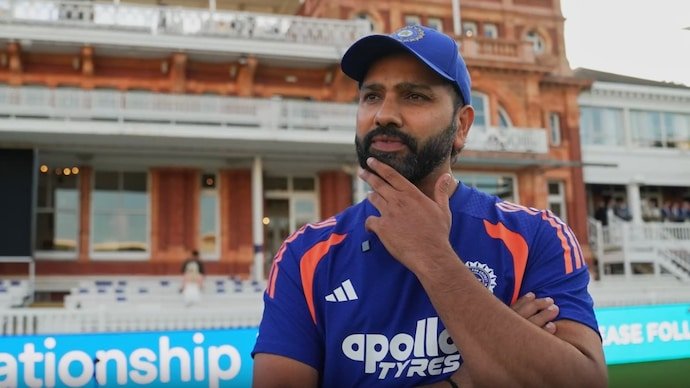
For weeks, discussions surrounding India’s ODI future revolved around one question: should Rohit Sharma continue playing until the 2027 ODI World Cup? The debate intensified after a lean run of scores, concerns over age, and reports suggesting selectors were considering a transition toward younger players.
Then came Lord’s.
Under immense pressure, Rohit Sharma produced one of the most significant innings of his ODI career, smashing a magnificent century against England and becoming the first Indian batter to score an ODI hundred at the iconic venue. It was the kind of innings that great players produce when their careers are being questioned.
Yet despite Rohit’s heroics, India lost the match and the series. More importantly, the defeat exposed several structural weaknesses that could prove far more damaging than the future of one veteran batter.
As India begins preparing for the 2027 ODI World Cup in South Africa, the focus may need to shift away from Rohit Sharma’s age and toward a series of deeper issues that continue to affect the team’s long-term prospects.
Rohit Sharma Delivered When India Needed Him Most
Great players are often judged not by how they perform when everything is going well, but by how they respond when pressure reaches its highest point.
Heading into the Lord’s ODI, Rohit was facing scrutiny from every direction. Questions about retirement, succession planning, form, fitness, and future leadership dominated headlines.
Instead of retreating from the spotlight, he answered with the bat.
His century was more than just another statistical achievement. It was a statement that he remains capable of producing match-defining performances at the highest level.
The innings demonstrated several qualities that have defined Rohit’s career:
- Composure under pressure.
- Ability to absorb early challenges.
- Experience in managing difficult situations.
- Conversion of starts into major scores.
- Leadership through performance.
Most importantly, it proved that India’s ODI struggles cannot simply be blamed on a veteran opener approaching the latter stages of his career.
The Bigger Question: Did India Lose Because of Rohit?
The answer is straightforward: no.
India lost despite Rohit Sharma’s century, not because of it.
When a batter scores a commanding hundred during a high-pressure chase, attention naturally shifts elsewhere for explanations.
At Lord’s, those explanations were impossible to ignore.
England posted a massive total and largely neutralized India’s bowling attack. Even a remarkable innings from Rohit could not compensate for the challenges India faced with the ball.
The result raised an uncomfortable reality: India’s biggest ODI concerns are increasingly linked to squad balance, bowling depth, and selection strategy rather than the future of one senior batter.
India’s Overdependence on Jasprit Bumrah
If one issue emerged clearly from the England series, it was India’s extraordinary dependence on Jasprit Bumrah.
Bumrah remains one of the world’s best fast bowlers, capable of changing matches with both new-ball and death-over spells. However, the gap between India with Bumrah and India without Bumrah continues to look alarming.
When he is available, India’s attack appears balanced, dangerous, and capable of challenging any batting lineup.
When he is absent, the attack often looks vulnerable.
| Area | With Bumrah | Without Bumrah |
|---|---|---|
| New Ball Threat | High | Inconsistent |
| Death Overs | Controlled | Expensive |
| Pressure Creation | Constant | Limited |
| Leadership of Attack | Strong | Uncertain |
| Overall Balance | Stable | Fragile |
No international team can build a World Cup-winning strategy around the assumption that one player will remain available at all times.
The best teams create systems that can survive injuries. India’s ODI setup still appears heavily dependent on Bumrah’s presence.
The Fast-Bowling Depth Problem
Modern ODI cricket demands depth, variety, and adaptability from bowling attacks.
England’s performance at Lord’s highlighted what happens when India’s frontline plans break down.
The attack struggled to apply sustained pressure, contain scoring rates, and take wickets consistently throughout the innings.
This raises a critical question: does India currently have enough reliable ODI bowling options beyond Bumrah?
World Cups are rarely won by teams relying on a single strike bowler. Successful campaigns require multiple match-winners capable of delivering in different conditions.
Building that depth should be one of India’s highest priorities over the next 18 months.
The Mohammed Siraj Debate
One of the most debated selection decisions involves Mohammed Siraj.
Despite being among India’s most experienced fast bowlers and carrying a significant workload across formats, Siraj has found himself increasingly absent from ODI plans.
This has puzzled many observers because his skill set remains well suited to fifty-over cricket.
Siraj offers:
- New-ball movement.
- Experience in overseas conditions.
- Ability to bowl attacking spells.
- Proven international pedigree.
- Big-match experience.
Every team requires clarity regarding its core bowling group. Uncertainty surrounding experienced performers can create unnecessary instability during a World Cup cycle.
The Search for All-Rounders Lacks Clarity
Another concern involves India’s handling of all-rounders.
Modern ODI cricket increasingly rewards teams that possess multiple players capable of contributing with both bat and ball. These players provide flexibility, improve balance, and create tactical advantages.
India appears to be searching for solutions in this area, but the pathway remains unclear.
Several players have been introduced, recalled, or discussed as options. However, there has been little evidence of a consistent long-term plan.
A successful transition strategy generally requires:
- Clearly defined roles.
- Extended opportunities.
- Consistent selection.
- Patience through failures.
- Long-term investment.
Without those elements, succession planning becomes reactive rather than strategic.
What Is India’s Actual World Cup Blueprint?
The strongest international teams typically operate with a clear roadmap.
Players understand where they fit into the system. Selectors understand who is being developed. Fans understand the direction of the project.
At times, India’s ODI planning appears less certain.
Several questions remain unanswered:
- Who are the preferred backup fast bowlers?
- Which all-rounders are central to future plans?
- What is the long-term spin strategy?
- Who forms the leadership core beyond current veterans?
- How much emphasis is being placed on continuity?
Answering these questions may be more important than deciding whether Rohit Sharma plays another season.
The Kuldeep Yadav Situation Raises Serious Questions
Perhaps the most surprising selection discussion involves Kuldeep Yadav.
Over the past several years, Kuldeep has established himself as one of India’s most effective ODI wicket-takers, particularly in overseas conditions.
His ability to attack middle overs and provide genuine wicket-taking threat makes him a valuable asset in fifty-over cricket.
Yet his opportunities have become increasingly limited.
In modern ODI cricket, variety often separates elite bowling attacks from average ones. Wrist-spin remains one of the most difficult skills for batters to counter, particularly during middle phases of an innings.
When such a resource is underutilized, questions naturally arise.
Why Variety Matters in ODI Cricket
The Lord’s defeat exposed another challenge: predictability.
Successful bowling attacks rarely rely on one style.
The best teams combine:
- Express pace.
- Swing bowling.
- Wrist spin.
- Finger spin.
- All-round options.
- Death-over specialists.
Variety forces opponents to constantly adjust.
Without enough variation, batting lineups can settle into predictable scoring patterns.
Developing multiple dimensions within the bowling attack should remain a major objective before the next World Cup.
Age Is Not India’s Biggest ODI Concern
Every sporting generation eventually faces transition decisions. Rohit Sharma’s age will continue to be discussed because international sport is naturally future-focused.
However, age alone does not determine value.
Performance remains the most important metric.
At Lord’s, Rohit demonstrated that he can still produce elite-level ODI innings under immense pressure. Until that ability disappears consistently, discussions about immediate replacement remain far from straightforward.
India’s more urgent concerns involve building a squad capable of winning major tournaments regardless of individual availability.
What India Must Fix Before the 2027 ODI World Cup
| Priority Area | Why It Matters |
|---|---|
| Bowling Depth | Reduce dependence on Bumrah |
| All-Rounder Development | Improve squad balance |
| Spin Strategy | Add wicket-taking variety |
| Selection Consistency | Provide clarity to players |
| Succession Planning | Ensure smooth transitions |
| Fitness Management | Keep key players available |
Conclusion
Rohit Sharma arrived at Lord’s carrying questions about his future. He left having answered the most important one: can he still produce world-class ODI innings when India needs him most?
The answer was a resounding yes.
What remains unanswered are the bigger issues confronting Indian cricket. A bowling attack heavily reliant on Jasprit Bumrah, uncertainty surrounding experienced performers, inconsistent squad planning, and unresolved questions about spin and all-rounder depth all present challenges that extend far beyond one player’s future.
As India looks ahead to the 2027 ODI World Cup, the focus should not simply be on replacing senior players. It should be on building a balanced, resilient squad capable of succeeding regardless of who occupies the spotlight. Lord’s did not expose Rohit Sharma as India’s problem. If anything, it highlighted that the real problems lie elsewhere.
For breaking news and live news updates, like us on Facebook or follow us on Twitter and Instagram. Read more on Latest Sports on thefoxdaily.com.






COMMENTS 0