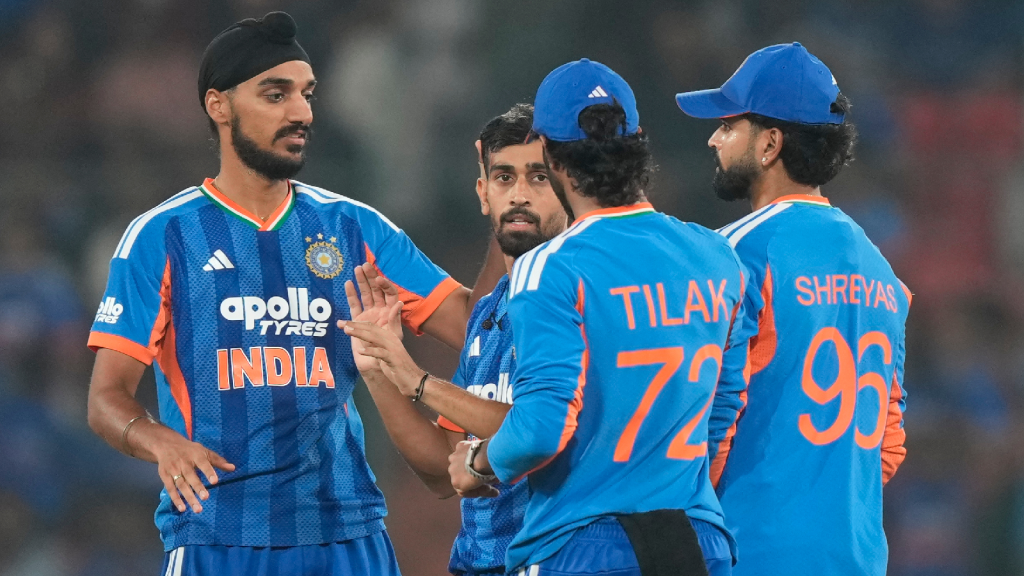
India’s struggle to contain the West Indies in high-scoring T20Is has exposed a growing weakness in their bowling strategy: an overreliance on attacking deliveries at the expense of defensive execution. With the series heading towards a decisive encounter at Bengaluru’s M. Chinnaswamy Stadium, India must find a way to control the scoring rate against a powerful West Indies batting line-up.
Across the last three T20Is, India have repeatedly struggled to contain the opposition after the West Indies batters found their rhythm. The problem has not been limited to flat pitches or dew. India’s bowlers have continued to prioritise taking wickets, even when restricting boundaries and slowing the scoring rate could have been equally important.
The absence of Jasprit Bumrah has made the challenge more difficult, while the decision not to include Kuldeep Yadav has further tested India’s ability to adapt to demanding conditions. As Shreyas Iyer’s side prepares for the next match, the key question is whether India can develop a more flexible bowling approach without abandoning the attacking philosophy that has served them well.
India’s Bowling Strategy Under Pressure After West Indies’ 200-Plus Totals
India’s problems against the West Indies have become increasingly visible as the T20I Series has progressed. Apart from the opening match, when the visitors managed 171 runs while batting first, every subsequent contest has featured totals above the 200-run mark.
The second T20I at Ranchi provided a particularly striking example. India scored 249/5, putting themselves in a strong position, but their bowlers conceded 252/4 with nine balls remaining. The West Indies completed the chase with considerable authority, exposing India’s difficulties in defending a formidable total.
India subsequently managed to hold their nerve at Indore’s Holkar Stadium, a venue where the relatively small boundaries leave little room for bowling errors. However, the next match in Hyderabad brought another setback. The West Indies posted 247/3, a total that proved beyond India’s reach as the hosts eventually lost by 24 runs.
These results have highlighted a recurring problem. India have shown that they can score heavily, but their bowling unit has struggled to prevent opposition batters from maintaining an aggressive approach throughout an innings.
Flat pitches and dew have certainly complicated the task. The ball can become difficult to grip in damp conditions, while batting-friendly surfaces offer fewer opportunities for bowlers to rely on movement or unpredictable bounce. Nevertheless, India’s approach has also contributed to the problem, particularly when their attacking plans have failed to produce regular wickets.
Why India’s Attack-First Philosophy Is Not Always Working
India have traditionally backed their bowlers to attack rather than spend long periods trying to contain the opposition. The philosophy is straightforward: taking wickets disrupts partnerships, forces new batters to settle in and can prevent an aggressive batting unit from building momentum.
That approach also played a significant role during India’s successful T20 World Cup campaign. Even when they encountered three consecutive high-scoring fixtures, the team continued to trust its ability to take wickets and apply pressure through attacking bowling.
However, the current series has demonstrated the limitations of relying too heavily on that strategy. The presence of Bumrah can make an attacking plan considerably more effective because of his ability to execute yorkers, vary his pace and deliver under pressure. Without him, India have had to depend on a less experienced group of fast bowlers in situations where precision is essential.
The challenge is not necessarily that India’s bowlers lack attacking ability. Instead, they need to recognise when the conditions or the batter’s approach require a change of plan.
In T20 cricket, aggression does not always mean bowling at the stumps and searching for a wicket. A well-directed wide yorker, a slower delivery outside the hitting arc or a carefully planned short ball can force a batter to reach for the ball and reduce the likelihood of a clean strike.
Such deliveries may not always produce wickets, but they can prevent boundaries and create pressure. Against a team capable of clearing the ropes with regularity, that ability to slow the scoring rate can be just as valuable as taking wickets.
IPL Experience Shows the Importance of Defensive Bowling
The evolution of the Indian Premier League has underlined the importance of defensive bowling in modern T20 cricket. With the Impact Player rule contributing to increasingly aggressive batting approaches and more totals crossing 200, bowling teams have been forced to develop ways to limit the damage.
Wide yorkers have become an important option at the death because they encourage batters to reach outside their natural hitting zones. Short deliveries delivered with pace off can disrupt timing, while spinners can bowl away from a batter’s preferred hitting arc to make clean contact more difficult.
These tactics do not eliminate the risk of conceding boundaries. Instead, they give bowlers alternative methods of controlling an innings when conventional attacking lines become predictable.
India’s current difficulties suggest that their bowling plans have not consistently offered enough variety. When batters anticipate deliveries aimed at the stumps, they can prepare to attack straight and through the leg side. Repeatedly challenging powerful hitters with similar lines can become dangerous, particularly on pitches where the ball travels quickly off the bat.
A more balanced approach would allow India to continue searching for wickets while also making boundaries harder to find. The objective is not to abandon attacking cricket but to recognise that restricting runs can create pressure that eventually produces wickets.
Arshdeep Singh Has the Skills to Execute a Defensive Plan
India’s current bowling group includes players capable of delivering defensive options, with Arshdeep Singh standing out as an example. The left-arm seamer has demonstrated his ability to bowl wide yorkers and mix slower bouncers with short deliveries when the situation demands.
His range gives India the flexibility to move away from a predictable attack-at-the-stumps strategy. By varying the pace, length and angle of his deliveries, Arshdeep can make it harder for batters to settle into a consistent rhythm.
The challenge is to ensure that these options are used as part of a clearly defined plan rather than as occasional alternatives. Defensive bowling requires more than simply delivering the ball outside the hitting arc. It depends on accuracy, an understanding of the batter’s strengths and the ability to repeat a delivery under pressure.
On high-scoring grounds, even a small error can turn a promising over into an expensive one. A wide yorker that misses its intended length may become a full toss, while a short ball that sits up can be dispatched over the boundary. Execution remains crucial regardless of the tactic selected.
Mayank Yadav and Prince Yadav Face Different Challenges
India have also turned to Mayank Yadav and Prince Yadav, two young fast bowlers who have made their way into the national setup following their stints with Lucknow Super Giants in the IPL.
Both have been associated with an attacking style of bowling, developed while working under LSG bowling coach Bharat Arun. Their strengths have helped them earn opportunities, but the demands of international T20 cricket require them to demonstrate greater adaptability, especially when defending totals against powerful opposition.
Prince Yadav’s Yorkers Offer a Potential Solution
Prince Yadav has shown that he can execute yorkers effectively, with his slightly round-arm action helping him bring the ball back into the batter. His performance in the third T20I at Indore illustrated how accurate yorkers can restrict a dangerous batting line-up during the closing stages of an innings.
Those deliveries helped prevent the West Indies from fully unleashing their hitting power at the death. However, the margin for error remains extremely small. When Prince misses his intended line, even slightly, batters have been able to send the ball over the boundary.
For a young bowler, the next step is learning how to respond when the preferred delivery is not working. Changing the angle, varying the pace or using a different length can prevent batters from anticipating the same ball repeatedly.
Yorkers can remain his primary weapon, but they need to form part of a broader plan rather than become the only option available under pressure.
Mayank Yadav Must Develop Greater Control
Mayank Yadav’s raw pace remains one of his biggest assets. His ability to hurry batters with hard-length deliveries can make it difficult for them to get into position, particularly when the ball skids off the surface.
However, translating that pace into an effective defensive strategy has proved more challenging. Bowling fast can produce hurried shots, but it can also work against a bowler when the batter uses the pace to guide or power the ball towards the boundary.
Mayank’s challenge is to develop a reliable alternative when sheer speed does not provide the desired result. Changes of pace, more carefully directed short deliveries and improved control over his lengths could help him become less predictable.
Against the West Indies, whose batters are comfortable taking on pace, that variation could be particularly important. The objective is not to reduce Mayank’s natural aggression but to ensure that he has options when attacking the stumps or bowling hard lengths becomes expensive.
India’s Spinners Have Also Struggled to Find the Right Length
The difficulties have not been restricted to India’s fast bowlers. When the seamers have struggled to contain the scoring, the spinners have also attempted to limit damage by bowling outside the batters’ hitting arcs.
Kuldeep Yadav’s outing at Ranchi illustrated the difficulty of executing such a plan. He conceded 53 runs in his four overs, as the West Indies continued to attack despite India’s substantial first-innings total.
Axar Patel has also resorted to bowling away from the hitting arc, but that approach has not consistently delivered the desired results. On flat pitches, batters can still reach deliveries outside their preferred zones and exploit even small errors in length or trajectory.
Bowling wider can be an effective defensive tactic, but it needs to be supported by accurate execution and appropriate field placements. If a delivery is too wide or too short, it can offer batters the room they need to free their arms and generate power.
India’s decision not to include Kuldeep in the XI because of the conditions has further complicated the bowling equation. However, the larger issue remains the team’s ability to identify the most effective option for a particular situation, rather than relying on a single approach throughout the innings.
Why the Bengaluru T20I Could Be India’s Biggest Bowling Test
The upcoming match at M. Chinnaswamy Stadium presents India with a particularly difficult challenge. The Bengaluru venue is known for being unforgiving to bowlers, with relatively small boundaries and a high-scoring environment leaving little room for mistakes.
Even mishits can travel the distance, making it difficult to defend totals when the opposition has several powerful hitters capable of clearing the ropes. A bowler who misses the yorker or delivers a short ball without enough control can quickly lose momentum.
That makes tactical flexibility especially important. India cannot depend exclusively on taking wickets to control the game, nor can they expect every attacking delivery to produce a mistake from the batter.
Instead, they need to assess the situation over by over. When wickets are falling, an aggressive approach can help maintain pressure. When a batter is well set and finding boundaries regularly, defensive lines and changes of pace may offer a better chance of reducing the damage.
The example of Royal Challengers Bengaluru in the IPL has shown how teams can combine attacking and defensive bowling options at the venue. Although the conditions remain challenging, a carefully planned strategy can help bowlers avoid becoming predictable.
Ultimately, India do not necessarily need to restrict the West Indies to a low score. At a venue such as Bengaluru, that may be an unrealistic expectation. Their priority should be to prevent the opposition from scoring freely throughout the innings and keep the target within a manageable range.
Gautam Gambhir Admits India Must Find a Way
India head coach Gautam Gambhir acknowledged the need for improvement after the defeat at Ranchi. While he pointed to the difficulty of bowling on flat pitches with dew, he also made it clear that the team could not afford to ignore its shortcomings.
“If you want to keep improving, you don’t want to put anything under the carpet. We are a world-champion team so we want to keep improving. These are obviously tough conditions to bowl – we know flat wickets with the dew – obviously it’s tough but we need to figure out and find the way,” Gambhir said.
His comments reflect the challenge facing India’s bowling unit. Difficult conditions can explain why bowlers struggle, but they cannot remove the need to find solutions. A team that wants to remain competitive at the highest level must be able to adjust its tactics when its preferred strategy stops working.
For India, that means finding the right balance between attack and control. Taking wickets will remain central to their approach, but an inability to slow the scoring rate can make even a strong batting performance insufficient.
What India Must Change to Contain the West Indies
As the series reaches its decisive stage, India need to focus on improving their execution and making their bowling plans less predictable. Several adjustments could help them manage the West Indies’ aggressive batting more effectively.
- Use more variation at the death: Wide yorkers, slower bouncers and pace-off deliveries can help disrupt the rhythm of established batters.
- Give young fast bowlers alternative plans: Mayank Yadav and Prince Yadav need options beyond attacking the stumps, particularly when batters begin anticipating their preferred deliveries.
- Improve consistency: Defensive tactics work only when bowlers execute them accurately. Missed yorkers and poorly directed short balls can quickly become boundary opportunities.
- Adapt field placements to the plan: Bowling outside the hitting arc must be supported by fields that protect the areas batters are most likely to target.
- Recognise when to contain rather than attack: If a batter is scoring freely, slowing the run rate can be as important as searching for a wicket.
- Make better use of the available bowling options: India need to assess the conditions and the opposition’s strengths before deciding which bowlers and tactics offer the best chance of control.
These changes would not require India to abandon their attacking identity. Instead, they would allow the team to respond more intelligently when the opposition begins to dominate.
Frequently Asked Questions
Why have India conceded so many 200-plus totals against the West Indies?
India have struggled to contain the West Indies’ powerful batting line-up, particularly on flat pitches and in conditions affected by dew. Their preference for an attacking bowling strategy has not always been balanced by defensive options capable of slowing the scoring rate.
How has Jasprit Bumrah’s absence affected India?
Bumrah’s absence has left India without one of their most reliable options for executing high-pressure deliveries. The remaining bowlers have had to shoulder greater responsibility, and the team has found it difficult to reproduce the same level of control while maintaining its attacking approach.
What is defensive bowling in T20 cricket?
Defensive bowling involves using accurate deliveries and tactical variations to reduce boundary opportunities. Wide yorkers, slower bouncers and deliveries outside a batter’s preferred hitting arc are common options for controlling the scoring rate.
Why is the M. Chinnaswamy Stadium a difficult venue for bowlers?
The Bengaluru ground is known for its relatively small boundaries and high-scoring conditions. Bowlers have little margin for error because even mistimed shots can travel for boundaries, making accuracy and tactical variation especially important.
Can India still rely on an attacking bowling strategy?
India can continue to prioritise wickets, but the current series has shown the importance of having a Plan B. Combining attacking deliveries with defensive tactics could help the team maintain pressure and prevent opposition batters from scoring freely.
Conclusion: India Need More Than Wickets to Win
India’s struggles against the West Indies have exposed a weakness in their bowling approach rather than simply a lack of talent or experience. The team has continued to back its attacking instincts, but the absence of Bumrah and the difficulties faced by its younger bowlers have made that strategy harder to sustain.
With the series on the line in Bengaluru, India must demonstrate that they can adapt to conditions where every mistake carries a heavy price. Arshdeep Singh’s variations, Prince Yadav’s yorkers and Mayank Yadav’s pace provide useful weapons, but the bowling unit needs to combine them with greater discipline and tactical awareness.
The lesson from the high-scoring contests is clear: taking wickets remains important, but it is not the only way to control a T20 innings. Sometimes, the ability to choke the scoring rate, force batters into uncomfortable positions and make boundaries difficult to find can be just as decisive. India’s challenge is to rediscover that balance before the series is decided.
For breaking news and live news updates, like us on Facebook or follow us on Twitter and Instagram. Read more on Latest Cricket on thefoxdaily.com.






COMMENTS 0