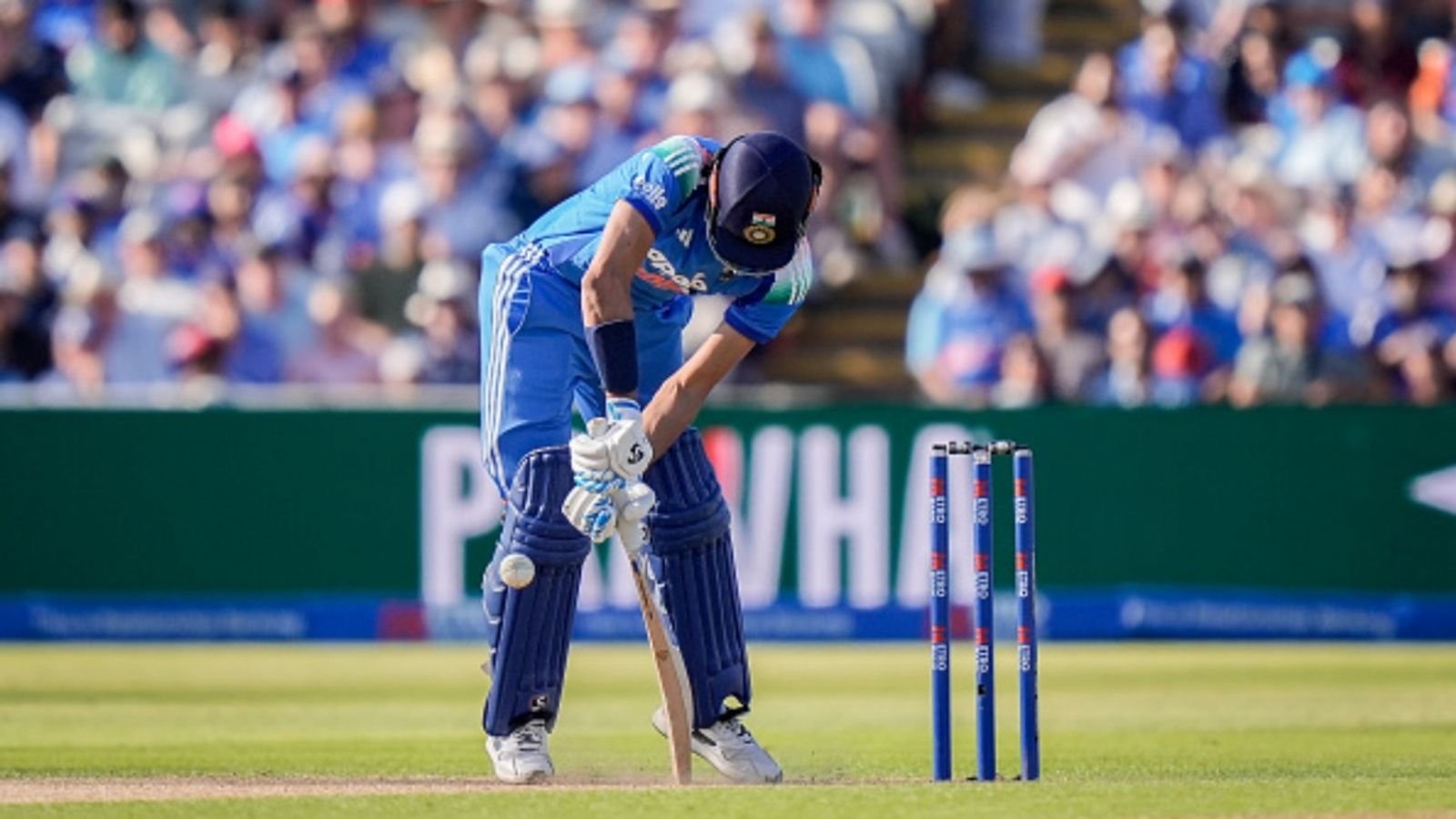
Few players in modern Indian cricket embody versatility quite like Axar Patel. Often viewed as a dependable utility cricketer rather than a headline-maker, the left-handed all-rounder reminded the cricketing world of his immense value during India’s six-wicket victory over England in the first ODI at Edgbaston.
Axar’s performance was not merely another Player of the Match display. It was a statement. After enduring a disappointing T20I series in which he struggled for runs and never settled into a consistent batting role, he responded with a complete all-round exhibition—claiming four wickets and then scoring an unbeaten half-century in a pressure chase.
More importantly, the innings highlighted an evolution in Axar’s approach. Instead of forcing the game, he trusted the conditions, backed his technique, and delivered one of the most mature ODI knocks of his career.
Axar Patel’s Historic Achievement in England
By scoring an unbeaten fifty and taking four wickets in the same away ODI, Axar joined an exclusive group of Indian cricketers.
| Player | Opponent | Achievement |
|---|---|---|
| Sachin Tendulkar | Australia | Century plus four wickets in an away ODI |
| Hardik Pandya | England | Half-century plus four wickets in an away ODI |
| Axar Patel | England | Half-century plus four wickets in an away ODI |
Being mentioned alongside Sachin Tendulkar and Hardik Pandya is significant. While Tendulkar’s all-round exploits are legendary and Pandya has long been regarded as India’s premier white-ball all-rounder, Axar’s performance demonstrated that he can also influence games with both bat and ball on the biggest stages.
For India, the timing could not have been better. The team entered the ODI series seeking momentum after a difficult T20I campaign, and Axar’s heroics provided exactly that.
The Mistake Axar Patel Admitted After the T20I Series
Following the victory, Axar openly reflected on his struggles in the T20I series. Rather than blaming conditions or circumstances, he identified a technical and mental error in his batting approach.
According to Axar, he was trying to hit the ball too hard in T20 cricket. Frequently entering during the final overs, he felt compelled to attack immediately, which disrupted his balance and caused him to lose his shape while playing shots.
This self-assessment offers an important insight into the difference between T20 and ODI cricket.
In T20s, players often have only a handful of deliveries to make an impact. The pressure to maximize every ball can lead to rushed decision-making and poor shot selection. In ODIs, however, batters have the luxury of building partnerships, reading conditions, and pacing an innings.
At Edgbaston, Axar embraced that ODI mindset perfectly.
How Axar Changed His Approach Against England
India’s chase was progressing smoothly before captain Shubman Gill retired hurt with cramps after an excellent innings. Soon afterward, KL Rahul departed, creating a potentially tricky situation.
England sensed an opening.
The crowd became involved, the bowlers tightened their lines, and India suddenly needed a calm presence in the middle.
That presence came from Axar Patel.
Rather than searching for boundaries from the outset, he focused on rotating strike and building a partnership with Washington Sundar. The pair absorbed pressure, assessed the pitch, and gradually shifted momentum back in India’s favour.
The result was an unbeaten 102-run partnership that completely took the game away from England.
It was not a flashy innings built on power-hitting. Instead, it was a masterclass in game awareness.
Axar recognized that India’s priority was not entertaining the crowd but securing victory. That distinction ultimately defined the innings.
The Bowling Spell That Changed the Match
While his batting earned plenty of praise, Axar’s contribution with the ball was arguably even more crucial.
England looked well placed thanks to a substantial partnership between Joe Root and Liam Dawson. Root was anchoring the innings, while Dawson was beginning to accelerate.
India needed a breakthrough.
Axar delivered.
His dismissal of Dawson broke a partnership worth over 100 runs and immediately shifted momentum. Once that stand was broken, England’s lower order struggled to maintain the same scoring rate.
Axar then cleaned up the tail, finishing with four wickets and ensuring England were restricted to a manageable total.
This ability to strike at critical moments has become one of the defining features of Axar’s bowling. He may not generate headlines like Jasprit Bumrah or Kuldeep Yadav, but he consistently produces breakthroughs when India need them most.
Why Axar Patel Is Becoming Indispensable to India’s ODI Plans
India’s preparations for the 2027 ODI World Cup are already underway, and Axar Patel’s performance reinforced why he remains central to those plans.
Modern ODI cricket demands multi-dimensional cricketers.
Teams can no longer afford specialists who contribute in only one discipline. The most successful sides possess players capable of influencing matches in multiple ways.
Axar fits that profile perfectly.
- Reliable left-arm spin option.
- Capable middle-order batter.
- Excellent fielder.
- Strong temperament under pressure.
- Flexible enough to bat in multiple positions.
Those qualities make him one of the most complete white-ball cricketers in India’s setup.
The Washington Sundar Partnership Deserves More Credit
Much of the post-match discussion focused on Axar’s fifty and four wickets, but his partnership with Washington Sundar was equally important.
The two all-rounders demonstrated why balance is becoming increasingly valuable in ODI cricket.
When India lost momentum, they did not rely on specialist batters to finish the chase. Instead, two genuine all-rounders calmly guided the team home.
This provides India with strategic flexibility going forward.
Having lower-order players capable of batting responsibly allows the top order to play with greater freedom. It also gives the team management more options when selecting bowling combinations.
What This Means for India’s Middle Order
One of India’s biggest discussions ahead of the 2027 World Cup concerns the middle-order structure.
While Rohit Sharma, Virat Kohli, and Shubman Gill continue to dominate headlines, tournaments are often won by players operating between positions five and eight.
Axar’s performance highlighted why he could become a crucial piece of that puzzle.
His ability to stabilize innings against spin, accelerate when required, and contribute significant overs makes him uniquely valuable.
Unlike many lower-order hitters, he does not depend solely on power. He understands angles, rotates strike effectively, and has developed the temperament needed for ODI cricket.
A Comparison with Hardik Pandya’s ODI Impact
India’s white-ball setup has long revolved around Hardik Pandya’s all-round abilities.
However, Axar’s emergence offers a different type of balance.
| Category | Hardik Pandya | Axar Patel |
|---|---|---|
| Bowling Style | Fast-medium | Left-arm spin |
| Batting Role | Finisher | Middle-order stabilizer |
| Strength | Power hitting | Control and adaptability |
| Fielding | Athletic | Reliable and versatile |
Rather than competing with Pandya, Axar complements him. Together, they provide India with one of the most balanced all-round combinations in world cricket.
The Psychological Importance of This Performance
Elite athletes often speak about confidence being the difference between success and failure.
For Axar, this innings may prove significant beyond the immediate result.
Scoring only 19 runs in an entire T20I series can create doubts. Questions begin to emerge about form, batting position, and future role within the team.
By producing a match-winning performance in the very next format, Axar effectively answered those questions.
More importantly, he reminded himself of what makes him successful: patience, balance, and trust in his natural game.
Those lessons could have a lasting impact on the remainder of the England tour.
What Comes Next for Axar Patel?
Another milestone is approaching.
Axar needs fewer than 100 runs to reach 1,000 ODI runs, a landmark that would further underline his growth as a genuine all-rounder.
The upcoming matches against England provide an opportunity not only to achieve that milestone but also to cement his role in India’s long-term plans.
If he continues performing at this level, discussions about India’s strongest ODI XI may increasingly revolve around ensuring Axar’s presence rather than debating his position.
Conclusion: More Than Just a Match-Winning Performance
Axar Patel’s performance at Edgbaston was about far more than statistics.
Yes, he became one of the few Indians to score a fifty and take four wickets in an away ODI. Yes, he earned the Player of the Match award. And yes, he helped India secure a crucial series lead.
But the bigger story was his response to adversity.
After a disappointing T20I series, Axar analyzed his mistakes, adjusted his approach, and delivered a career-defining performance when his team needed him most.
For India, that adaptability may be even more valuable than the runs and wickets themselves.
As preparations for the 2027 ODI World Cup continue, performances like this suggest Axar Patel is evolving from a dependable squad player into one of India’s most important white-ball cricketers. If Edgbaston is any indication, his influence on India’s future could be much greater than many imagined.
For breaking news and live news updates, like us on Facebook or follow us on Twitter and Instagram. Read more on Latest Sports on thefoxdaily.com.






COMMENTS 0