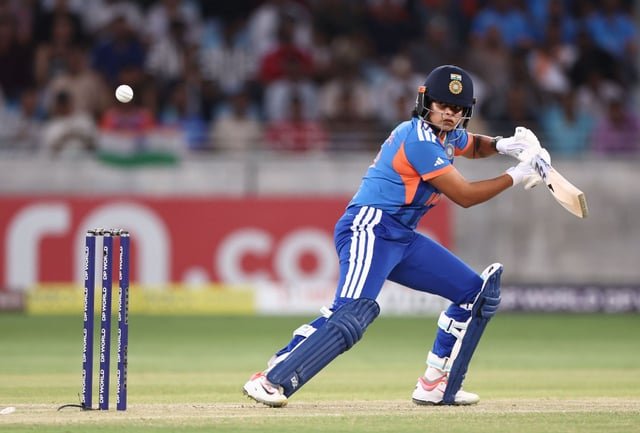
Shafali Verma reached a major T20I milestone after scoring her maiden century against Bangladesh at the 2026 Asian Games, providing an interesting statistical comparison with Rohit Sharma after the same 117 T20I innings.
The India Women opener produced a spectacular unbeaten 100 from just 49 balls in the Women’s Asian Games 2026 semifinal at Korogi Sports Park in Nisshin on September 20. Her innings helped India post 195/4 before Bangladesh were bowled out for 81, giving India a 114-run victory and a place in the final.
With Shafali now having batted in 117 T20I innings, her numbers can be compared with Rohit’s record after he had reached the same number of innings in the format. The comparison covers overall batting, scoring consistency, performances in wins and numbers while chasing.
Shafali Verma’s Record After 117 T20I Innings
Shafali has scored 3,277 runs in 117 T20I innings, averaging 30.06 at a strike rate of 140.70. Her numbers underline the aggressive approach that has become a defining feature of her batting.
Her latest century against Bangladesh was particularly significant because it was her first hundred in T20I cricket. She reached the milestone with an unbeaten 100 from 49 deliveries, hitting three fours and nine sixes.
Shafali also has a strong record against several opponents. She has scored 527 runs in 24 innings against Australia at a strike rate of 139.41, while her 492 runs in 15 innings against Sri Lanka have come at 143.02.
Against Bangladesh, she has accumulated 482 runs in 15 innings at a strike rate of 140.52. She has also scored 438 runs in 15 innings against South Africa at a strike rate of 140.38.
Rohit Sharma’s Numbers After 117 T20I Innings
Rohit Sharma had scored 3,313 runs after 117 T20I innings, giving him a slightly higher run tally than Shafali at the same stage.
His average was 32.48, while his strike rate stood at 139.55. Although Shafali has a marginally higher strike rate, Rohit’s average was stronger after the same number of innings.
Rohit’s record also included four centuries and 26 half-centuries during that period. His highest T20I score was 118, which he scored against Sri Lanka in Indore in December 2017.
His other T20I centuries in the comparison period included an unbeaten 111 against West Indies, 106 against South Africa and an unbeaten 100 against England.
Shafali Verma vs Rohit Sharma: Overall Batting Comparison
| Player | Runs | Average | Strike Rate | Highest Score | 100s | 50s |
|---|---|---|---|---|---|---|
| Shafali Verma | 3,277 | 30.06 | 140.70 | 100* | 1 | 21 |
| Rohit Sharma | 3,313 | 32.48 | 139.55 | 118 | 4 | 26 |
The numbers show a relatively close comparison in overall scoring output. Rohit had 36 more runs after 117 innings and a higher batting average, while Shafali’s strike rate was slightly better.
The difference becomes more noticeable in the number of 50-plus scores. Rohit had 30 such scores, including four centuries and 26 fifties. Shafali had 22, consisting of one century and 21 half-centuries.
Shafali’s Maiden T20I Century Changes the Picture
Shafali’s century against Bangladesh added an important milestone to her T20I record. Before the Asian Games semifinal, she had accumulated 21 half-centuries but had not yet reached three figures in the format.
Her unbeaten 100 came at an exceptional scoring rate, with nine sixes providing much of the acceleration. She also built important partnerships during India’s innings.
Shafali added 72 runs for the opening wicket with Smriti Mandhana, who scored 37 from 19 balls. Later, she shared a 94-run partnership for the third wicket with captain Harmanpreet Kaur, who contributed 40 from 33 deliveries.
The innings helped India reach 195/4 before the bowling attack restricted Bangladesh to 81 in 15.4 overs.
How Shafali and Rohit Performed in Wins
The comparison becomes particularly interesting when only matches won by their respective teams are considered.
Shafali has scored 2,282 runs in 71 T20I innings in wins, averaging 36.22 at a strike rate of 144.15. She has one century and 15 half-centuries in those victories.
Rohit’s numbers in wins were higher in terms of both runs and average. He scored 2,663 runs in 79 innings during victories, averaging 39.74 with a strike rate of 143.09. He recorded three centuries and 23 fifties in those innings.
| Player | Innings in Wins | Runs | Average | Strike Rate | 100s | 50s |
|---|---|---|---|---|---|---|
| Shafali Verma | 71 | 2,282 | 36.22 | 144.15 | 1 | 15 |
| Rohit Sharma | 79 | 2,663 | 39.74 | 143.09 | 3 | 23 |
Shafali’s strike rate in wins was slightly higher, while Rohit produced more runs and had the stronger average. Both players showed a clear improvement in their scoring rates when their teams were successful.
What Happened in Their T20I Losses?
The contrast becomes sharper when their performances in defeats are considered.
Shafali scored 876 runs in 43 losses, averaging 20.37 with a strike rate of 130.74. She registered five half-centuries in those innings.
Rohit scored 575 runs in 36 innings during losses, averaging 16.91 at a strike rate of 123.65. He recorded one century and two fifties in those innings.
These numbers show that both players maintained a relatively aggressive approach even when their teams were losing. Shafali’s average and strike rate were higher than Rohit’s figures in this particular comparison.
Shafali Verma vs Rohit Sharma in T20I Chases
The chasing numbers offer another useful perspective. Shafali has scored 1,344 runs in 53 innings while chasing, averaging 29.21 at a strike rate of 140.29. She has recorded nine half-centuries in those innings.
Rohit had scored 1,364 runs in 56 innings while chasing, averaging 27.83 at a strike rate of 132.68. His record included one century and 11 half-centuries.
| Player | Chasing Innings | Runs | Average | Strike Rate | 100s | 50s |
|---|---|---|---|---|---|---|
| Shafali Verma | 53 | 1,344 | 29.21 | 140.29 | 0 | 9 |
| Rohit Sharma | 56 | 1,364 | 27.83 | 132.68 | 1 | 11 |
Rohit had scored 20 more runs while chasing, but Shafali had the higher average and strike rate. The difference in strike rate is particularly notable, with Shafali scoring at 140.29 compared with Rohit’s 132.68.
Batting First: Another Interesting Contrast
Shafali has scored 1,933 runs in 64 T20Is while batting first, averaging 30.68 at a strike rate of 140.99. She has recorded one century and 12 half-centuries in those innings.
Rohit had scored 1,949 runs in 61 innings while batting first, averaging 36.77 at a strike rate of 144.79. He had three centuries and 15 fifties in that situation.
The numbers suggest that Rohit produced a higher average and strike rate when setting a target, while Shafali’s chasing numbers compare favorably in terms of scoring rate and average.
Shafali’s Explosive Batting Style
One of the clearest features of Shafali’s T20I record is her scoring speed. Her overall strike rate of 140.70 is slightly higher than Rohit’s 139.55 after 117 innings.
Her innings against Bangladesh further illustrated that approach. Nine sixes formed a major part of her unbeaten century, allowing India to reach a commanding total in the semifinal.
Shafali’s aggressive approach has been evident throughout her T20I career, and her numbers indicate that she has maintained that style even as her role and experience have developed.
Rohit’s Experience Reflected in His Milestones
Rohit’s numbers after 117 innings show a different statistical profile. His average was higher, and he had accumulated significantly more 50-plus scores.
Four centuries and 26 half-centuries demonstrate his ability to convert starts into substantial scores. His highest score of 118 also remained considerably higher than Shafali’s 100 not out at the same stage.
His record across different opponents also featured several major innings, including centuries against England, South Africa, West Indies and Sri Lanka.
What the Numbers Tell Us
The comparison between Shafali Verma and Rohit Sharma after 117 T20I innings offers several different conclusions depending on the statistical category being examined.
- Overall runs: Rohit had a narrow advantage with 3,313 compared with Shafali’s 3,277.
- Average: Rohit’s 32.48 was higher than Shafali’s 30.06.
- Strike rate: Shafali’s 140.70 was slightly higher than Rohit’s 139.55.
- Centuries: Rohit had four compared with Shafali’s one.
- 50-plus scores: Rohit had 30, while Shafali had 22.
- Runs in wins: Rohit scored 2,663 compared with Shafali’s 2,282.
- Strike rate in wins: Shafali’s 144.15 was marginally higher than Rohit’s 143.09.
- Chasing average: Shafali’s 29.21 was higher than Rohit’s 27.83.
- Chasing strike rate: Shafali’s 140.29 was higher than Rohit’s 132.68.
Final Verdict
The Shafali Verma vs Rohit Sharma comparison after 117 T20I innings reveals two highly productive and aggressive opening batters with some notable statistical differences.
Rohit had more runs, a higher average and more 50-plus scores at the same stage of his T20I career. His four centuries also gave him a clear advantage in converting big scores.
Shafali, meanwhile, had a slightly better overall strike rate and stronger strike-rate figures while chasing and in matches her team won. Her unbeaten 100 against Bangladesh also added her first T20I century to the record.
The comparison provides a statistical snapshot of two careers at an identical innings milestone, while Shafali’s latest Asian Games performance gives her record a significant new chapter as India advanced to the Women’s Asian Games 2026 final.
For breaking news and live news updates, like us on Facebook or follow us on Twitter and Instagram. Read more on Latest Cricket on thefoxdaily.com.






COMMENTS 0