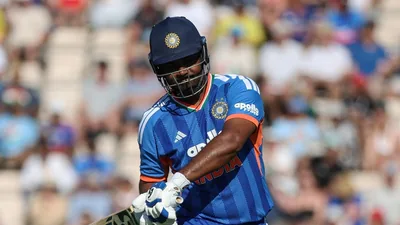
Sanju Samson vs Vaibhav Sooryavanshi has emerged as one of the biggest selection debates ahead of India’s first T20I against Afghanistan in New Delhi. With both batters available alongside Abhishek Sharma, head coach Gautam Gambhir and captain Shreyas Iyer face an important decision over India’s opening combination.
The first match of the three-game series is scheduled for September 13 at the Arun Jaitley Stadium. India have several options at the top of the order, but the contrasting profiles of Samson and Sooryavanshi make the decision particularly difficult.
Sooryavanshi has recently attracted enormous attention after an impressive series against Zimbabwe, where the 15-year-old was named Player of the Series after scoring more than 200 runs. Samson, meanwhile, brings considerably more international experience and was an important member of India’s T20 setup during their World Cup triumph earlier in the year.
Former India pacer Vivek Razdan believes the management should resist the pressure surrounding Sooryavanshi and continue backing Samson for the opening game.
Why India’s opening combination is a difficult call
India’s squad gives the management several possible combinations at the top. Samson, Sooryavanshi and Abhishek are all available, meaning only two are expected to open if the team follows a conventional opening structure.
The situation became more complicated because Samson was rested for India’s Zimbabwe tour. During that series, Abhishek and Sooryavanshi opened together and produced the combination the management wanted to examine.
Sooryavanshi’s performances ensured that his name could not easily be ignored. His run-scoring in Zimbabwe strengthened his case for another opportunity, while his growing reputation has made him one of the most discussed young players in Indian cricket.
At the same time, Abhishek’s relatively underwhelming Zimbabwe campaign has made the selection equation less straightforward. The management now has to decide whether recent form should outweigh experience when selecting the opening pair.
Vivek Razdan backs Sanju Samson
Razdan believes Samson deserves the opportunity to return to the playing XI. Speaking ahead of the Afghanistan series, the former India pacer argued that the management should not make a major selection decision simply because Sooryavanshi has become one of the biggest names among India’s emerging cricketers.
His central argument is based on Samson’s experience and his contribution to India’s recent T20 success. Razdan also pointed out that Sooryavanshi himself did not enjoy a strong outing against England after entering the team following Samson’s omission.
The former India bowler therefore sees the Afghanistan opener as an opportunity to restore confidence in Samson rather than immediately making another change.
Razdan’s argument is essentially about selection consistency. If a senior player is dropped after a short run of low scores, while a younger replacement also experiences a difficult stretch, the logical response may be to reassess the original decision instead of automatically continuing with the replacement.
Samson’s World Cup contribution strengthens his case
One of the strongest arguments in Samson’s favour is his recent record in India’s successful T20 campaign. Razdan highlighted Samson’s role in helping India win the T20 World Cup and argued that such a contribution should carry significant weight when the team considers its next combination.
The point is particularly relevant because international selection is not based solely on a player’s latest innings. A player’s ability to perform under pressure, experience in major tournaments and understanding of the team’s tactical requirements can also influence selection.
For Samson, the challenge is that his international career has frequently been interrupted by competition for places. Every low-scoring run can increase pressure because India have a large pool of talented batters waiting for opportunities.
The Afghanistan series therefore represents another chance for Samson to demonstrate that he can occupy a regular role at the top of India’s T20 order.
Vaibhav Sooryavanshi has made selection impossible to ignore
While Razdan backs Samson, Sooryavanshi’s recent performances have made the teenager’s case extremely strong. The 15-year-old was named Player of the Series against Zimbabwe after scoring more than 200 runs in the three-match contest.
His rise has been remarkably rapid. Sooryavanshi has moved from being a highly rated young batter to a player whose performances are already influencing India’s senior-team selection discussions.
That creates a different kind of pressure for the management. Dropping an experienced player is one challenge, but leaving out a teenage batter who has just produced a standout international series can also generate questions.
However, recent success does not necessarily mean a player must be selected in every match. India’s management has to consider the wider structure of the team, opposition, batting balance and the long-term development of a young player.
Sooryavanshi’s England experience offers another lesson
The current debate also brings back memories of India’s recent tour of the UK. Samson initially played three matches on that tour, including two against Ireland and one against England, but a sequence of low scores led to him being left out.
Sooryavanshi subsequently received an opportunity. However, the young left-hander also struggled to make a major impact in his initial chances and was later left out before returning to the lineup for the fifth match against England.
That sequence is important because it shows how quickly selection decisions can change in India’s T20 setup. A player can receive an opportunity, fail to produce immediately and find himself outside the XI, regardless of reputation.
For the Afghanistan series, the management must decide whether to continue with the same philosophy or give Samson another opportunity based on his previous contribution and experience.
Left-right combination could influence India’s decision
Batting balance is another factor in the selection discussion. Sooryavanshi and Abhishek are both left-handed options, while Samson provides a right-handed presence.
Razdan specifically highlighted the balance issue when arguing in favour of Samson. With several left-handers potentially occupying the top and middle order, introducing a right-handed batter could give India greater variety.
This does not mean a left-right combination automatically produces a better batting lineup. However, changing angles for bowlers can sometimes influence matchups, field placements and bowling plans.
India’s management will therefore have to look beyond individual statistics. The question is not simply which player is better, but which combination gives the team the most effective overall batting structure.
Abhishek Sharma remains central to the debate
Abhishek’s position also deserves attention because he was one of India’s preferred openers during the Zimbabwe tour. His ability to attack in the powerplay makes him an important part of the team’s T20 strategy.
However, his underwhelming performances on that tour have opened the door for a possible change. If India decide that Samson should return, the management would have to determine whether Sooryavanshi or Abhishek partners him at the top.
This makes the Afghanistan selection puzzle more complicated than a simple Samson-versus-Sooryavanshi debate. India’s decision could affect the roles of all three batters.
| Player | Batting profile | Key selection argument |
|---|---|---|
| Sanju Samson | Experienced right-handed batter | International experience and recent T20 World Cup contribution |
| Vaibhav Sooryavanshi | Young left-handed batter | Outstanding recent Zimbabwe series and Player of the Series award |
| Abhishek Sharma | Left-handed attacking opener | Established option in India’s recent T20 plans |
Why the Afghanistan series matters for Samson
The Afghanistan series gives Samson an opportunity to establish himself again in India’s T20 plans. A strong start could strengthen his position, particularly if the management is looking for a dependable combination ahead of future tournaments.
At the same time, Samson cannot afford to assume that his previous achievements guarantee a place. India’s T20 squad has considerable depth, and Sooryavanshi’s emergence is evidence of how quickly competition can change.
For Samson, the best response would be to focus on performance rather than the surrounding selection debate. If he receives the opportunity, early runs could immediately reduce the pressure surrounding his place in the team.
Why India may still prefer Sooryavanshi
There is also a strong argument for giving Sooryavanshi another chance. His Zimbabwe performances have created momentum, and continuing with him could reward current form while allowing India to assess how the teenage batter develops against different opponents.
Young players also benefit from continuity when they are being introduced to international cricket. Frequent changes can make it harder for a player to understand his role and settle into the team’s tactical plans.
However, the management must balance that developmental approach with India’s immediate objectives. The Afghanistan series is not simply an experiment; the matches form part of India’s preparation for the Asian Games later in September.
Gambhir and Iyer face an important call
Gambhir and Iyer will ultimately have to decide which factors deserve the most weight. Recent form, previous tournament performances, batting balance and long-term planning all point in different directions.
The coaching staff may also consider how they want the opening pair to approach the powerplay. If India want maximum aggression, the combination could look different from one designed to provide greater stability.
There is no shortage of options, which is a positive problem for the Indian team. The difficulty is selecting the right combination from several players capable of contributing at international level.
Samson’s experience versus Sooryavanshi’s momentum
The central battle can be understood as experience versus current momentum. Samson has spent years dealing with international pressure and has been part of India’s recent T20 success. Sooryavanshi represents the next generation and has already shown that he can make an impact despite his age.
Neither factor should automatically determine the selection. A young player should not be selected solely because of hype, just as an experienced player should not be guaranteed a place solely because of past achievements.
The most useful approach may be to judge both players according to the role India want their opener to perform in the Afghanistan series.
What could happen in the first T20I?
If Razdan’s recommendation is followed, Samson could return to the playing XI alongside one of the two left-handed openers. Such a move would give India a more experienced right-handed presence while still retaining the attacking qualities of either Abhishek or Sooryavanshi.
Another possibility is that India continue with Sooryavanshi and Abhishek, rewarding the combination that opened during the Zimbabwe tour. That would give the teenage batter further exposure and allow the management to build on his recent success.
The final decision will depend on the team’s assessment before the match, but the debate itself highlights India’s remarkable batting depth.
Final Verdict
Sanju Samson vs Vaibhav Sooryavanshi is a difficult selection call for India ahead of the Afghanistan T20I series. Sooryavanshi has created enormous momentum after a prolific Zimbabwe campaign, while Samson brings experience and a strong recent connection with India’s T20 success.
Vivek Razdan believes the management should back Samson for the opening game, arguing that his experience and contribution to India’s T20 World Cup triumph should not be overlooked after a brief run of poor results.
Sooryavanshi, however, has already demonstrated that he deserves serious consideration. His performances at such a young age have made him much more than a developmental prospect, while Abhishek Sharma remains another important option at the top.
Ultimately, India have a selection problem that many teams would welcome. The challenge for Gambhir and Iyer is to choose the combination that offers the best balance between present form, experience, batting variety and India’s longer-term T20 plans.
For breaking news and live news updates, like us on Facebook or follow us on Twitter and Instagram. Read more on Latest Cricket on thefoxdaily.com.






COMMENTS 0