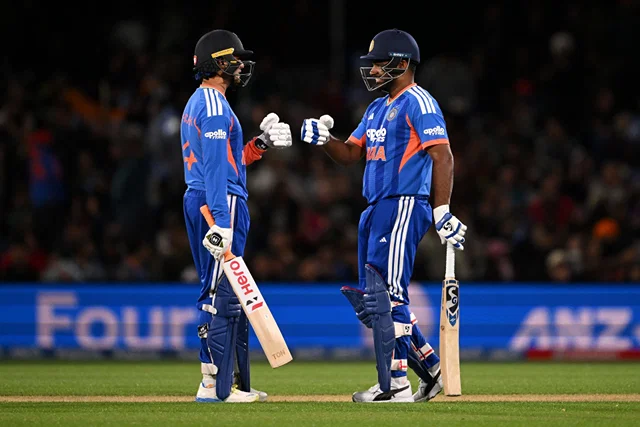
Former India all-rounder Ravichandran Ashwin has identified four of the most dangerous opening partnerships in modern T20 international cricket, placing Sanju Samson and Abhishek Sharma at the top of his list following India’s thrilling victory over New Zealand in the first T20I of their 2026 series. While Ashwin acknowledged the destructive potential of several international combinations, he ultimately favoured India’s opening pair because of Abhishek’s attacking intent and the tactical advantages offered by their left-right batting combination.
India began their five-match T20I series against New Zealand with a four-wicket victory at Hagley Oval in Christchurch on Thursday, October 22, successfully chasing a target of 226. Samson and Abhishek provided the foundation for the remarkable pursuit, adding 93 runs for the opening wicket from just 35 deliveries. Their explosive start helped India complete what the supplied report describes as their highest-ever successful run chase in T20 internationals.
The performance renewed discussion about India’s aggressive batting philosophy and the importance of their opening combination. With Abhishek capable of attacking from the outset and Samson bringing his own power-hitting ability, the partnership has become an important component of India’s approach to the shortest international format.
Speaking on his YouTube channel, Ashwin compared the Indian duo with New Zealand’s Finn Allen and Tim Seifert, England’s Phil Salt and Jos Buttler, and Australia’s Travis Head and Mitchell Marsh. He described all three rival combinations as serious competitors but explained why he currently believes Samson and Abhishek offer India a particularly effective blend of aggression, balance and tactical flexibility.
R Ashwin Picks His Top Four T20I Opening Partnerships
Ashwin’s assessment reflected the evolution of T20 batting, where opening pairs are increasingly expected to maximise the powerplay rather than spend several overs building a cautious foundation. In modern international cricket, the ability to attack from the first delivery can determine whether a team reaches a competitive total or successfully chases a demanding target.
The four partnerships highlighted by the former India international were:
- Sanju Samson and Abhishek Sharma India
- Finn Allen and Tim Seifert New Zealand
- Phil Salt and Jos Buttler England
- Travis Head and Mitchell Marsh Australia
Ashwin initially stopped short of declaring the Indian duo unquestionably the most destructive opening partnership in the world. He stressed that New Zealand’s Allen-Seifert combination and England’s Salt-Buttler pairing were equally capable of producing devastating starts.
Explaining his assessment, Ashwin said that determining the most destructive partnership was a close call. He noted that Allen and Seifert were just as dangerous as Samson and Abhishek, while Salt and Buttler also deserved to be considered among the leading combinations in international T20 cricket.
He also pointed to Australia’s Head-Marsh partnership as another formidable option, highlighting the broader trend towards aggressive opening batting across the leading T20I teams.
However, when choosing his preferred combination, Ashwin ultimately backed India. His decision was based not simply on the number of runs the pair could score, but also on the extra impetus Abhishek brings and the challenges their batting styles create for opposition bowlers.
Why Ashwin Rates Samson and Abhishek Above the Competition
One of the main reasons behind Ashwin’s preference is the additional attacking intensity Abhishek Sharma brings to the partnership. The left-handed opener has established himself as an aggressive batter who looks to put bowlers under pressure early in the innings.
In T20 cricket, such an approach can have a significant effect on the opposition’s plans. When an opener scores quickly during the powerplay, captains may have to change their bowling options, adjust field placements and introduce different match-ups earlier than expected. That can create opportunities for the other batter to exploit the disruption.
Samson complements that approach with his own attacking ability. Together, the pair can put pressure on different types of bowling and maintain a high scoring rate without relying entirely on one batter to dominate the innings.
Their left-right combination is another important advantage. With Abhishek batting left-handed and Samson right-handed, opposition captains must frequently reassess their plans depending on which batter is on strike. Bowlers may need to alter their angles, lines and lengths, while fielders can be required to adjust their positions.
A left-right combination is not automatically superior to two batters who use the same stance, but it can complicate a bowling side’s preparation and execution. Ashwin believes India’s combination offers an especially effective version of that tactical challenge.
He contrasted India with Australia, whose opening partnership also features a left-right combination through Head and Marsh. However, Ashwin argued that Australia could be restricted more effectively through spin bowling than India, suggesting that Abhishek and Samson present a more difficult overall match-up for opposition attacks.
The distinction is important because modern T20 cricket increasingly depends on how teams respond to specific bowling options. A successful opening pair must do more than hit boundaries against pace. It must also find ways to maintain scoring momentum when captains turn to spin or introduce bowlers with different angles and variations.
For Ashwin, India’s ability to combine attacking intent with this tactical flexibility makes Samson and Abhishek his preferred opening partnership at the current stage.
Finn Allen and Tim Seifert: New Zealand’s Explosive Alternative
New Zealand’s Finn Allen and Tim Seifert were among the first combinations Ashwin identified as genuine challengers to India’s opening pair. Both are capable of attacking aggressively, and their inclusion in the discussion reflects New Zealand’s emphasis on scoring quickly in the shortest format.
Allen is known for his attacking approach, particularly when looking to take advantage of fielding restrictions during the powerplay. An opener who can put pace bowlers under immediate pressure can force the opposition to abandon a carefully planned start and search for alternative solutions.
Seifert provides New Zealand with another attacking option at the top of the order. When the two batters settle quickly, they can give the middle order a strong platform and reduce the pressure on the players who follow.
Ashwin’s assessment also underlined that India’s success should not be considered in isolation. New Zealand’s opening combination is capable of matching the scoring intensity of the Indian pair, making the contest between the two sides particularly interesting during the 2026 series.
The first T20I in Christchurch demonstrated how quickly the match could develop into a high-scoring contest. New Zealand posted 225 runs, but India’s response showed that a powerful opening partnership can transform a challenging target into a realistic pursuit.
Although the supplied report does not establish a definitive statistical ranking between the two combinations, Ashwin’s comments make clear that he regards Allen and Seifert as among the most dangerous opening pairs in the format.
Phil Salt and Jos Buttler: England’s Power-Hitting Combination
England’s Phil Salt and Jos Buttler were also included in Ashwin’s list of elite T20I opening partnerships. The pair represent the aggressive batting philosophy that has become closely associated with England’s white-ball cricket.
Salt’s attacking intent can put bowlers under immediate pressure, while Buttler’s experience and range of scoring options allow him to attack across different areas of the ground. When both batters are in form, England can score rapidly and establish a platform for a substantial total.
Their threat extends beyond the powerplay. Aggressive openers can influence how an opposition captain manages the entire innings, particularly if the first few overs force the fielding side to rethink its bowling rotation.
A quick start can also provide England’s middle order with greater freedom. If the opening partnership scores at a high rate, subsequent batters may be able to maintain the momentum rather than spend time rebuilding the innings.
Ashwin’s decision to place Salt and Buttler alongside the Indian and New Zealand combinations shows that he considers England’s pair capable of matching the most destructive opening partnerships in international T20 cricket.
Nevertheless, his final preference remained with India because of the specific qualities Abhishek brings to the partnership and the tactical advantages created by the combination of a left-handed and a right-handed opener.
Travis Head and Mitchell Marsh: Australia’s Dangerous Opening Pair
Australia’s Travis Head and Mitchell Marsh complete Ashwin’s top four. Their aggressive approach makes them a significant threat in T20 cricket, particularly when they are able to attack pace bowling and exploit scoring opportunities early in the innings.
Head’s left-handed batting and Marsh’s right-handed approach give Australia a combination that can challenge bowlers through changes of angle and field placement. Their ability to score quickly can help Australia establish momentum before the opposition has an opportunity to settle into its bowling plans.
Ashwin described the Australian pair as another outstanding combination but explained why he would still choose India. Although Head and Marsh also form a left-right partnership, Ashwin believes opposition teams have a better opportunity to restrict the Australian duo through spin bowling.
His comparison highlights a key feature of T20 analysis: the most destructive partnership is not necessarily the one that hits the most boundaries in favourable conditions. Teams must also be evaluated on how effectively they respond when opponents identify weaknesses and use specific bowlers to disrupt their rhythm.
Spin bowling can change the pace of a T20 innings by forcing batters to adjust their shot selection, timing and risk tolerance. An opening partnership that continues scoring freely against spin can make it difficult for the captain to regain control of the game.
According to Ashwin’s assessment, India’s opening combination offers a particularly effective balance in this respect. That does not mean Australia lack the ability to dominate matches, but it explains why he considers the Indian duo his preferred choice.
Samson-Abhishek Partnership: The Numbers Behind India’s Success
The statistics supplied in the report support the growing importance of Samson and Abhishek in India’s T20I plans. The pair average more than 31 runs together across 39 innings, with seven half-century partnerships and one century stand.
These figures indicate that the partnership has produced several substantial contributions rather than relying solely on isolated high-scoring performances. In T20 cricket, consistent opening contributions can make a major difference because the top order has a limited number of deliveries in which to establish momentum.
Their record also reflects the value of having two aggressive batters who can build pressure together. If one opener starts quickly, the other can continue attacking rather than being forced into a conservative role. Conversely, when one batter takes time to settle, the other can maintain the scoring rate.
The pair also played a role in India’s 2026 T20 World Cup triumph, according to the supplied report. Their contribution to that campaign adds further significance to Ashwin’s endorsement, as their partnership has been associated with success in a major international competition as well as the subsequent series against New Zealand.
However, partnership averages and milestone stands must be considered in context. Conditions, opposition quality, match situations and the roles assigned to each batter all influence how a pair performs. The statistics demonstrate the effectiveness of the combination but do not guarantee that the same level of production will continue in every match.
India’s immediate challenge will be to maintain their aggressive approach while adapting to different surfaces and bowling attacks. The first T20I in Christchurch offered a strong example of the rewards available when the opening pair establishes momentum early.
How Samson and Abhishek Changed India’s T20 Batting Philosophy
One of the most revealing aspects of Ashwin’s analysis was his discussion of the broader change in India’s T20 batting philosophy. He recalled a conversation with a fielding coach during the European T20 Premier League, in which the coach suggested that India might not have lost their T20I series in Ireland earlier in 2026 if Shubman Gill had played as an opener.
India lost that series 0-2, with Abhishek and Samson opening on what the report describes as bowler-friendly wickets. Ashwin said the coach believed Gill’s measured approach and quality as a batter could have provided greater value in conditions where scores of approximately 160 to 170 were competitive.
The observation raises an important question about how teams should approach T20 cricket. An aggressive strategy can produce extraordinary results when conditions favour batting, but it can also create risks on difficult pitches where scoring becomes more challenging.
A batter who can assess conditions and adapt the pace of an innings may be particularly valuable when the surface offers assistance to bowlers. Rather than trying to force a high score regardless of circumstances, a team may need to recognise when a more controlled approach gives it the best chance of winning.
Ashwin acknowledged that Gill’s measured approach could have been useful in the conditions described by the coach. However, he also argued that the Samson-Abhishek partnership had helped transform India’s approach by raising expectations about what constituted a competitive T20 total.
According to Ashwin, the pair helped establish a mindset in which scores of 180 or 190 were no longer considered sufficient targets in every situation. Instead, India began aiming for totals in the region of 220 to 230 when conditions and match circumstances allowed.
This philosophy places greater emphasis on sustained aggression. It encourages batters to attack from the beginning and places pressure on opposition bowlers to defend larger totals. It can also give India a greater chance of chasing demanding targets when the batting conditions are favourable.
But the approach comes with a trade-off. As Ashwin pointed out, India must accept that an aggressive template can produce defeats in low-scoring matches, such as the series in Ireland. A strategy designed to maximise scoring potential may not always be the best fit for surfaces where survival and calculated risk-taking become more important.
India’s Historic Chase of 226 Against New Zealand
India’s opening T20I victory over New Zealand provided an immediate example of why the aggressive approach has become central to their plans. Chasing 226, India needed a strong start to remain within reach of the target, and Samson and Abhishek responded with a rapid 93-run opening stand from just 35 balls.
Their partnership gave India momentum during the early overs and reduced the pressure on the middle order. Rather than allowing the required run rate to climb, the openers attacked quickly enough to keep the chase within reach.
India eventually completed the target with four wickets to spare, securing a significant opening victory in the five-match series. The result reinforced the importance of aggressive batting at the top of the order when pursuing a large total.
However, the chase should not be interpreted as proof that an attacking approach will always succeed. High-scoring pursuits depend on several factors, including pitch conditions, the quality of the bowling attack, the contribution of the middle order and the ability of batters to manage pressure during the closing overs.
What the performance did demonstrate was the potential reward when India’s opening pair gets off to a flying start. Their contribution created the conditions for the rest of the batting order to pursue the target with confidence.
Conclusion: Ashwin Backs India’s Opening Pair to Lead the Way
Ravichandran Ashwin’s assessment places Sanju Samson and Abhishek Sharma among the leading opening partnerships in international T20 cricket. While he recognised the destructive potential of Finn Allen and Tim Seifert, Phil Salt and Jos Buttler, and Travis Head and Mitchell Marsh, he ultimately selected India as his preferred combination.
Abhishek’s attacking intent, the left-right batting combination and the pair’s ability to create pressure from the beginning were central to Ashwin’s decision. Their record of averaging more than 31 runs together, along with seven half-century stands and a century partnership across 39 innings, provides statistical support for their growing reputation.
Their 93-run opening stand against New Zealand also showed how effectively they can set up a demanding run chase. At the same time, Ashwin’s comments about India’s defeat in Ireland highlight the need to adapt their approach when conditions favour bowlers and lower totals become competitive.
For India, the challenge is to preserve the aggression that makes Samson and Abhishek so dangerous while ensuring the team can respond intelligently to different match situations. If the pair continues to deliver strong starts and adapts when conditions demand it, they will remain a central part of India’s plans in T20 international cricket.
For breaking news and live news updates, like us on Facebook or follow us on Twitter and Instagram. Read more on Latest Cricket on thefoxdaily.com.






COMMENTS 0