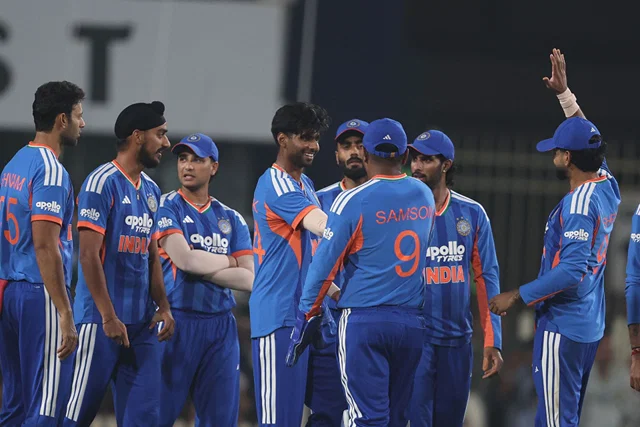
Former Indian cricketer Cheteshwar Pujara has expressed confidence in Abhishek Sharma‘s potential, predicting that the young left-handed opener will leave a lasting impression on Indian cricket. Ahead of the fourth T20I between India and the West Indies, Pujara praised Sharma’s remarkable progress in the shortest format and admitted that he had not expected the batter to reach the 2,000-run milestone so quickly.
The fourth match of the five-match T20I series is scheduled for Wednesday, October 14, in Hyderabad, according to the supplied report. Sharma enters the contest after delivering an impressive performance in the third T20I in Indore, where he scored 69 runs off just 30 deliveries to help India secure a 14-run victory.
Sharma’s aggressive approach, ability to score boundaries and growing understanding of match situations have made him an important part of India’s T20 batting lineup. Pujara believes the opener has the ability to remain influential for years and establish himself among India’s most memorable T20 players.
Cheteshwar Pujara Predicts a Bright Future for Abhishek Sharma
Speaking on the JioHotstar programme ‘Game Plan’, Pujara was asked whether he had anticipated Sharma reaching 2,000 runs in T20 internationals so early in his career. The former India batter acknowledged that the milestone had arrived faster than expected and highlighted the opener’s exceptional ability.
“No one had thought he would surpass such a big milestone so soon. However, the way Abhishek has done that, he is probably one of India’s best T20 players thus far, and going forward as well, I feel he has so much ability that the Indian team will remember his name,” Pujara said.
Pujara’s assessment reflects the growing expectations surrounding Sharma, whose aggressive style has helped him make an impact in international cricket. Reaching the 2,000-run mark at such a pace highlights his ability to score quickly while maintaining an attacking approach against different bowling attacks.
For India, Sharma’s presence provides an opportunity to build strong starts during the powerplay. His ability to attack from the beginning can put opposition bowlers under pressure and create scoring opportunities for the batters who follow.
However, maintaining consistency will remain important as teams continue to study his technique and develop strategies to restrict his scoring. Pujara’s comments suggest that Sharma’s adaptability and understanding of his own game could be just as important as his natural hitting ability.
Abhishek Sharma’s T20I Numbers Highlight His Explosive Batting
According to the statistics provided in the report, Sharma has scored 2,036 runs in 64 T20I innings at a strike rate of 195.95. His ability to accumulate runs at such a high scoring rate underlines his attacking approach in international T20 cricket.
He reached the 2,000-run milestone after facing just 1,024 deliveries, making him the fastest among players representing Test-playing nations to reach the mark by balls faced, according to the supplied information.
A strike rate of 195.95 means Sharma scores almost two runs for every ball he faces over the course of his T20I career. This scoring speed can make a significant difference in a format where teams have only 20 overs to establish a competitive total.
His innings of 69 from 30 balls against the West Indies in Indore provided another example of how quickly he can change a match. The knock combined aggressive scoring with the ability to make an impact during a limited number of deliveries.
For an opening batter, rapid scoring can help a team maximise the powerplay and establish momentum early in an innings. Sharma’s approach gives India an attacking option, although his contribution will also depend on how he responds to different bowling plans and match conditions.
Pujara Compares Abhishek Sharma’s Ability to Chris Gayle
One of the most notable parts of Pujara’s assessment was his comparison between Sharma’s T20 ability and that of former West Indies great Chris Gayle. Gayle became widely recognised for his powerful hitting, particularly his capacity to clear the boundary and dominate bowling attacks in the shortest format.
Pujara believes Sharma possesses a similar ability to make a major impact in T20 cricket. The comparison highlights the Indian opener’s potential to become a dangerous batter when he finds his rhythm.
“When we talk about the T20 format, we remember Chris Gayle’s name from the West Indies team. He has ability like that,” Pujara observed.
However, Pujara also highlighted a different aspect of Sharma’s development: his growing maturity at the crease. Rather than attempting to attack every delivery immediately, the left-hander has shown signs of taking a short period to assess the conditions before accelerating.
Referring to Sharma’s innings in Indore, Pujara noted that the opener took five or six balls to settle into his innings. For a batter known for his aggressive scoring, that brief period of assessment can be significant.
“That’s a very long time for him. He is understanding his game and the opposition’s strength, and batting according to that,” Pujara said.
This ability to assess the opposition before launching an attack could help Sharma become a more complete T20 batter. Power hitting is an important skill, but reading bowling variations, identifying favourable matchups and selecting the right deliveries to attack can make a substantial difference at the highest level.
Why Abhishek Sharma’s Off-Side Batting Is So Effective
Pujara also analysed the technical aspects of Sharma’s batting, identifying his off-side play as one of his strongest areas in T20 cricket. The former India batter explained how the opener uses his stance and movement in the crease to create room for his shots.
“The off side has been his strength in the T20 format. He has a lot of shots on the off side,” Pujara said.
According to Pujara, Sharma’s stance begins close to the leg-stump line, but he frequently moves away from the ball to create additional space. This movement allows him to free his arms and access deliveries that might otherwise restrict his ability to play attacking shots.
The technique also enables Sharma to redirect some deliveries pitched around the leg stump towards the off side. By changing his position in the crease, he can create different angles and expand his range of scoring options.
For bowlers, this approach can make it difficult to settle into a predictable line and length. Deliveries intended to cramp the batter for room may become scoring opportunities if Sharma moves effectively and makes the required adjustments.
However, moving across the crease also requires precise timing and control. Bowlers can attempt to counter such movement through changes in line, length and pace, meaning Sharma must continue adapting his approach as opponents look for weaknesses.
Downswing and Leg-Side Scoring Add to Sharma’s Batting Strengths
While Pujara highlighted Sharma’s off-side play, he also pointed to the importance of the batter’s downswing and his ability to score on the leg side. These elements help provide balance to an attacking game that might otherwise become predictable for opposition bowlers.
A batter’s downswing plays an important role in connecting with the ball and generating power. Sharma’s ability to combine this movement with a range of scoring shots gives him options against different types of deliveries.
His leg-side scoring is also significant because it prevents bowlers from focusing exclusively on restricting his off-side shots. When a batter can score on both sides of the wicket, it becomes more difficult for the opposition to establish a single defensive plan.
Pujara’s analysis suggests that Sharma’s success is not based only on brute force. His movement, shot selection and developing awareness of the opposition also contribute to his effectiveness in T20 cricket.
As his international career progresses, the challenge will be to preserve his attacking strengths while improving his responses to different bowling strategies. Such development could help him remain productive even when opponents prepare specifically to counter his preferred shots.
Hyderabad Conditions Could Benefit Abhishek Sharma in the Fourth T20I
Pujara also suggested that familiar conditions in Hyderabad could work in Sharma’s favour during the fourth T20I against the West Indies. The venue is associated with Sunrisers Hyderabad, the Indian Premier League franchise for which Sharma has played.
Familiarity with a ground can help a batter feel more comfortable when assessing the playing surface, judging boundary dimensions and adapting to local conditions. Although these factors do not guarantee a big score, they may help a player approach an innings with greater confidence.
Sharma will look to build on his 69-run performance in Indore as India attempt to continue their progress in the five-match series. His ability to provide an aggressive start could be particularly important against a West Indies side known for its power-hitting approach in T20 cricket.
At the same time, the fourth match will present a fresh challenge. The opposition can study Sharma’s previous innings and adjust its plans, making his ability to adapt during the game an important factor.
For India, the ideal outcome would be another confident performance from the left-handed opener, supported by contributions from the rest of the batting lineup. A strong start could help establish the platform needed for a competitive total.
India vs West Indies: What to Expect From the Fourth T20I
The fourth T20I in Hyderabad offers Sharma another opportunity to demonstrate why Pujara rates him so highly. His recent form and milestone achievement have increased expectations, but the focus will remain on how he contributes to the team’s performance.
India will want to maintain the momentum gained from their 14-run win in the third match. Sharma’s 30-ball 69 was a key part of that result, and another productive innings could strengthen India’s position in the series.
The West Indies, meanwhile, will aim to prevent Sharma from dictating the pace of the contest. Controlling his scoring opportunities during the early overs could be a priority, particularly given his ability to accelerate quickly once settled.
Pujara’s comments also underline the importance of long-term development. While Sharma’s scoring rate and power have already attracted attention, his ability to read the game and adjust his approach could determine how consistently he performs against international opposition.
With 2,000 T20I runs already behind him, Sharma has established an important milestone in his career. His next challenge is to build on that achievement and continue producing performances that help India succeed.
Frequently Asked Questions
1. What did Cheteshwar Pujara say about Abhishek Sharma?
Pujara praised Sharma’s rapid progress in T20 internationals and said the opener has the ability to become one of India’s best T20 players and remain memorable for the national team.
2. How many T20I runs has Abhishek Sharma scored?
According to the supplied report, Sharma has scored 2,036 runs in 64 T20I innings at a strike rate of 195.95.
3. How did Abhishek Sharma perform in the third T20I against the West Indies?
Sharma scored 69 runs from 30 balls in India’s 14-run victory in the third T20I in Indore.
4. Why did Pujara compare Abhishek Sharma to Chris Gayle?
Pujara compared their abilities in T20 cricket, highlighting Sharma’s potential to dominate bowling attacks through aggressive batting and powerful hitting.
5. What is Abhishek Sharma’s biggest batting strength?
Pujara identified Sharma’s off-side game as one of his major strengths, particularly his ability to create space in the crease and play attacking shots.
6. How quickly did Abhishek Sharma reach 2,000 T20I runs?
The supplied report states that Sharma reached the milestone after facing 1,024 balls, the fastest among players from Test-playing nations by balls faced.
7. When and where is the fourth India vs West Indies T20I scheduled?
According to the supplied report, the fourth match is scheduled for Wednesday, October 14, in Hyderabad.
8. Why could Hyderabad conditions help Abhishek Sharma?
Familiarity with the venue through his association with Sunrisers Hyderabad could help Sharma feel more comfortable with the ground and its playing conditions, although it does not guarantee a strong performance.
For breaking news and live news updates, like us on Facebook or follow us on Twitter and Instagram. Read more on Latest Cricket on thefoxdaily.com.






COMMENTS 0