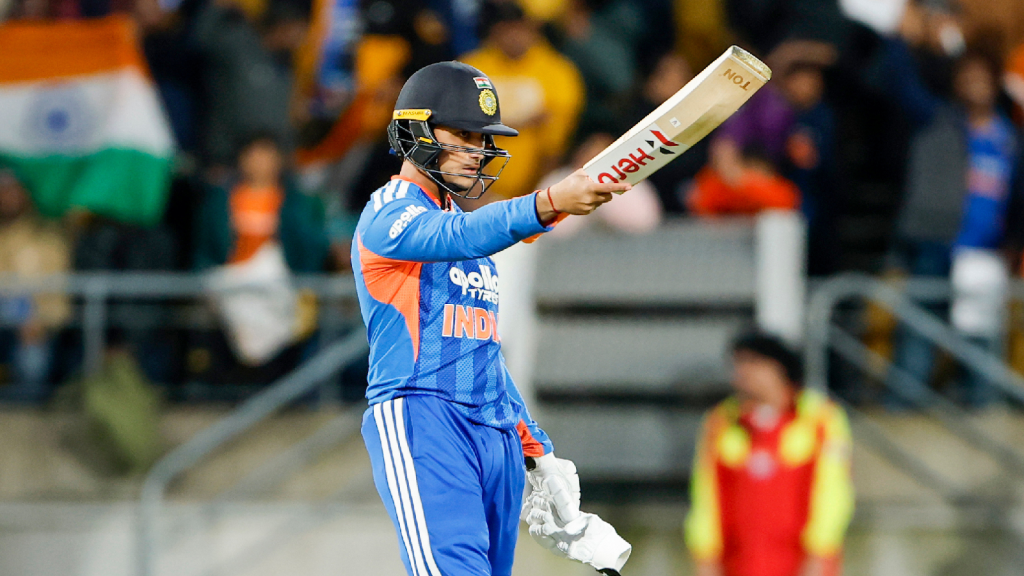
Abhishek Sharma delivered a remarkable batting performance in India’s third T20I against New Zealand in Wellington, reaching a century in just 35 balls while chasing a target of 199 runs. The left-handed opener’s aggressive approach put the spotlight on his ability to change the course of a T20 match in a short period and added another major achievement to his growing record in the shortest format.
The century was reported to be Abhishek’s second T20 International hundred of the calendar year and his 11th century across all forms of T20 cricket. With that achievement, he moved past Virat Kohli in the reported list of Indian batters with the most T20 centuries. The milestone underlined the speed of Abhishek’s progress and strengthened his reputation as an attacking opening batter.
However, the significance of the innings extends beyond the record itself. A century from an opener during a chase can reshape a team’s approach to the remaining overs, reduce the pressure on the middle order and force the opposition to reconsider its bowling plans. Abhishek’s 35-ball hundred offered a clear illustration of how quickly momentum can shift in modern T20 cricket.
Abhishek Sharma Reaches T20 Century in Just 35 Balls
Abhishek began his innings with an attacking mindset as India pursued New Zealand’s target of 199. Rather than allowing the required scoring rate to dictate a cautious start, he looked to put the bowling side under pressure from the outset.
His century in 35 balls represented an exceptionally rapid scoring performance. In T20 cricket, where each team normally has only 120 legal deliveries available in an uninterrupted innings, reaching three figures in fewer than 40 balls is a significant achievement. It requires a batter to maintain a high scoring rate while managing the risks associated with aggressive stroke play.
Abhishek’s innings was particularly notable because it came during a run chase. Batting first and chasing a target are different tactical challenges. When setting a total, a batter can concentrate on building an innings around the resources available. During a chase, the batting side must also account for the target, the overs remaining and the required run rate.
An explosive opening innings can make those calculations considerably easier. If the opening batter scores quickly, the team may be able to approach the middle overs with greater flexibility. Other batters can then focus on maintaining momentum rather than attempting to recover from a slow start.
The supplied match report identifies the target as 199 runs but does not provide the complete scorecard, Abhishek’s final score, the number of boundaries he hit or India’s final result. Those details are necessary to assess the full statistical impact of the innings and should not be inferred from the century alone.
How Abhishek Sharma Moved Ahead of Virat Kohli
The central record associated with Abhishek’s innings was his reported 11th century in all T20 cricket. According to the supplied report, that took him beyond Virat Kohli in the tally of T20 hundreds scored by Indian batters.
The distinction between T20 Internationals and all T20 cricket is essential to understanding the achievement. T20 cricket includes several categories of matches, including international fixtures between national teams and domestic or franchise competitions. A player’s record across all T20 matches can therefore differ substantially from his record for his country.
For example, a batter who regularly participates in franchise tournaments has more opportunities to accumulate T20 appearances than someone whose career is concentrated in international cricket. The number of centuries a player scores is influenced by his scoring ability, the volume of matches played, his batting position and the conditions in which he competes.
Abhishek’s reported tally of 11 centuries is consequently a broader career statistic rather than a record limited to matches played for India. The source specifically attributes the record to all T20 cricket, so it should not be confused with the separate category of most centuries in T20 Internationals.
Why the distinction between T20 and T20I records matters
A T20 International is a match between two national teams that has official international status. All T20 cricket includes a wider range of recognised T20 competitions, subject to the classification used by the relevant statistical record.
This difference matters when comparing Abhishek with Kohli or any other Indian batter. A player may have a substantial number of centuries across franchise and domestic competitions without holding the same position in the international-only rankings.
For readers following cricket statistics, the category attached to a record is just as important as the number itself. A claim about the most T20 centuries should identify whether it refers to all recognised T20 matches, international matches or a particular tournament.
The supplied report places Abhishek’s achievement in the all-T20 category. That is the appropriate scope for describing the reported milestone, while a definitive historical comparison would require checking the relevant statistical records as of the match date.
Why a 35-Ball Century Is Significant in Modern T20 Cricket
Scoring a century in 35 balls demonstrates how effectively a batter can convert a limited number of deliveries into runs. A century from 35 balls represents an average of approximately 2.86 runs scored per ball across the first 35 deliveries, equivalent to a strike rate of about 286.
That calculation illustrates the scale of the scoring rate without requiring assumptions about the number of fours or sixes. The actual boundary distribution would be needed to explain precisely how Abhishek reached the milestone.
Strike rate is one of the most useful measures of aggressive batting in T20 cricket, but it should not be considered in isolation. The value of an innings also depends on the match situation, the target, the number of wickets available and the batter’s contribution to the team’s overall position.
In a chase of 199, a rapid start can reduce the pressure on the rest of the batting order. The opening batter can establish an early scoring rate, while the partner at the other end may have more freedom to rotate the strike, build a partnership or attack selected bowlers.
However, an aggressive innings also involves risk. Attempting to score rapidly can lead to mistimed shots and dismissals, potentially exposing the middle order earlier than planned. The challenge for an elite T20 batter is to combine attacking intent with sufficient control to keep scoring opportunities available.
Reaching a hundred in only 35 balls suggests that Abhishek was able to sustain an exceptional scoring pace during the period covered by the milestone. A full evaluation of the innings would also consider the bowling attack, the match conditions and how India progressed after the opening partnership.
Abhishek Sharma’s Growing Importance as an Indian Opener
Opening the innings gives a batter an opportunity to influence the match from the first over. Unlike a middle-order batter, who may enter after the fielding side has already established a plan and taken wickets, an opener begins against the new ball and can set the tempo for the innings.
Abhishek’s attacking style is particularly relevant to this role in T20 cricket. A quick-scoring opener can force captains to reconsider their field placements and bowling changes earlier than expected. If the opening batter consistently finds scoring opportunities, the opposition may have less freedom to follow its preferred plan.
His century against New Zealand, as described in the supplied report, highlighted the potential value of that approach during a substantial chase. Rather than treating the target as a reason to begin cautiously, Abhishek attacked early and reached three figures before facing 40 balls.
That does not mean every innings should follow the same template. Conditions, the quality of the bowling attack and the performance of the partner at the other end all influence the appropriate strategy. A difficult pitch or early loss of a wicket may require a different approach from one used on a surface that offers regular scoring opportunities.
The wider lesson is that an attacking opener provides tactical flexibility. When the opening partnership scores quickly, the middle order may be able to preserve wickets for the final overs. When the start is slower, later batters may need to accept greater risks to bring the required run rate under control.
For India, the value of Abhishek’s performance therefore lies not only in the individual milestone but also in the possibility of establishing an effective approach at the top of the order. Consistency across different opponents and conditions would be necessary to determine how reliably that approach can deliver results.
What the Record Means in Comparison With Virat Kohli
Virat Kohli has long been associated with high-level batting across international and franchise cricket. His presence in a comparison of T20 centuries gives Abhishek’s reported achievement additional significance, particularly for followers of Indian Cricket who track milestones across generations of players.
Nevertheless, comparing the two batters requires care. Career totals can reflect different roles, periods of participation, competition schedules and opportunities. A player’s century count provides a useful measure of high-scoring performances, but it does not independently establish who has had the better career or made the greater contribution to a team.
Abhishek’s reported 11th T20 hundred marks a specific statistical achievement. It does not, by itself, establish that he has surpassed Kohli in other batting categories, such as total T20 runs, international centuries, average or performances in major tournaments.
The most meaningful comparison would examine each category separately. All-T20 centuries measure the frequency with which a batter reaches 100 across the competitions included in the record. Total runs measure accumulated output, while batting average and strike rate provide different perspectives on scoring efficiency and pace.
Match context also matters. A century in a successful chase may have a different practical effect from one scored in a match where the team ultimately loses. Likewise, a batter’s contribution can sometimes be substantial even without a hundred, particularly when a shorter innings helps establish a strong position for the team.
Abhishek’s milestone should therefore be understood on its own terms: the supplied report credits him with moving ahead of Kohli in the all-T20 centuries tally. It is a notable record, while broader claims about the relative achievements of the two players would require a more comprehensive statistical comparison.
Why the New Zealand Match Matters Beyond the Century
International T20 matches provide a different test from franchise fixtures because teams operate within a national setup and must adapt to opponents who may have different combinations, bowling strategies and match plans.
Scoring a century in an international fixture can demonstrate that a batter’s attacking methods are effective in that particular contest. It can also provide useful information for future selection and tactical decisions. However, one innings is not enough to establish how a player will perform in every condition or against every opponent.
The Wellington match also placed Abhishek’s performance within a specific team objective: chasing 199. A century during a pursuit of that size has a clear tactical purpose because the batter must contribute not simply to a personal score but to the progress of the chase.
The full significance depends on how the remaining innings unfolded. India’s final score, the number of wickets lost, the contributions of other batters and the result would help establish whether Abhishek’s hundred completed the chase, created a winning position or came in a more complicated match situation.
Because those details are not included in the supplied report, the safest conclusion is that the innings was a major individual scoring achievement during India’s pursuit of the target. The match result and complete statistical record would be needed for a fuller assessment of its outcome.
What to Watch After Abhishek Sharma’s Record-Breaking Innings
The next important question is whether Abhishek can build on the milestone with consistent performances. A century can demonstrate a batter’s capacity for explosive scoring, but sustained success depends on adapting when opponents change their plans.
Opposition teams may respond to an aggressive opener by altering their bowling combinations, using different field placements or targeting specific areas outside the batter’s preferred scoring zones. How a player responds to those adjustments can be as important as the initial attacking performance.
For Abhishek, the relevant indicators in subsequent matches will include his ability to provide strong starts, maintain scoring pressure and contribute effectively when conditions are less favourable. His performances against different types of bowling and in different stages of a series will provide a broader picture than a single innings.
Statistical tracking will also help clarify the scale of his achievement over time. The number of all-T20 centuries, international hundreds, total runs and innings played can show how his career develops. These figures should be assessed using clearly defined categories and updated records rather than treating one milestone as a complete measure of long-term performance.
There is also a team-level consideration. An opener’s impact is strongest when rapid scoring supports the overall objective rather than becoming an end in itself. The balance between attacking play, partnerships and the preservation of wickets remains central to successful T20 batting.
Abhishek Sharma’s 35-Ball Hundred: The Key Takeaway
Abhishek Sharma’s reported 35-ball century against New Zealand was a major individual milestone in India’s third T20I in Wellington. Batting at the top of the order in a chase of 199, he produced a rapid hundred that the supplied report identifies as his second T20I century of the calendar year and his 11th hundred across all T20 cricket.
The reported achievement moved him ahead of Virat Kohli in the all-T20 centuries tally for Indian batters. It also highlighted the influence an aggressive opener can have on a T20 chase, where a fast start can change the required scoring rate and the options available to the rest of the batting order.
The distinction between all-T20 and T20 International records remains important, as does the difference between an individual scoring milestone and a team’s final result. A complete scorecard and verified statistical records are needed to establish the wider match context and confirm the exact standing of the record.
Even with those distinctions, the central achievement is clear from the supplied report: Abhishek reached a T20 hundred in just 35 balls and added another landmark to his career. His future performances will determine how consistently he can turn that attacking ability into sustained contributions for India.
For breaking news and live news updates, like us on Facebook or follow us on Twitter and Instagram. Read more on Latest Cricket on thefoxdaily.com.






COMMENTS 0