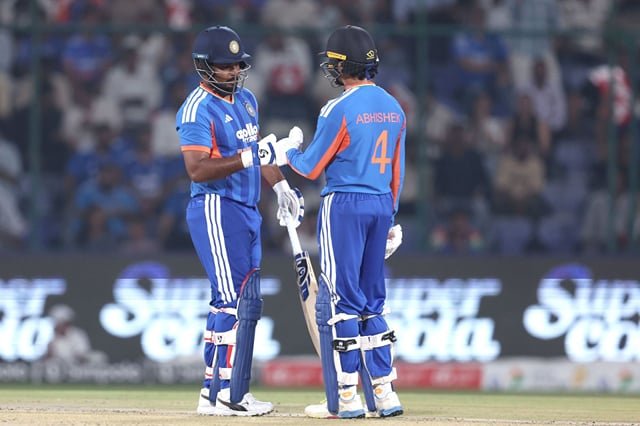
Former India fast bowler Varun Aaron has identified an area where Abhishek Sharma could improve his batting ahead of the third T20I against the West Indies. Aaron believes the left-handed opener could become more effective against spin by using the depth of the crease rather than relying primarily on his front-foot shots.
India and the West Indies are scheduled to meet in the third match of the five-T20I series at the Holkar Cricket Stadium in Indore on Sunday, October 11, 2026. With the series level at 1-1, India will look to regain the advantage after losing the second match in Ranchi by six wickets.
Abhishek has made quick starts in both matches but has been unable to convert them into substantial scores. Aaron’s comments have therefore brought attention to the opener’s shot selection, footwork and approach against spin as India prepare for another important encounter.
Varun Aaron Wants Abhishek Sharma to Use the Depth of the Crease
Speaking during an interaction on Star Sports’ Game Plan, Aaron was asked what advice he would offer Abhishek before the third T20I. The former India pacer highlighted the opener’s tendency to move forward and play aggressively off the front foot.
“I think the one part of his game, against spin especially, where Abhishek Sharma could maybe evolve a little bit is using the depth of the crease.”
Aaron explained that Abhishek often plants his front foot to attack the ball but does not regularly move backwards to create additional scoring options. He suggested that using the depth of the crease could give the batter another way to respond to spinners.
The observation does not mean Abhishek should abandon his attacking style. Instead, the suggestion is to add another option to his existing game so that bowlers cannot rely on one approach to challenge him.
Why using the depth of the crease matters
In cricket, using the depth of the crease means adjusting one’s position by moving backwards within the available batting area. This movement can create additional time against certain deliveries and allow a batter to play shots that might be difficult when committing forward early.
Against spin, a batter who moves forward can attempt to reach the pitch of the ball and hit through the line. However, if the delivery is shorter than expected, the batter may have limited room to adjust after committing to the front foot.
Moving backwards can help a batter respond to shorter deliveries, create space and access different scoring areas. It can also make a bowler reconsider the length required to challenge the batter.
For an aggressive opener such as Abhishek, this variation could be especially useful. If he can threaten bowlers with both front-foot and back-foot options, it may become more difficult for them to settle into a predictable plan.
Abhishek Sharma’s Scores in the First Two T20Is
Abhishek made quick contributions in the opening two matches of the series but was unable to build on either start. His dismissals came against West Indies off-spinner Roston Chase, who found ways to remove the Indian opener in different situations.
| Match | Abhishek Sharma’s Score | Dismissal Detail |
|---|---|---|
| 1st T20I | 21 off 10 balls | Caught at long-off while attempting a big shot against Roston Chase |
| 2nd T20I | 20 off 12 balls | Caught at mid-on while attempting to hit across the line against Chase |
These innings showed Abhishek’s ability to score quickly, but they also highlighted the risk involved in his aggressive approach. In T20 cricket, openers are often expected to maximise the powerplay, although maintaining a balance between attacking and preserving their wicket remains important.
For India, Abhishek’s ability to turn early momentum into a bigger score could become a significant factor in the remaining matches. A longer innings would not only strengthen the team’s total but could also reduce pressure on the middle order.
Varun Aaron Explains Why Abhishek’s Two Dismissals Were Different
Aaron also discussed the circumstances surrounding Abhishek’s dismissals in the first two T20Is. He stressed that the two wickets came in different ways, suggesting that the batter and the bowling side would need to assess each situation separately.
“Both were very different dismissals. He first bowled far from Abhishek Sharma, and then he cramped Abhishek Sharma.”
In the first match, Abhishek was caught at long-off while attempting an aggressive shot. In the second, he was caught at mid-on after trying to hit the off-spinner across the line towards the leg side.
Although both dismissals came against Chase, the difference in execution and delivery placement is important. A batter may be challenged by a delivery outside the preferred hitting area in one innings and by a delivery that restricts the available room in another.
Length remains a crucial factor
Aaron emphasised the importance of bowling length, pointing out that deliveries around the top of the stumps can create problems for batters. Such deliveries can restrict a batter’s room to swing freely while forcing a decision about whether to play forward, defend or attempt an attacking shot.
He also warned against relying exclusively on very full deliveries or attempting to bowl too far away from the batter. According to Aaron, consistently attacking the area around the top of the stumps can be an effective way to challenge even high-quality batters.
The broader lesson is that successful bowling plans often depend on precision rather than simply trying to surprise a batter with an extreme length. A well-directed delivery can create uncertainty about shot selection and make it harder for the batter to commit confidently.
How West Indies Could Approach Abhishek in the Third T20I
With the series level, the West Indies will have an opportunity to build on the success of their bowling plans from the first two matches. Chase’s dismissals of Abhishek may encourage the visitors to continue studying the opener’s preferred scoring areas and responses to spin.
However, repeating the same approach does not guarantee another wicket. Abhishek and India’s coaching staff can review the previous dismissals and consider adjustments to his footwork, shot selection and response to different lengths.
1. Varying the length
One option for the bowling side is to vary the length while maintaining control of the line. The aim would be to prevent Abhishek from predicting the delivery and committing too early to a particular shot.
For Abhishek, recognising the length quickly and adjusting his footwork could help him respond more effectively. Moving forward is useful when he can reach the pitch of the ball, while moving backwards may offer a better option against certain shorter deliveries.
2. Controlling the scoring areas
Abhishek’s aggressive approach means that bowlers must consider both his preferred hitting zones and the field placements around them. The West Indies could look to make his strongest shots more difficult without giving away easy scoring opportunities elsewhere.
The Indian opener, in turn, will need to identify opportunities rather than force every delivery into a boundary attempt. Choosing the right ball to attack can help him maintain a high scoring rate while improving his chances of batting for longer.
3. Managing the risk against spin
Spin bowling can challenge aggressive batters by changing pace, trajectory and length. A batter who relies heavily on power may face difficulties when the ball does not arrive in the expected area.
Aaron’s suggestion about using the depth of the crease is relevant here because it offers Abhishek another response. Adding variation to his footwork could make it harder for bowlers to target a single weakness throughout an innings.
Why Abhishek Sharma’s Form Matters for India
Abhishek’s role at the top of the order is important because a fast start can put pressure on the opposition and provide India with a strong foundation. His attacking style gives the team the potential to score quickly during the powerplay, but the value of that start increases when he can remain at the crease for longer.
His scores of 21 off 10 balls and 20 off 12 deliveries show that he has been able to find runs early in the innings. The next step is converting those starts into a more substantial contribution when the conditions and match situation allow it.
India will also need to consider the partnership between its opening batters. A productive opening stand can reduce the pressure on the middle order, provide flexibility in the batting approach and create opportunities for the team to build a competitive total.
At the same time, one or two low scores should not automatically be treated as evidence of a wider problem. T20 cricket involves high-risk decisions, and even accomplished batters can be dismissed while attempting shots that have previously brought them success.
Aaron’s remarks are therefore best understood as a technical suggestion rather than a call for Abhishek to change his entire approach. Improving one aspect of his game could give him more options without removing the aggression that makes him valuable at the top of the order.
India vs West Indies 3rd T20I: What to Watch
The third T20I in Indore presents an important opportunity for both teams. India will want to respond after the six-wicket defeat in Ranchi, where the West Indies chased down a target of 250 with nine balls remaining.
The visitors’ successful chase in the second match was led by Shai Hope, who scored an unbeaten 102 off 45 balls, and Sherfane Rutherford, who made 84 off 37 deliveries. Their performances underlined the importance of sustained attacking batting in modern T20 cricket.
India will need its top order to provide momentum while ensuring that the middle order has enough time to build on the opening partnership. The bowling attack will also be under scrutiny after conceding 252 runs in Ranchi.
For Abhishek, the key individual storyline will be whether he can make better use of the crease and turn another quick start into a longer innings. The West Indies, meanwhile, will look to exploit any opportunities created by their bowling plans.
Conclusion
Varun Aaron has advised Abhishek Sharma to use the depth of the crease more effectively, particularly when facing spin bowling. The former India pacer believes that adding back-foot options to the opener’s attacking front-foot game could help him become less predictable.
Aaron also highlighted the different circumstances behind Abhishek’s dismissals against Roston Chase in the first two T20Is. His comments focused on the importance of bowling length and the challenge posed by deliveries directed around the top of the stumps.
As India prepare for the third T20I against the West Indies in Indore, Abhishek’s response will be worth watching. If he can combine his natural attacking instincts with more varied footwork and improved shot selection, he could strengthen India’s start and help the hosts regain the lead in the five-match series.
“`
For breaking news and live news updates, like us on Facebook or follow us on Twitter and Instagram. Read more on Latest Cricket on thefoxdaily.com.






COMMENTS 0