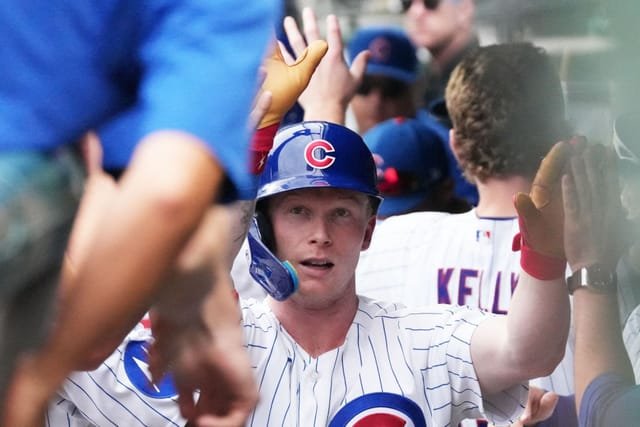
The 2026 NL MVP race is shaping up to be one of the most fascinating individual battles in Major League Baseball, with Los Angeles Dodgers superstar Shohei Ohtani and Chicago Cubs breakout star Pete Crow-Armstrong emerging as two of the leading names in the conversation.
Former Cincinnati Reds standout Sean Casey recently offered his perspective on the debate, praising Crow-Armstrong’s all-around improvement while explaining why Ohtani remains extremely difficult to surpass. Casey’s argument centers on one of baseball’s oldest truths: elite hitting is enormously valuable, but a player capable of making an impact on both sides of the ball occupies a completely different category.
Crow-Armstrong has given the Cubs plenty of reasons to believe he belongs in the conversation. His combination of defensive range, baserunning ability and improved offensive production has transformed him into one of Chicago’s most complete players.
Yet Ohtani’s ability to contribute as an elite hitter while also returning to the mound creates a unique MVP case. No other player can replicate the exact combination of offensive production and pitching value that the Dodgers star brings.
Why Pete Crow-Armstrong has entered the NL MVP conversation
Crow-Armstrong’s candidacy is built on more than one statistic or highlight-reel moment. His value comes from how many different areas of the game he influences.
The Cubs outfielder has established himself as a premium defensive presence while simultaneously becoming a more dangerous offensive player. His speed adds another dimension, allowing him to create pressure on opposing defenses once he reaches base.
That combination matters in an MVP discussion because traditional offensive production is only one part of a player’s overall value.
A center fielder who can cover enormous amounts of ground, steal bases, create extra-base opportunities and produce consistently at the plate can influence games in ways that do not always appear in a basic batting-line comparison.
Casey acknowledged precisely that point when discussing Crow-Armstrong.
“I love PCA. Obviously, what he’s doing is incredible. He hits the ball to all ballparks, he runs the bases well, he steals… he does everything you’d want in an MVP.”
That is a significant endorsement from a former major-league player. Casey is not dismissing Crow-Armstrong’s candidacy. Instead, he is arguing that the Cubs star has developed into a legitimate MVP-level player even if Ohtani ultimately has the stronger case.
Sean Casey’s biggest argument for Shohei Ohtani
The central point in Casey’s comparison is simple: Ohtani can affect a game as both a hitter and a pitcher.
That distinction separates the Dodgers superstar from virtually every other MVP candidate.
For a normal position player, offensive and defensive performance form the foundation of the MVP case. For a traditional pitcher, value comes primarily from preventing runs and controlling games from the mound.
Ohtani can potentially contribute in both categories.
That means his MVP argument cannot be evaluated solely through his offensive statistics. His pitching workload and effectiveness must also be considered when determining his total impact.
Casey emphasized that difference when explaining why he still leans toward Ohtani despite Crow-Armstrong’s outstanding season.
“No one could do that. No one can pitch and hit at an elite level.”
That may be the most important sentence in the entire debate.
Why the pitching component changes the MVP calculation
Baseball is uniquely suited to separating individual responsibilities. Hitters control their plate appearances, while pitchers control the game from the mound. Players generally specialize in one of those roles.
Ohtani challenges that structure.
When he is productive as both a hitter and pitcher, his total contribution becomes unusually difficult to compare with a conventional position player. A player such as Crow-Armstrong can accumulate enormous value through defense, offense and baserunning, but he cannot add pitching value to the equation.
That does not automatically make Ohtani the MVP. MVP voting still depends on the quality and scale of each player’s actual season.
However, it gives Ohtani an additional pathway to separate himself if his pitching performance reaches the level expected of a frontline starter while his offensive production remains comparable with the best hitters in the National League.
Ohtani’s two-way case is more than a novelty
One potential mistake in evaluating Ohtani is treating his two-way ability as a novelty rather than a source of measurable value.
Being able to hit and pitch is impressive. Doing both at an elite level is something entirely different.
The MVP discussion should therefore focus on the actual value produced by those roles rather than simply celebrating the rarity of the achievement.
If Ohtani produces elite offensive numbers and adds substantial value as a starting pitcher, the argument becomes straightforward: he is contributing at a superstar level in two distinct areas of the game.
That creates a higher potential ceiling than a player whose value is concentrated in position-player skills, even when that position player is as complete as Crow-Armstrong.
Pete Crow-Armstrong has one major advantage over Ohtani
While Ohtani’s versatility is extraordinary, Crow-Armstrong’s supporters have a powerful counterargument: he can provide elite defensive value every day in center field.
Defensive impact is often more difficult for casual fans to evaluate than home runs or batting average, but center field requires exceptional anticipation, speed, route efficiency and decision-making.
Crow-Armstrong’s range can prevent hits that never appear in an offensive stat line. His speed can also create additional value on the bases and allow him to turn singles into scoring opportunities.
That makes his MVP case broader than simply comparing his batting numbers with Ohtani’s.
If Crow-Armstrong’s offensive improvement continues while his defense remains elite, he has a legitimate argument that his overall contribution is closer to Ohtani’s than a basic hitter-versus-pitcher comparison might suggest.
Dave Roberts says Crow-Armstrong and Ohtani are “toe to toe”
The strength of Crow-Armstrong’s campaign is also reflected in comments from Dodgers manager Dave Roberts.
Roberts described Crow-Armstrong as having an “MVP-type season” and said the Cubs star has earned his place among the leading candidates.
“I do think they were going toe to toe. Obviously, there’s a lot of talk about those two guys being the front-runners for the MVP.”
Roberts also pointed to Crow-Armstrong’s development at the plate, describing his adjustment as part of the process that has made him a more complete player.
That assessment is particularly noteworthy because Roberts manages Ohtani in Los Angeles. His comments suggest that even within the Dodgers organization, Crow-Armstrong’s performance is being recognized as a serious challenge to Ohtani’s MVP case.
The MVP race is not simply Ohtani vs Crow-Armstrong
Although the two stars have become the focus of the current discussion, MVP voting is not a head-to-head competition in the literal sense.
Other National League stars can influence the final result if their performances surge during the remainder of the season.
That means the race could ultimately depend on several factors:
- Offensive production: Home runs, extra-base hits, on-base ability and overall run creation remain central.
- Defensive value: Crow-Armstrong’s defensive contribution could strengthen his case significantly.
- Baserunning: Speed and efficient base running add value beyond hitting.
- Pitching: Ohtani’s mound performance gives him a category Crow-Armstrong cannot match.
- Team impact: The performance of the Dodgers and Cubs can influence the broader narrative, even though MVP voting is about individual achievement.
- Voter perception: How voters evaluate two-way performance and repeated MVP-caliber seasons could matter.
Could voter fatigue hurt Shohei Ohtani?
Another issue surrounding Ohtani’s candidacy is what is often called voter fatigue.
Ohtani has already established himself as one of the most dominant and recognizable players in baseball. When a superstar repeatedly appears in award conversations, voters can sometimes become more interested in a new challenger.
Former Reds star Joey Votto has previously raised the possibility of voter fatigue in the wider discussion around Crow-Armstrong and Ohtani.
That does not mean voters will intentionally penalize Ohtani. Instead, a particularly compelling season from a younger player such as Crow-Armstrong could make the decision more difficult if the statistical gap between the candidates is relatively small.
In other words, Crow-Armstrong does not necessarily need to be dramatically better than Ohtani in every category. He needs his overall value to be strong enough that voters can reasonably argue that his season deserves the award.
Why Crow-Armstrong’s defensive value could become the deciding factor
If the offensive numbers between the two candidates are relatively close, defense could become one of the most important areas of comparison.
Crow-Armstrong’s value in center field gives him a distinctive profile. A strong defensive season can change the way a player’s total contribution is viewed, especially when combined with significant offensive improvement.
Ohtani, meanwhile, has another form of value that is even more unusual: pitching.
This creates an intriguing statistical problem for MVP voters.
One player may prevent runs through elite defense, while another prevents runs through pitching. The question becomes how much each form of contribution should count relative to the player’s offensive production.
That is why this race could become more complicated than simply comparing home runs or batting averages.
Ohtani’s pitching return could be the ultimate tiebreaker
From Casey’s perspective, Ohtani’s work on the mound could provide the clearest separation.
If Ohtani demonstrates that he can operate as a genuine frontline pitcher while continuing to produce at an elite level offensively, his MVP case becomes exceptionally difficult to overcome.
The key is quality rather than merely participation.
Simply appearing as a pitcher would not automatically make Ohtani more valuable than Crow-Armstrong. The pitching component needs to provide meaningful production.
That is the crucial distinction in Casey’s argument. Ohtani’s advantage comes from the possibility of combining two elite skill sets, not from receiving extra credit merely because he performs two jobs.
What makes this MVP race different from a typical award debate?
Most MVP debates compare players who occupy broadly similar roles. Even when their positions differ, voters can use offensive and defensive metrics to build a relatively consistent framework.
Ohtani complicates that process.
Comparing him with Crow-Armstrong requires evaluating a hitter-pitcher against a position player whose value is spread across hitting, defense and baserunning.
That makes this more than a simple statistical race. It is also a debate about how baseball value should be measured.
Should extraordinary versatility receive additional weight? How should pitching value be compared with elite center-field defense? How much should offensive production influence the final decision?
Those questions make the 2026 NL MVP discussion especially compelling.
Ohtani vs Crow-Armstrong: The clearest comparison
| Category | Shohei Ohtani | Pete Crow-Armstrong |
|---|---|---|
| Offense | Elite offensive profile | Major offensive improvement |
| Defense | Not the central component of his current value | Elite center-field defense is a major strength |
| Baserunning | Provides athletic value on the bases | Speed and stolen-base ability are major assets |
| Pitching | Provides an additional source of MVP value | Does not pitch |
| Versatility | Two-way player | Complete position player |
| Main MVP argument | Elite production as both hitter and pitcher | Combination of offense, defense and baserunning |
Why Sean Casey’s argument matters
Casey’s perspective is valuable because he does not diminish Crow-Armstrong to make the case for Ohtani.
Instead, he acknowledges that the Cubs star is doing almost everything an MVP candidate should do. His conclusion is simply that Ohtani has an additional dimension that nobody else can reproduce.
That distinction makes the debate more credible.
The question is not whether Crow-Armstrong deserves consideration. He clearly does. The question is whether his complete position-player profile can overcome the additional value created by Ohtani’s two-way role.
That answer may ultimately depend on how effective Ohtani is on the mound and whether Crow-Armstrong can maintain his offensive pace.
Prediction: Shohei Ohtani still has the edge, but the race is far from over
Ohtani should remain the slight favorite if his pitching performance reaches an elite level while his offensive production stays comparable with Crow-Armstrong’s.
The two-way factor gives him the clearest differentiator in the race. Crow-Armstrong can counter with elite defense, baserunning and a rapidly improving offensive game, but there is no direct equivalent to adding legitimate pitching value.
However, the race could shift if Crow-Armstrong creates a substantial offensive gap or continues producing at an extraordinary level while maintaining elite defense.
That is what makes the remainder of the season so important. Ohtani’s pitching performance and Crow-Armstrong’s ability to sustain his offensive breakout could determine whether this remains a close debate or becomes a clearer MVP decision.
The bigger story for MLB
Regardless of who wins, the competition between Ohtani and Crow-Armstrong is good for baseball.
Ohtani represents something extremely rare: a modern two-way superstar capable of changing how fans think about player value. Crow-Armstrong represents another compelling development: a young, dynamic center fielder showing how defensive excellence, speed and offensive growth can combine into an MVP-caliber profile.
The contrast gives fans two very different definitions of greatness.
Ohtani’s case asks how much value one player can create through multiple elite skills. Crow-Armstrong’s case asks how dominant a complete position player can become when defense and athleticism accompany offensive development.
Conclusion: Shohei Ohtani’s two-way ability remains his biggest MVP weapon
The 2026 NL MVP race between Shohei Ohtani and Pete Crow-Armstrong could come down to one of baseball’s most difficult value comparisons. Crow-Armstrong has emerged as a legitimate contender through his improved hitting, elite defense and outstanding baserunning, earning praise from both Sean Casey and Dave Roberts.
But Ohtani possesses a rare advantage that Casey believes could ultimately separate him: the ability to contribute as both an elite hitter and pitcher.
That does not make the race automatic. Crow-Armstrong’s defensive value and offensive development could still give him a powerful argument, particularly if Ohtani’s pitching impact does not reach the level expected.
For now, however, Ohtani has the more difficult-to-replicate MVP profile. Crow-Armstrong may be capable of matching or even surpassing him in certain areas, but he cannot add pitching value to his résumé.
That could be the difference between being one of the National League’s most exciting stars and ultimately taking home the 2026 MVP award.
For breaking news and live news updates, like us on Facebook or follow us on Twitter and Instagram. Read more on Latest MLB on thefoxdaily.com.



COMMENTS 0