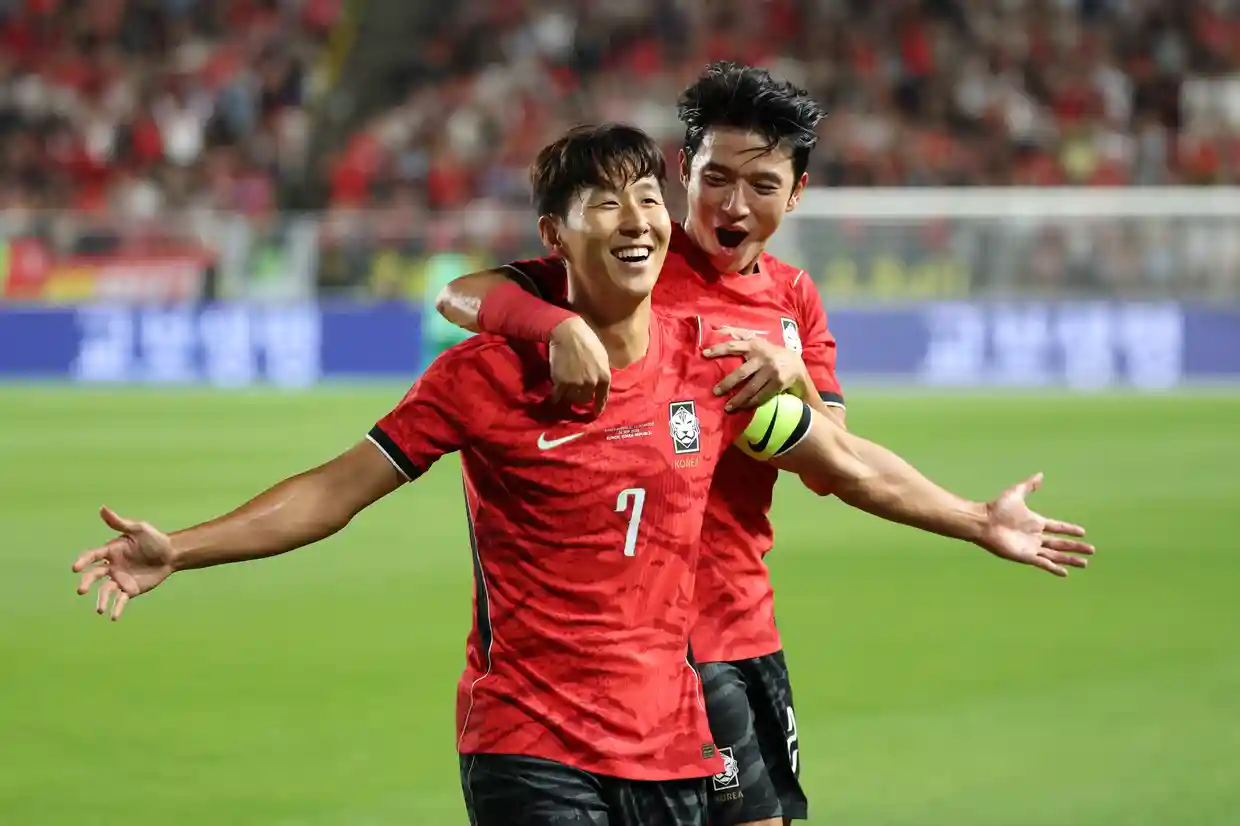
South Korean football is facing a period of uncertainty as reports of dressing-room divisions, leadership disagreements and administrative problems continue to raise questions about the national team’s future. Less than two years before another major international challenge, tensions between senior and younger players have placed captain Son Heung-min’s position under scrutiny.
The situation has become a national talking point following a parliamentary committee meeting on October 21, where questions were raised about the atmosphere inside the South Korea squad. Reports suggested that some players had stopped referring to Son by his name, instead using expressions such as “No 7” or “that person”. The exchange brought growing concerns about team unity into the public spotlight.
South Korea’s difficulties extend beyond the dressing room. The national team endured a disappointing World Cup campaign, head coach Hong Myung-bo and Korea Football Association (KFA) president Chung Mong-gyu stepped down, and police subsequently raided the federation’s offices. With the Asian Cup approaching, the country is searching for stability both on and off the pitch.
At the centre of the discussion is Son, one of South Korea’s most recognisable sporting figures. The 34-year-old remains the national team’s record goalscorer, but questions about his leadership, current performances and long-term international future have created an increasingly complicated situation.
Son Heung-min’s Leadership Comes Under Scrutiny
Son Heung-min has been one of the defining figures in South Korean football for more than a decade. His achievements in the Premier League, international performances and status as a national sporting icon have made him an influential presence within the team.
However, concerns about the national team’s internal relationships emerged publicly during a parliamentary committee meeting on October 21. Politician Jeong Yeon-wook questioned acting KFA president Lee Yong-soo about reports that players had started referring to a senior teammate as “No 7” or “that person” rather than using his name.
When Lee asked whether the politician was referring to Son, Jeong indicated that this appeared to be the case. He also suggested that disagreements within the national team’s leadership had created wider divisions. Lee declined to comment on the matter.
The exchange attracted attention because it raised questions about Son’s standing among his teammates. However, the reported comments do not establish the full extent of the disagreement, and the precise nature of the alleged dressing-room tensions remains unclear.
Son’s influence has been built over many years. After leaving South Korea at the age of 16, he developed into one of the country’s most successful footballers, eventually captaining Tottenham Hotspur and lifting the Europa League trophy before leaving the London club.
His move to Los Angeles FC in Major League Soccer was partly motivated by preparations for the 2026 World Cup. Yet the tournament did not provide the farewell or defining international moment that many supporters might have hoped for.
South Korea’s World Cup Campaign Deepened the Crisis
The national team’s disappointing World Cup campaign became a turning point in an already difficult period for South Korean football. South Korea suffered a group-stage exit, while controversy surrounding media relations added another layer of tension.
Unnamed reporters had reportedly mocked Son over his lack of military service, leading to a media boycott during the tournament. Son also started on the bench for South Korea’s final match, a heavy defeat against South Africa.
The result and surrounding controversies intensified criticism of the team’s leadership. Head coach Hong Myung-bo and KFA president Chung Mong-gyu subsequently stepped down after facing questions from parliamentarians.
The situation then extended beyond football management when police raided the KFA’s offices. These developments left the federation dealing with administrative uncertainty at the same time that the national team needed to prepare for upcoming international competitions.
Although there appears to be broad agreement that the World Cup campaign represented a difficult period for Korean football, there is less agreement about how the problems should be addressed.
The combination of disappointing results, questions about governance and reported disagreements between players has created uncertainty around the national team’s direction.
Why Are There Tensions Between Older and Younger South Korean Players?
Generational differences have long been a feature of South Korean football, partly because age and seniority influence how players communicate with one another. Even a small age difference can affect the way teammates address each other and interact within a squad.
Former South Korea coach Guus Hiddink recognised this cultural dynamic when he took charge of the national team in 2001. He reportedly encouraged players to sit together during meals, helping younger teammates become more comfortable communicating with senior players.
The objective was to create an environment in which younger footballers could speak freely and give instructions to experienced teammates during matches. Hiddink believed that greater communication could improve the team’s collective performance.
The current reported disagreements appear more complicated than a simple difference in age or seniority. Several reports have suggested that a group of established players born in 1996 are unhappy with aspects of the national team’s leadership.
That group reportedly includes Bayern Munich defender Kim Min-jae, FC Porto midfielder Hwang In-beom and Hwang Hee-chan, who now plays for Schalke 04 after previously representing Wolverhampton Wanderers.
According to reports, the players wanted a fresh start following the World Cup, including changes to the captaincy and coaching position. However, the exact demands and the extent of their disagreement with Son have not been publicly established.
The situation has therefore created questions about whether the national team can maintain a shared sense of purpose while navigating differences between experienced leaders and younger members of the squad.
Son Heung-min and Lee Kang-in’s Previous Dressing-Room Incident
The latest reports have also brought renewed attention to an earlier disagreement involving Son and younger teammate Lee Kang-in.
During the 2024 Asian Cup, an altercation reportedly took place following a disagreement over table tennis. Son dislocated a finger during the incident, which involved Lee and several younger players.
The incident attracted considerable attention in South Korea because it involved the national team’s captain and one of its most promising young footballers. Son and Lee subsequently reconciled, but the episode highlighted the challenges of maintaining relationships within a squad where seniority and communication carry significant importance.
The current situation appears to involve a wider group of players and broader questions about leadership. It would therefore be inaccurate to treat the earlier incident as the sole explanation for the reported divisions.
Nevertheless, the recurrence of questions about relationships between senior and younger players has intensified public interest in the national team’s internal environment.
Kim Min-jae and Hwang In-beom Express Frustration
Comments from senior players after recent international matches have added to concerns about the team’s direction.
Following a goalless draw against Venezuela on October 2, Hwang In-beom spoke openly about his frustration. He said he was physically and mentally tired after approximately nine years with the national team, adding that many things needed to change both in football and in other areas.
His remarks suggested that the concerns extended beyond one disappointing performance. Hwang indicated that despite years of international experience, he had not seen the changes he believed were necessary.
Kim Min-jae also expressed dissatisfaction after the match, criticising the lack of collective effort within the team. He said that everyone needed to compete and fight together, while expressing sympathy for the defenders because of the difficulties they faced.
These comments contributed to speculation about the atmosphere inside the squad. Reports subsequently suggested that Kim, Hwang In-beom and Hwang Hee-chan were considering leaving the national team before a KFA official persuaded them to reconsider.
The association did not deny those reports. However, without direct confirmation from the players, the full circumstances surrounding the alleged discussions remain uncertain.
Robert Moreno Takes Interim Charge as KFA Searches for Stability
South Korea’s administrative uncertainty has made it difficult to establish a clear long-term plan for the national team. With Hong Myung-bo leaving his coaching position and Chung Mong-gyu stepping down as KFA president, the federation has been operating without permanent leadership in key roles.
Robert Moreno was appointed interim head coach in September and is expected to remain in charge until the end of November. His appointment provides temporary continuity, but the arrangement leaves questions about who will guide the team beyond that period.
The absence of a permanent federation president adds another challenge. Decisions about coaching appointments, team leadership and long-term preparation may become more complicated while the organisation remains in a transitional phase.
For the players, the immediate priority is to concentrate on football despite the uncertainty surrounding the federation. However, resolving disagreements and establishing clear communication will be important if the squad is to prepare effectively for its next major tournament.
Son Heung-min’s Form and International Future
Son remains a hugely popular figure in South Korea, but his position within the national team is increasingly part of a wider debate about the future of the squad.
At 34, he is no longer at the same stage of his career as some of the younger players around him. Questions about his best position have existed for years, with discussions often focusing on whether he is most effective operating out wide or in a central attacking role.
Now, the debate has expanded to whether he should continue starting every match. Such discussions are not unusual for an experienced international player, particularly when a team is considering a new generation of talent.
However, Son continues to produce important moments for South Korea. On October 6, he scored a free-kick against Uzbekistan to reach 59 international goals, becoming the country’s leading goalscorer.
That achievement demonstrates that he remains capable of contributing at international level. At the same time, the national team’s long-term planning may require difficult decisions about how much responsibility should remain with its established captain.
Son has not publicly indicated that he intends to remain in International Football until the end of his career. Unlike some players who issue lengthy statements about their future, he has generally maintained a more restrained public approach.
The possibility of representing South Korea at the 2030 World Cup appears uncertain, given his age and the demands of elite international football. His immediate opportunity to strengthen his legacy could instead come through the upcoming Asian Cup.
Asian Cup Could Become a Defining Moment for South Korea
The Asian Cup represents a major opportunity for South Korea to move beyond its recent difficulties. The Taeguk Warriors have not won the competition since 1960, making the next edition particularly important for a country with a strong footballing tradition.
The tournament is scheduled to begin on January 7, according to the supplied report. South Korea will need to address its internal disagreements and establish a clear team structure before the competition begins.
For Son, the Asian Cup could provide an opportunity to contribute to a long-awaited continental title. Winning the competition would represent a significant achievement in his international career and potentially provide a memorable conclusion to his time as captain.
However, there is also uncertainty about the tournament’s schedule. Reports have raised the possibility of a delay until 2028 because of Houthi attacks on Saudi Arabia, the tournament’s host nation.
A postponement could give South Korea additional time to resolve its internal problems and rebuild relationships within the squad. On the other hand, an extended period of uncertainty could make the situation more difficult if disagreements remain unresolved.
Whatever the eventual schedule, the national team needs a stable environment in which players can focus on preparation and performance.
South Korean Fans Demand Answers Over National Team Problems
Supporters have become increasingly frustrated by reports of dressing-room disagreements and indirect comments from players and officials. Many fans want a clearer explanation of what is happening and how the problems will be addressed.
Son remains a popular figure despite leaving South Korea at 16 to pursue his football career in Europe. However, his relationship with sections of the media has become more complicated, particularly following the World Cup boycott.
Some supporters believe certain reporters are highlighting internal disagreements in response to the media boycott. That interpretation remains a matter of opinion, and the motivations behind individual reports have not been established.
What is clear is that the continuing public discussion has increased pressure on the players and federation. Without clear communication, speculation about the captaincy and dressing-room relationships is likely to remain a subject of debate.
For South Korea, restoring confidence will require more than changing the head coach or appointing a new federation president. The national team will also need to rebuild trust, clarify responsibilities and create an environment in which players can work together.
Final Verdict: South Korea Faces a Crucial Period of Transition
South Korean football is approaching an important crossroads. The disappointing World Cup campaign, changes in federation leadership, police investigation-related developments and reports of disagreements among senior players have created challenges across the national team structure.
Son Heung-min remains one of the country’s most influential footballers, but his captaincy and role in the team’s future are now being discussed alongside the emergence of a new generation of players.
Kim Min-jae, Hwang In-beom and Hwang Hee-chan are among the established figures whose reported concerns have added to the uncertainty. Meanwhile, interim coach Robert Moreno faces the task of guiding the team during a period when permanent leadership arrangements remain unresolved.
The upcoming Asian Cup could provide South Korea with an opportunity to restore confidence and pursue a title it has not won since 1960. Whether Son leads that challenge or the team begins a new chapter under different leadership remains uncertain.
For now, the priority is to move beyond speculation, address the reported divisions and establish a clear direction. South Korea’s future success will depend not only on the quality of its players but also on their ability to function as a united national team.
For breaking news and live news updates, like us on Facebook or follow us on Twitter and Instagram. Read more on Latest Football on thefoxdaily.com.





COMMENTS 0