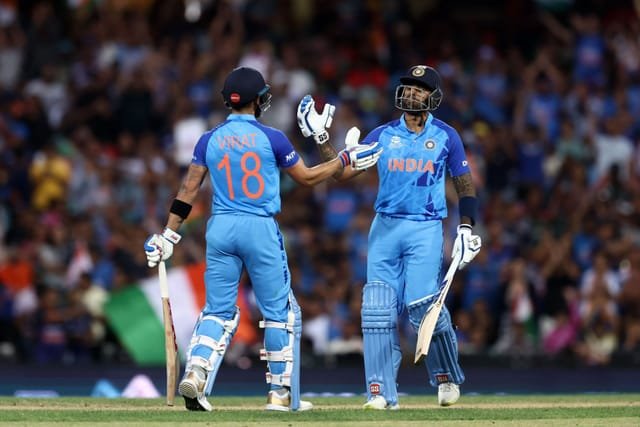
Suryakumar Yadav has been removed as India’s T20I captain, sacked despite leading his country to a World Cup title just months ago. Comparing his captaincy record with Virat Kohli‘s reveals the full dimensions of what India are stepping away from, and why the stats deserve a proper examination before the conversation moves on.
The Context Behind the Comparison
When a captain is removed from a position, the instinct is to focus on what went wrong. The declining batting form. The wrist injury that reportedly affected his stroke-making. The strike rate that fell below the levels his reputation demands. These are the reasons that have been discussed at length in the days since the BCCI announced Shreyas Iyer as India’s new T20I captain.
What has received less
Win Percentage: The Summary Statistic That Favours Surya Decisively
The headline comparison between the two captains is their win percentages, and the gap between them is more significant than most casual observers will have registered.
| Captain | Matches | Won | Lost | Tied | No Result | Win Percentage |
|---|---|---|---|---|---|---|
| Suryakumar Yadav | 52 | 40 | 8 | 2 | 2 | 76.92% |
| Virat Kohli | 50 | 30 | 16 | 2 | 2 | 60.00% |
A win percentage of 76.92 versus 60.00. Suryakumar won 40 of 52 matches. Kohli won 30 of 50. The gap of nearly 17 percentage points across comparable sample sizes is not a statistical noise figure. It represents a consistent, sustained pattern of match-winning leadership across the full breadth of both captaincy tenures.
Kohli’s win record reflects the challenges of an era when India were building their T20I identity and navigating the period when their squad composition was not as settled as it later became. The context matters. But the numbers are the numbers, and by the most fundamental measure of a captain’s job, winning matches, Suryakumar Yadav’s record stands above his predecessor’s by a clear and meaningful margin.
Batting as Captain: Where Kohli’s Numbers Are Stronger
The captaincy batting comparison produces a more divided picture, and it is important to give Kohli his due in this dimension of the analysis.
| Captain | Matches | Runs | Average | Strike Rate | Highest Score | Hundreds | Fifties |
|---|---|---|---|---|---|---|---|
| Suryakumar Yadav | 52 | 1,232 | 28.65 | 154.96 | 100 | 1 | 8 |
| Virat Kohli | 50 | 1,570 | 47.57 | 140.55 | 94* | 0 | 13 |
Kohli’s batting average as T20I captain, 47.57, is considerably higher than Suryakumar’s 28.65. He scored 338 more runs across a comparable number of matches and produced 13 half-centuries to Suryakumar’s eight. On average and volume of runs, Kohli was the more consistent batting presence during his captaincy tenure.
The one area where Suryakumar has a clear advantage is strike rate: 154.96 versus 140.55. In the T20I context, that gap carries genuine significance. A strike rate differential of 14 points across dozens of innings means Suryakumar consistently contributed at a tempo that put more pressure on opposition bowling attacks even in innings where his total was modest.
There is also the matter of the batting era. T20I batting standards, strike rates in particular, have risen sharply over the decade between Kohli’s captaincy peak and Suryakumar’s. Comparing absolute averages without acknowledging the evolving norms of the format risks penalising Kohli for conditions that reflect historical progress rather than individual quality. By the standards of his era, Kohli’s batting as T20I captain was exceptional. By the standards of Suryakumar’s era, his strike rate was the defining contribution.
Batting in Victories: The Causal Question
A more revealing comparison is how both captains performed specifically in matches their team won, since this addresses the question of how directly their batting contributed to those victories.
| Captain | Wins | Runs in Wins | Average in Wins | Strike Rate in Wins | Hundreds | Fifties |
|---|---|---|---|---|---|---|
| Suryakumar Yadav | 40 | 1,028 | 31.15 | 163.17 | 1 | 7 |
| Virat Kohli | 30 | 984 | 57.88 | 146.21 | 0 | 8 |
Kohli’s average in wins, 57.88, is the figure of a captain who was frequently a central reason his side was winning. That is a high average even by ODI standards, let alone T20I cricket, where innings are typically shorter and the variance in individual scores is much higher. When Kohli’s team won, he was very often scoring substantially.
Suryakumar’s strike rate in wins, 163.17, tells a different but equally valuable story. He was, in victories, contributing at an extraordinary pace, accelerating through innings in the way that T20I cricket’s most dangerous middle-order batters do. The 10-wicket wins, the chases completed with overs to spare, the targets set with such aggression that opposition teams lose heart before the final powerplay, these kinds of outcomes become more likely when a captain is scoring at 163 in the middle order.
The two sets of numbers describe different batting archetypes: Kohli as the volume, consistency-oriented anchor whose presence stabilised chases and made totals reliable; Suryakumar as the acceleration-oriented striker whose impact was measured more in pace than in permanence. Both are genuinely valuable. They are simply different.
T20 World Cup Captaincy: The Tournament That Defines a Legacy
The most emotionally significant comparison in this analysis is between the two captains’ records in the T20 World Cup specifically, because it is in ICC events that legacies are most definitively shaped.
| Captain | Tournament | Matches | Runs | Average | Strike Rate | Highest Score | Fifties | Result |
|---|---|---|---|---|---|---|---|---|
| Suryakumar Yadav | 2026 T20 World Cup | 9 | 242 | 30.25 | 136.72 | 84* | 1 | Winner |
| Virat Kohli | 2021 T20 World Cup | 5 | 68 | 34.00 | 100.00 | 57 | 1 | Super 12 exit |
This is where the comparison becomes most stark, and most telling. Kohli led India in the 2021 T20 World Cup and exited in the Super 12 stage after losses to Pakistan and New Zealand in the opening matches. His personal batting return of 68 runs at a strike rate of exactly 100 was, by his own standards, a significant underperformance in the competition that mattered most.
Suryakumar captained India through nine matches in the 2026 T20 World Cup. India lost only once, to South Africa in the Super 8 stage, recovered their composure, and claimed the trophy for the third time. Suryakumar’s personal batting, 242 runs at a strike rate of 136 across nine matches, was not the defining individual contribution of the tournament. But his leadership across those nine matches, nine matches at a tournament played on home soil with all the pressure that implies, produced the outcome that defines his captaincy: a winner’s medal.
That result, a World Cup title, is the specific achievement that separates Suryakumar’s captaincy legacy from Kohli’s in the one context where the difference is unambiguous. Kohli is one of the greatest batters in cricket history. His T20I captaincy record is respectable and contextually significant. But he did not win a T20 World Cup as captain. Suryakumar did.
The Wrist Injury Angle: Understanding the Performance Decline
The batting decline that contributed to Suryakumar’s removal from the squad is more explicable when the injury context is acknowledged. Reports indicate he has been managing a wrist injury that has affected his stroke-making over the past two seasons. The averages of 26.81 and 13.62 across those two seasons are not the numbers of a player who has lost his ability. They are the numbers of a player whose physical condition has compromised his mechanics at the crease in ways that are difficult to overcome without proper recovery time.
The wrist injury explanation does not change the selection decision. A captain whose batting is compromised to that degree cannot hold a squad place in a side with the depth India currently possess. But it does contextualise the decline in a way that the raw numbers alone do not convey, and it suggests that a full recovery could see Suryakumar’s batting return to something considerably closer to the levels his career figures represent.
Conclusion: The Ledger Belongs to Suryakumar on the Metrics That Matter Most
Comparing Suryakumar Yadav and Virat Kohli as T20I captains produces a nuanced result that defies a single-line verdict. Kohli was, by average and by consistency, the better batter during his captaincy tenure. His record in victories shows a player who was frequently the central reason his side was winning.
But Suryakumar’s win percentage is 17 points higher. He won more matches. He won the only T20 World Cup that either man captained India in. He maintained a strike rate across his tenure that reflects the demands of the format’s evolving standards. And he did all of this while managing, latterly, a physical condition that was actively undermining his batting.
The decision to remove him from the squad is defensible on the basis of his recent batting returns. But the decision should not allow the narrative to settle on the impression that his captaincy was anything other than one of the most successful tenures in Indian T20I history. The numbers make that case, and they deserve to be read properly before being set aside.
Suryakumar Yadav led India to 40 wins in 52 matches and a World Cup title. Whatever comes next for India’s T20I captaincy, that record will take some beating.
For breaking news and live news updates, like us on Facebook or follow us on Twitter and Instagram. Read more on Latest Sports on thefoxdaily.com.






COMMENTS 0