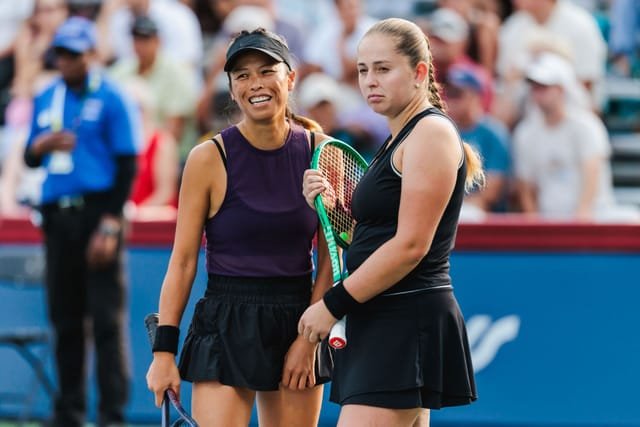
US Open 2026 controversy erupted around a tense women’s doubles encounter involving Hsieh Su-wei, Jelena Ostapenko and Hao-Ching Chan, with the match producing accusations of deliberate interference, physical contact and unsportsmanlike conduct.
Hsieh and Ostapenko eventually advanced to the quarter-finals after defeating Chan and her partner 6-4, 6-4. However, the result was overshadowed by an increasingly hostile atmosphere between the players and members of their respective teams.
The dispute extended beyond the court. Chan later responded publicly to accusations made by Hsieh and Ostapenko, denying that her team had attempted to interfere with their opponents and making separate allegations about incidents involving Hsieh.
Because the claims involve the conduct of individual players, coaches and spectators, they should be understood as allegations exchanged between the parties rather than independently established facts.
What happened during the US Open doubles match?
The match between the two teams became increasingly tense as the contest progressed. Hsieh Su-wei and Jelena Ostapenko eventually won in straight sets, but several incidents involving the players and coaching staff attracted attention.
At one point during a changeover, Hsieh and Ostapenko approached the chair umpire. Ostapenko was unhappy with the behaviour of the opposing team’s coach, whom she accused of clapping and shouting when she and Hsieh made mistakes.
The Latvian star later explained that she believed some of the reactions from the opposing side were intentional and designed to distract her team.
Rather than allowing the atmosphere to affect their performance, Ostapenko said the situation motivated her to become even more determined to win.
The tension ultimately remained throughout the contest, creating one of the more memorable off-court storylines from the US Open doubles draw.
Hao-Ching Chan responds to Hsieh Su-wei’s accusations
Following the match, Chan publicly addressed the controversy and disputed the suggestion that she or her team had acted improperly.
One of the clearest flashpoints involved the handshake at the net. Chan did not wait for Hsieh for the customary post-match handshake, prompting criticism over sportsmanship.
Chan offered a different explanation. She claimed that there had previously been several occasions when she had waited at the net but Hsieh had not exchanged a handshake with her.
According to Chan’s account, her decision at the US Open was therefore connected to their previous interactions rather than an attempt to show disrespect after the match.
She also rejected the suggestion that members of her team had been responsible for comments or behaviour intended to distract Hsieh and Ostapenko.
Chan makes separate allegations against Hsieh
Chan’s response went beyond the handshake dispute. She also alleged that Hsieh had deliberately made physical contact with her on separate occasions around the tournament venue.
Chan claimed that Hsieh struck her with a tennis bag while they were passing each other in a hallway before one of the matches. She said that she initially chose not to escalate the situation because she and her partner were preparing to compete.
Chan then alleged that another incident occurred before their match when she was resting in the players’ lounge. According to her account, Hsieh walked past and hit her chair, startling her and disrupting her rest.
These claims have not been independently established in the information available from the original report, so they remain Chan’s allegations.
| Issue | What Was Alleged or Reported |
|---|---|
| Handshake | Chan did not wait for the customary handshake after the match |
| Team behaviour | Hsieh and Ostapenko objected to reactions from the opposing team’s side |
| Physical contact | Chan alleged deliberate contact involving a tennis bag and her chair |
| China Open incident | Chan accused Hsieh of arranging spectators who allegedly heckled her team |
| Match result | Hsieh and Ostapenko won 6-4, 6-4 |
The China Open allegation adds another layer
Chan also brought up an earlier incident that she said occurred at the China Open.
She alleged that Hsieh had arranged for people to sit courtside and heckle her team during a previous match. Chan claimed that tournament officials eventually identified those spectators and removed them from the venue.
Again, this is an allegation made by Chan and should not be treated as an independently verified finding without additional evidence or an official statement.
Chan used the incident to challenge the idea that her own team was responsible for deliberately interfering with Hsieh and Ostapenko at the US Open.
The exchange therefore appears to be rooted in a much longer history between the players rather than being caused by one isolated moment in New York.
Hsieh and Chan have a history of tension
The latest disagreement reportedly comes against the background of an established rivalry between Hsieh and Chan.
Chan has suggested that tensions have existed for some time, while Hsieh has previously raised concerns about perceived preferential treatment involving Chan and her sister within Taiwanese tennis.
That history helps explain why relatively small incidents during a doubles match can quickly become emotionally charged.
Doubles tennis requires constant communication between partners, while players are also highly aware of the behaviour of opponents, coaches and spectators. A disagreement that might otherwise remain minor can become much more visible when the competitors already have unresolved history.
Why Jelena Ostapenko became involved
Although the dispute largely centres on Hsieh and Chan, Ostapenko became a central figure because of her reaction to the opposing team’s behaviour during the match.
The Latvian star believed that members of the other team were intentionally creating distractions when Hsieh and Ostapenko were making errors.
Ostapenko explained that the atmosphere made her more fired up rather than causing her to lose focus. She described the intensity as excessive but said it ultimately strengthened her determination to win.
That competitive response was reflected in the final score. Hsieh and Ostapenko secured both sets 6-4 and moved into the quarter-finals.
Match result versus controversy
| Category | Outcome |
|---|---|
| Winning team | Jelena Ostapenko and Hsieh Su-wei |
| Score | 6-4, 6-4 |
| Tournament | US Open 2026 |
| Round reached | Quarter-finals |
| Main controversy | Disagreements involving player conduct, team behaviour and the post-match handshake |
Was the handshake really about sportsmanship?
The handshake became one of the most visible aspects of the controversy because it is a traditional part of tennis etiquette.
However, the context provided by Chan changes the interpretation of her decision.
From Hsieh and Ostapenko’s perspective, failing to exchange a handshake can appear disrespectful, particularly after an intense match. From Chan’s perspective, however, she viewed the decision as a response to what she described as repeated previous incidents.
This is an important distinction. The same action can look very different depending on the history between the people involved.
Without an independent account establishing exactly what happened during previous encounters, it is difficult to determine which side’s interpretation is completely accurate.
Could the controversy lead to further fallout?
The biggest question now is whether the dispute ends with the conclusion of the match or develops into a longer-running rivalry.
Because Hsieh and Chan have reportedly had tension before, the latest accusations could add another layer to their relationship.
However, tennis tournaments are tightly scheduled, and players often have to move quickly from one match to another. Unless tournament officials or governing bodies become involved, the disagreement may ultimately remain a personal dispute between the players and their teams.
The allegations are serious enough to attract attention, but it would be premature to predict disciplinary action without an official ruling or further evidence.
What the incident says about doubles tennis
The episode also highlights how different doubles tennis can be from singles competition.
Players share a court with partners, interact more frequently with opposing teams and often have coaches or support staff close to the playing area. Spectator reactions can also become more noticeable because the court has more participants and more movement.
That environment can create additional opportunities for disagreements.
At elite tournaments such as the US Open, players are also competing under enormous pressure. A small distraction can feel much more significant when a match is close.
That does not excuse inappropriate conduct, but it helps explain why disagreements involving coaching behaviour, crowd reactions and player interactions can become major talking points.
What happens next for Hsieh and Ostapenko?
Despite all the drama surrounding their match, Hsieh and Ostapenko achieved the most important competitive objective: they won.
The 6-4, 6-4 victory puts them into the US Open quarter-finals, meaning their attention will now turn toward continuing their tournament run.
The pair will need to put the controversy behind them and maintain their focus as the draw becomes increasingly difficult.
Ostapenko’s reaction suggested that the tension actually increased her competitive energy during the match. Whether that intensity can be carried into the next round will be an interesting storyline to follow.
What happens next for Hao-Ching Chan?
For Chan, the immediate focus will be on moving beyond the controversy and continuing her own tournament campaign where applicable.
Her public response has made her position clear: she disputes the accusations made against her team and believes there is a longer history behind the disagreement.
The next step depends largely on whether the players or tournament authorities provide additional information. Until then, the competing accounts should be treated separately rather than assuming one version has been conclusively proven.
Final verdict
The US Open 2026 controversy involving Hao-Ching Chan, Hsieh Su-wei and Jelena Ostapenko turned an otherwise straightforward doubles victory into a much bigger story.
Hsieh and Ostapenko advanced to the quarter-finals with a 6-4, 6-4 win, but their match was overshadowed by disagreements involving the opposing team’s behaviour, the post-match handshake and accusations exchanged between Chan and Hsieh.
Chan denied claims that her team deliberately interfered with the opposition and made her own allegations about Hsieh’s conduct away from the court. Those claims remain allegations unless independently verified.
Ostapenko, meanwhile, made clear that she felt the opposing side crossed a line with its reactions during the match, although she also suggested the confrontation motivated her to compete even harder.
The result is a storyline built on rivalry, emotion and competing accounts. The tennis itself produced a clear winner, but the dispute surrounding it remains unresolved.
For breaking news and live news updates, like us on Facebook or follow us on Twitter and Instagram. Read more on Latest Sports on thefoxdaily.com.






COMMENTS 0