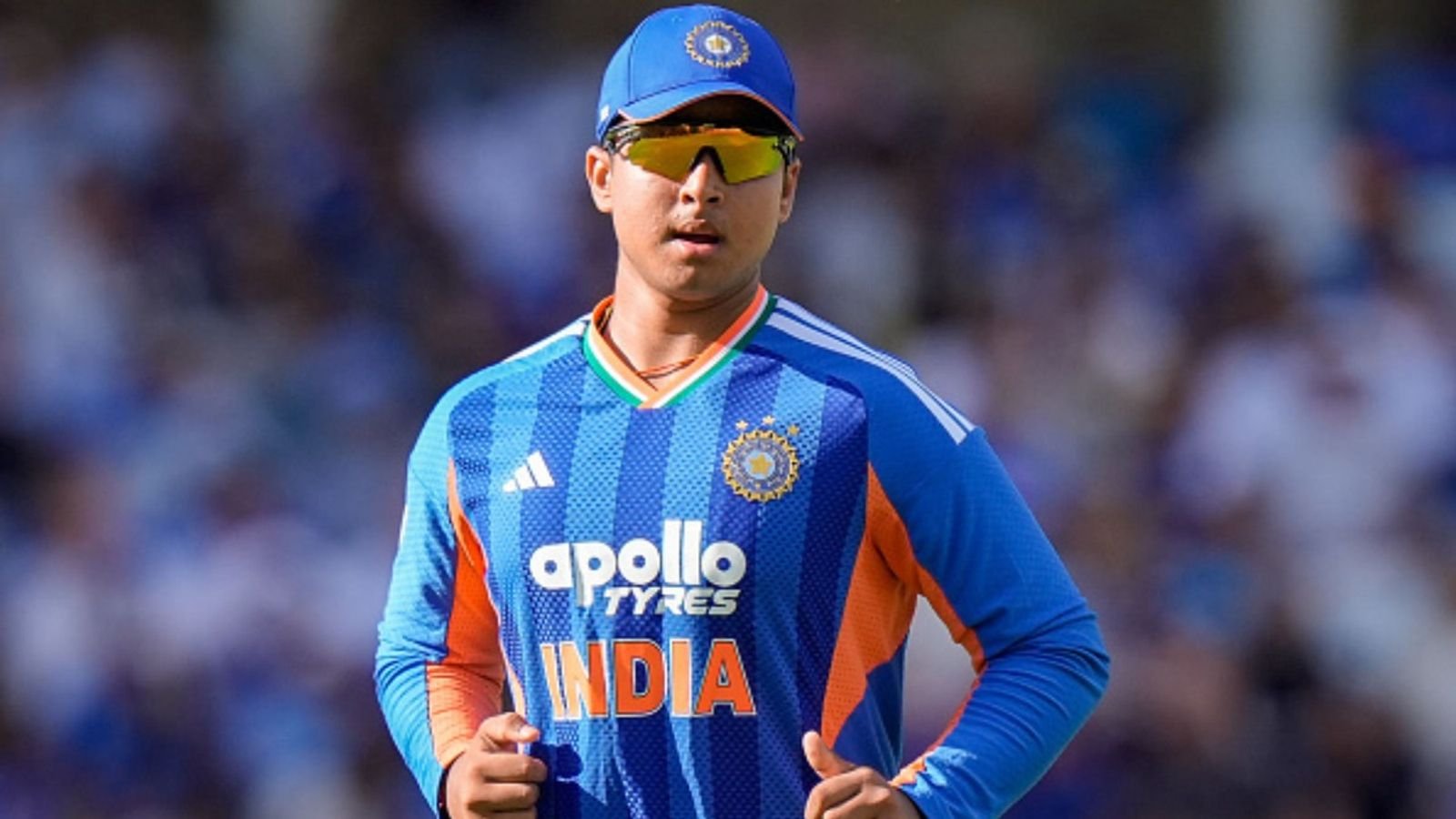
Vaibhav Sooryavanshi’s rapid rise has naturally triggered questions about when the teenage batting sensation could make his Test debut, but Rahul Dravid has urged everyone to slow down and allow the youngster to develop at the right pace.
Sooryavanshi has already achieved something extraordinary at an age when most young cricketers are still working through age-group competitions. Born in March 2011 in Bihar, the teenager became India’s youngest men’s international after making his T20I debut earlier in 2026. His performances in franchise and white-ball cricket have only increased the excitement around his future.
Yet Dravid’s message is clear: talent should be encouraged, not rushed.
The former India captain and coach believes Sooryavanshi has the ability to hold his own in Test cricket eventually, but he wants the youngster to spend time playing domestic cricket and gaining experience in red-ball cricket before the biggest step is considered.
What did Rahul Dravid say about Vaibhav Sooryavanshi?
Dravid has expressed confidence in Sooryavanshi’s ability while making patience the central part of his message.
“With Vaibhav, you’ve got to be patient.”
Dravid also pointed to the importance of allowing the teenager to practise, play domestic cricket and experience multiple seasons of red-ball cricket before being expected to perform at Test level.
The message is significant because it separates potential from readiness. Sooryavanshi may possess exceptional natural ability, but Test cricket demands skills that cannot always be measured through explosive performances in T20 cricket.
Why a Test debut at 15 would be a completely different challenge
Sooryavanshi’s age is one of the biggest reasons the discussion around his Test future has become so intense.
At 15, he has already experienced a level of professional cricket that most players reach much later. However, Test cricket presents a different challenge from T20 cricket because success depends on repeatedly solving problems over much longer periods.
A batter in a T20 match may have a limited number of deliveries to make an impact. In Test cricket, the same batter may have to survive difficult spells, adjust to changing conditions, build partnerships and maintain concentration for a prolonged period.
That requires technical discipline as well as physical and mental preparation.
Dravid’s advice therefore focuses on development rather than deadlines. Instead of asking when Sooryavanshi should play Test cricket, the more useful question is whether he is receiving the experiences necessary to become a Test cricketer.
Sooryavanshi’s rise has already been extraordinary
There is little doubt about why the teenager has attracted so much attention.
Sooryavanshi has progressed rapidly through the Indian cricket system and became the country’s youngest men’s international when he made his T20I debut earlier this year.
His performances for the Rajasthan Royals in the IPL further accelerated his rise. The franchise environment exposed him to established international cricketers and high-pressure matches, while his aggressive batting style made him one of the most talked-about young players in Indian cricket.
That exposure can be extremely valuable, but it also creates a potential problem.
The faster a young player becomes famous, the greater the expectations surrounding every subsequent performance can become.
Dravid’s call for patience is therefore not a criticism of Sooryavanshi. It is an attempt to protect the development process that helped produce the talent in the first place.
White-ball brilliance does not automatically translate into Test success
One of the biggest mistakes in evaluating young cricketers is assuming that success in one format guarantees success in another.
There are common skills across formats, including hand-eye coordination, timing, balance and the ability to read bowlers. But Test cricket places additional demands on technique and concentration.
A batter needs to understand when to attack and when to leave the ball alone. Shot selection becomes increasingly important because bowlers have more time to study weaknesses and create pressure.
Conditions can also change during a Test match. A surface that appears favourable for batting early in the contest may become more difficult later, while the ball can behave differently under different circumstances.
For a teenage batter, learning to manage those changing conditions requires experience.
That is why Dravid specifically highlighted domestic red-ball cricket.
Why domestic cricket could be the most important step
Domestic first-class cricket provides something international cricket cannot easily offer a developing player: repetition.
Sooryavanshi needs opportunities to bat for long periods, face different types of bowling, recover from poor performances and learn how to construct innings under pressure.
These experiences are difficult to replicate in short-format cricket.
A player can learn quickly through elite competition, but development is rarely a straight line. There will be good days, difficult days, technical adjustments and periods when the player needs to rebuild confidence.
Domestic cricket provides the environment to go through those stages without every innings being treated as a national event.
For Sooryavanshi, that could be more valuable than rushing toward a Test debut simply because his early career has been unusually successful.
The Duleep Trophy and red-ball pathway could matter
Competitions such as the Duleep Trophy can provide an important bridge between domestic cricket and the international level.
These matches expose players to strong opposition and longer periods of red-ball cricket while allowing selectors to assess how they handle first-class conditions.
For a player like Sooryavanshi, performances in such competitions can provide selectors with a clearer picture than isolated T20 innings.
The key indicators will not simply be how many runs he scores.
Selectors can also examine his technique against quality pace, his response to spin, his ability to bat for extended periods, his shot selection and how he reacts after being challenged.
Those details can help determine whether a promising young batter is genuinely ready for Test cricket.
Dravid’s experience explains the cautious approach
Dravid’s opinion carries particular weight because he understands the demands of Test cricket better than most.
His playing career was built around the qualities required for the longest format: patience, concentration, technical discipline and the ability to absorb pressure.
As a former India coach, he has also seen how young players can respond differently when they move into international cricket.
Some adapt quickly. Others need more time. A player’s age alone does not determine whether he can succeed, but age can influence how much physical, technical and emotional development remains ahead.
That makes Dravid’s recommendation particularly sensible: do not confuse an extraordinary beginning with a finished product.
The pressure surrounding Sooryavanshi could become a bigger challenge
The teenager’s popularity creates another layer to the situation.
Once a young player becomes associated with records and headlines, every innings can attract disproportionate attention. A score of 10 can suddenly become a talking point, while a century can generate immediate calls for greater responsibility.
That cycle can create unrealistic expectations.
Sooryavanshi does not need to prove his entire career every time he walks onto the field. His development will inevitably include setbacks, technical adjustments and ordinary performances.
The healthiest approach would be to judge him over extended periods rather than turning every match into a referendum on whether he belongs in Test cricket.
What Sooryavanshi needs before a Test debut
There is no universal checklist for becoming a Test cricketer, but several areas will be especially important for a teenage batter moving toward red-ball cricket.
- Long innings: He needs repeated opportunities to bat for extended periods and learn how to build an innings.
- Defensive technique: A reliable defence becomes crucial when bowlers attack a batter continuously.
- Shot selection: Knowing which deliveries to attack and which to leave is central to Test batting.
- Different conditions: Exposure to varied pitches and bowling styles can accelerate his development.
- Mental resilience: Test cricket inevitably includes periods of failure and pressure, making the ability to reset important.
- Physical development: Managing the workload associated with longer matches will also matter as his career progresses.
Why rushing him could be counterproductive
The temptation to accelerate Sooryavanshi’s career is understandable. Indian cricket has a huge audience, and supporters naturally want to see exceptional young talent at the highest level.
But a premature Test debut can create problems if the player is not yet equipped for the demands of the format.
One difficult series can quickly turn excitement into criticism. For a teenager, that transition can be particularly difficult to manage.
More importantly, an early struggle does not necessarily mean the player lacks Test potential. It may simply mean that the player needed more first-class experience.
That is why Dravid’s approach is focused on preparation rather than prediction.
Could Sooryavanshi eventually become a multi-format star?
The long-term possibility is certainly exciting.
Sooryavanshi has already demonstrated the kind of aggressive white-ball ability that can make him valuable in T20 cricket. If he can develop the patience and technical control required for red-ball cricket, he could eventually become a genuine multi-format player.
However, that development should happen organically.
The biggest advantage of being identified as a special talent at a young age is not necessarily getting to international cricket immediately. It is getting access to better coaching, stronger competition and more opportunities to learn.
If those advantages are used properly, the player can build a much stronger foundation for a long career.
What this means for Indian cricket
Sooryavanshi’s emergence is also important from a broader perspective.
Indian cricket continues to produce young players capable of succeeding in professional environments at increasingly early ages. That gives selectors an exciting pool of talent, but it also creates a responsibility to manage players carefully.
The challenge is particularly important in an era where T20 cricket can bring enormous attention and opportunities to teenagers.
Indian cricket must ensure that short-format success does not unintentionally discourage young players from developing the skills required for longer formats.
In that context, Dravid’s comments offer a useful blueprint: allow young players to enjoy the benefits of modern cricket while protecting the time they need to develop their complete game.
Prediction: Sooryavanshi’s Test future should be judged by progress, not age
The most sensible prediction is not that Sooryavanshi should definitely make his Test debut at a particular age. Instead, his progression should determine the timing.
If he produces consistent performances in domestic red-ball cricket, demonstrates the ability to bat for long periods and adapts successfully to stronger bowling attacks, the conversation about Test cricket will naturally become louder.
If that process takes several seasons, there should be no reason to consider it a failure.
For an exceptionally young player, development itself is the achievement.
Conclusion: Patience could be the key to Sooryavanshi’s Test career
Vaibhav Sooryavanshi has already achieved remarkable milestones, but Rahul Dravid’s message is that his biggest opportunity may come from not rushing the next one.
The teenager has shown enormous potential in white-ball cricket and has already reached the international stage. Yet Test cricket demands a different combination of technique, patience, concentration and physical preparation.
Domestic red-ball cricket can provide the experience required to develop those qualities. Strong performances across multiple seasons would offer a much clearer indication of his readiness than simply judging him on his age or T20 reputation.
For Indian cricket, the priority should therefore be simple: give Sooryavanshi the right environment, allow him to learn and resist the urge to turn every milestone into a race toward the Test team.
The teenager may have a Test career ahead of him, but as Dravid suggests, the best way to protect that future could be to let him grow into it.
For breaking news and live news updates, like us on Facebook or follow us on Twitter and Instagram. Read more on Latest Cricket on thefoxdaily.com.






COMMENTS 0