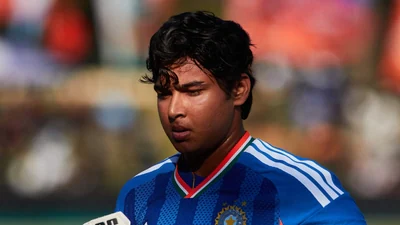
Indian cricket has always been fascinated by prodigies. From Sachin Tendulkar’s teenage arrival to the emergence of modern stars who entered international cricket before reaching adulthood, the country has repeatedly witnessed young talents carrying enormous expectations.
Now, 15-year-old Vaibhav Sooryavanshi finds himself at the center of a national discussion after a remarkable comeback innings against Zimbabwe raised uncomfortable questions about how young players should be handled at the highest level.
The explosive opener announced himself with a breathtaking half-century in Harare, reaching the milestone in just 18 deliveries and helping India secure a comfortable victory. While the innings showcased his extraordinary talent, the conversation quickly shifted toward why he had been dropped earlier after only three modest scores during India’s T20I series against England.
Former India captain Krishnamachari Srikkanth did not hold back, criticizing the decision and arguing that removing a teenager from the playing XI after such a brief run of failures risked damaging his confidence at a crucial stage of development.
The debate extends beyond a single selection call. It touches on a much larger question facing Indian cricket: how should the system nurture generational talent without placing unnecessary obstacles in the path of future stars?
Who Is Vaibhav Sooryavanshi and Why Is He Generating So Much Attention?
Few young cricketers have generated as much excitement in recent years as Vaibhav Sooryavanshi.
The teenager rose to prominence through fearless batting, exceptional hand-eye coordination, and an ability to score rapidly against quality bowling attacks. His performances in domestic and youth cricket convinced selectors that he possessed the talent required for international cricket despite his age.
What makes Sooryavanshi particularly intriguing is not merely his age but his style.
Modern T20 cricket rewards players capable of putting bowlers under pressure immediately. Sooryavanshi appears naturally suited to that role, displaying an attacking mindset rarely seen in players so young.
Rather than accumulating runs cautiously, he looks to dominate from the outset, a trait that has become increasingly valuable in contemporary cricket.
The Difficult Start Against England
The transition from domestic cricket to international cricket is challenging for any player. For a 15-year-old, the challenge becomes even greater.
Facing experienced England bowlers in a high-profile T20I series represented a significant step up in competition.
Sooryavanshi’s first three innings produced scores of 14, 13, and 15. While those numbers were disappointing on paper, they came within a tiny sample size that offered limited evidence about his long-term potential.
Many legendary cricketers struggled during the opening stages of their international careers.
The history of the sport is filled with examples of players who required time to adjust before establishing themselves at the highest level.
That context has become central to the criticism surrounding his omission from the fifth T20I.
The Harare Masterclass That Changed the Conversation
Great athletes often respond to setbacks in the most emphatic way possible.
Sooryavanshi’s innings against Zimbabwe did exactly that.
Chasing a modest target, he unleashed an extraordinary assault on the bowling attack, reaching fifty in just 18 balls. The innings featured powerful strokeplay, intelligent shot selection, and the fearlessness that initially made him one of the most exciting prospects in Indian cricket.
What impressed observers most was not merely the speed of scoring but the manner in which he approached the innings.
There was no visible hesitation.
There was no attempt to play conservatively to protect his place in the side.
Instead, he trusted the aggressive style that had brought him success throughout his young career.
That confidence became one of the biggest talking points after the match.
Why Srikkanth’s Criticism Has Resonated
Krishnamachari Srikkanth’s comments gained significant attention because they reflected concerns shared by many cricket observers.
The former India captain argued that dropping a teenager after just three failures was an overreaction.
His criticism centered on a simple principle: young players need opportunities to learn, adapt, and recover from setbacks.
International cricket is filled with examples of players who benefited from extended backing during difficult periods.
Without that support, many successful careers might never have developed.
Srikkanth’s argument is not necessarily about one specific selection decision. Rather, it is about the philosophy of player development and whether short-term results should outweigh long-term potential.
The Challenge of Managing Teenage Talent
Developing exceptional young athletes requires a delicate balance.
On one hand, exposure to elite competition accelerates growth. On the other, excessive pressure can hinder development.
Coaches and selectors must constantly navigate several competing priorities:
- Team performance and results.
- Player confidence and mental well-being.
- Long-term development goals.
- Competitive balance within the squad.
- Public and media expectations.
For teenage players, these challenges become even more pronounced.
Every performance attracts scrutiny. Every failure becomes a headline. Every selection decision is debated extensively.
Managing that environment effectively is one of the most difficult responsibilities in modern sport.
The Importance of Confidence in T20 Cricket
Confidence plays an especially important role in T20 cricket.
The format rewards aggression, creativity, and instinctive decision-making.
Players who begin worrying excessively about their place in the team often lose the freedom required to perform at their best.
That reality makes Sooryavanshi’s Harare innings particularly noteworthy.
Despite experiencing early setbacks, he maintained his natural approach.
Rather than becoming cautious, he continued attacking bowlers with conviction.
This willingness to embrace risk is often what separates elite T20 players from merely talented ones.
| Early Career Challenge | Impact on Young Players |
|---|---|
| Initial Failures | Can test confidence and self-belief |
| Media Scrutiny | Creates additional pressure |
| Selection Uncertainty | May affect natural playing style |
| Consistent Backing | Encourages long-term development |
| Strong Mentorship | Helps manage expectations |
What Makes Sooryavanshi Different?
Every generation produces talented batters, but only a few possess genuinely unique qualities.
Sooryavanshi’s greatest strength appears to be his fearless mindset.
Many young players enter international cricket focused on survival. They prioritize preserving their wicket and avoiding mistakes.
Sooryavanshi seems wired differently.
His instinct is to attack.
His scoring rate reflects a player who believes he can dominate bowlers rather than simply withstand them.
That mentality aligns closely with the demands of modern T20 cricket, where momentum often determines outcomes.
The Rajasthan Royals Factor
One aspect of Srikkanth’s comments that attracted attention was his praise for Sooryavanshi’s work ethic.
According to the former captain, the youngster did not immediately return home after the England series. Instead, he reportedly continued working on specific areas of his game, including handling short-pitched bowling.
This detail matters because elite sport is ultimately about adaptation.
Talented players become successful professionals when they identify weaknesses and actively improve them.
The willingness to continue learning despite disappointment is often a stronger indicator of future success than talent alone.
What This Means for Gautam Gambhir
The criticism directed at Gautam Gambhir highlights the difficult position every international coach faces.
Selection decisions are rarely straightforward.
Coaches must balance current performance with future potential while simultaneously trying to win matches.
Even the most successful coaches have made decisions that later became controversial.
Whether Sooryavanshi should have been retained remains a matter of opinion. However, his performance against Zimbabwe has ensured that the decision will continue to be scrutinized.
The incident also illustrates how quickly narratives can change in modern cricket.
One innings can completely transform public perception.
India’s Long-Term T20 Future
Beyond the immediate debate, Sooryavanshi’s emergence offers an exciting glimpse into India’s future.
T20 cricket is evolving rapidly.
Teams increasingly prioritize explosive batting, flexible line-ups, and fearless intent.
Players capable of maintaining strike rates above 180 or 200 are becoming increasingly valuable.
Sooryavanshi’s style appears perfectly suited to that environment.
If managed carefully, he could become part of a new generation of Indian cricketers designed specifically for the demands of modern white-ball cricket.
That possibility explains why discussions about his development have become so significant.
Lessons From Cricket History
History suggests patience often pays dividends with exceptional talent.
Many legendary cricketers experienced difficult starts before enjoying extraordinary careers.
What separated those players was not an absence of failure but their ability to learn from setbacks.
Young athletes rarely develop in a straight line.
Progress typically involves periods of success, disappointment, adjustment, and growth.
The key is creating an environment where talent can mature without being overwhelmed by short-term expectations.
India’s challenge is ensuring that players like Sooryavanshi receive that opportunity.
Why His Record-Breaking Fifty Matters Beyond the Numbers
Statistics tell only part of the story.
Yes, Sooryavanshi became the youngest batter to score an international half-century. Yes, he reached the milestone at remarkable speed.
But the larger significance lies elsewhere.
The innings demonstrated resilience.
It showed that early failures had not altered his mindset.
It revealed a player willing to trust his strengths even after experiencing disappointment.
Those qualities often define great careers.
Conclusion: A Star Reignites the Debate
Vaibhav Sooryavanshi’s explosive fifty against Zimbabwe has become much more than a memorable innings. It has sparked a wider conversation about talent management, confidence, and the future direction of Indian cricket.
Krishnamachari Srikkanth’s criticism of Gautam Gambhir reflects genuine concerns about how young players are introduced to international cricket. Whether one agrees with the criticism or not, the discussion highlights the importance of balancing immediate results with long-term development.
For Sooryavanshi himself, the most important outcome is that his performance has reminded everyone why he generated so much excitement in the first place. At just 15 years old, he has already demonstrated rare talent, remarkable fearlessness, and the ability to bounce back from adversity.
If his response to early setbacks is any indication, Indian cricket may be witnessing the emergence of a player capable of shaping the T20 format for many years to come. The challenge now is ensuring that his development receives the patience, guidance, and opportunities required to transform extraordinary potential into lasting greatness.
For breaking news and live news updates, like us on Facebook or follow us on Twitter and Instagram. Read more on Latest Sports on thefoxdaily.com.





COMMENTS 0