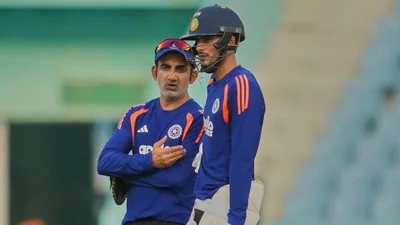
Gautam Gambhir is facing growing pressure as India prepare for their upcoming two-Test series against Sri Lanka, but former India spinner Amit Mishra believes the head coach should not be made the sole target for the team’s recent struggles. Mishra has called for more patience, pointing out that coaches can provide plans, skills and guidance, but players ultimately have to execute them on the field.
The debate around Gambhir’s tenure comes at a particularly important stage for Indian Test cricket. India are already facing a difficult path in the 2025-27 World Test Championship cycle, with the team needing a strong run of results from its remaining fixtures to keep its hopes of reaching the final alive.
India’s recent results have intensified scrutiny. The team suffered home-series defeats against New Zealand and South Africa, while losses in white-ball cricket against England and Ireland have added to the pressure surrounding the current coaching setup.
Yet Mishra believes the situation cannot be reduced to a coaching problem. He has highlighted the presence of inexperienced players in India’s Test side and compared Gambhir’s situation with Rahul Dravid’s early period as head coach.
His central argument is simple: Gambhir needs time, while India’s players need to take greater responsibility for their performances.
Why is Gautam Gambhir under pressure?
Gambhir took over as India’s head coach in July 2024 after Rahul Dravid’s tenure ended following India’s successful Men’s T20 World Cup campaign. Since then, the former India opener has had to manage teams across formats while overseeing a period of transition in Test cricket.
The pressure has increased because India’s results in red-ball cricket have not matched the standards traditionally expected from the team.
Two home-series defeats, against New Zealand and South Africa, have been particularly damaging. India have historically been extremely difficult to beat at home in Test cricket, so consecutive series setbacks naturally created questions around selection, preparation, tactics and coaching.
The team’s WTC qualification position has added another layer of pressure. With a limited number of matches remaining in the current cycle, India cannot afford a long sequence of disappointing results.
That means the Sri Lanka series is not simply another bilateral assignment. The results could have a significant influence on India’s route towards the WTC final.
Amit Mishra says Gambhir should not carry the blame alone
Mishra’s defence of Gambhir is based on the idea that responsibility in cricket is shared between coaches and players.
Speaking to the Times of India, the former spinner argued that players must take greater ownership of their performances and that a coach cannot control every aspect of what happens during a Test match.
“It’s tough for the coach. I think players need to take more responsibility.”
Mishra also pointed out that India’s Test squad includes players with relatively limited experience at the highest level. According to him, coaches and players need time to understand each other, develop systems and learn how to respond to different match situations.
That is an important distinction. A coach can prepare a game plan, identify weaknesses in opposition teams and help players develop skills. But once the first ball is bowled, the players are responsible for reading the conditions and executing those plans.
Why Mishra compared Gambhir with Rahul Dravid
One of the strongest points in Mishra’s argument was his comparison between Gambhir and Rahul Dravid.
Mishra said that it took Dravid roughly one to one-and-a-half years to establish himself as India’s head coach before performances improved.
The comparison is relevant because Dravid is widely regarded as one of India’s most respected cricket figures, yet even he needed time to develop his coaching environment.
Gambhir’s tenure began in July 2024, meaning that his time in the role must also be viewed within the context of team transition, changing leadership and the development of younger players.
Mishra’s argument is not that Gambhir should be immune from criticism. Instead, he believes judging a coach too quickly can ignore the time required to build a successful Test team.
Dravid’s example provides an important lesson
The comparison with Dravid highlights a broader reality about international coaching: success rarely comes from tactical instructions alone.
A coach has to establish relationships with players, understand individual personalities, build trust, develop support systems and create a consistent method of preparation.
Test cricket makes this even more complicated. Players have to deal with long spells in the field, changing pitch conditions, fatigue, pressure and momentum shifts that can develop over several days.
A coach can prepare a team for those situations, but players need to develop the ability to respond independently.
This is why Mishra’s emphasis on player responsibility is significant. He believes India’s current challenges cannot be solved simply by changing instructions from the dressing room.
‘Players have to execute’: Mishra’s central argument
Mishra stressed that a coach’s job is to guide, plan and improve the mental and technical aspects of players’ games. But execution remains the responsibility of the cricketers.
“A coach’s job is to guide, plan, but players have to execute.”
This distinction becomes particularly important in Test cricket because conditions can change dramatically during a match.
A pitch might offer movement in the morning and become easier for batting later. Spin can become increasingly important as a game progresses. Weather can influence swing and seam. A batter may also have to adjust depending on the bowler’s pace, line and field placement.
Players therefore need to read the match rather than blindly follow a pre-match plan.
Mishra believes India’s players must become better at adapting to these circumstances.
Why adapting to the pitch is so important in Test cricket
Mishra specifically highlighted the importance of understanding wicket behaviour and adapting according to the situation.
That may sound obvious, but it is one of the defining differences between successful Test teams and inconsistent ones.
In limited-overs cricket, the match has a defined number of deliveries and the pace of the game can force players into predetermined roles. Test cricket offers more time, which means players must continuously reassess the conditions.
A batter may need to leave more deliveries early in an innings before changing gears. A fast bowler may need to attack the stumps rather than search constantly for edges. A spinner may have to adjust his pace and trajectory depending on how quickly the pitch is deteriorating.
These decisions cannot always be dictated from the boundary.
They require players to understand the game themselves, which explains why Mishra believes responsibility must be shared within the squad.
India’s younger Test players face a major learning curve
Another important part of Mishra’s argument is India’s changing Test personnel.
The team is moving through a period in which new players are being introduced into the red-ball setup. For inexperienced players, international Test cricket can be very different from domestic cricket.
The intensity is greater, the scrutiny is stronger and opponents are better prepared to expose technical weaknesses.
Young players also need time to understand how to build long innings, bowl extended spells and manage the psychological demands of a five-day contest.
This is where Gambhir’s role becomes important. A coach can provide technical advice, help players prepare mentally and develop strategies for particular opponents.
But the players must then turn that preparation into performances.
What Gambhir can control and what he cannot
| Area | Gambhir and coaching staff | Players |
|---|---|---|
| Match planning | Develop strategies and identify opposition weaknesses | Understand and execute the plan |
| Technical preparation | Work on skills and identify areas for improvement | Apply those skills under match pressure |
| Mental preparation | Provide guidance and support | Control emotions and decision-making during matches |
| Pitch assessment | Help prepare players for possible conditions | Read how the pitch behaves during the match |
| Execution | Can guide from outside the boundary | Must deliver with bat, ball and in the field |
This division explains why blaming the coach for every defeat can oversimplify the reasons behind a team’s performance.
At the same time, it does not mean coaches should escape accountability. Selection, tactical decisions, team culture and preparation remain important areas where the coaching staff can have a major influence.
The strongest teams generally succeed when both sides perform their roles effectively.
The WTC equation makes the Sri Lanka series crucial
India’s current position in the World Test Championship cycle makes the upcoming Sri Lanka series particularly important.
According to the source report, India need to win seven of their remaining nine matches to have a chance of reaching the WTC final.
That creates very little room for error.
The remaining fixtures include Tests against Sri Lanka, New Zealand and Australia, meaning India’s road to the final will require consistency against different styles and conditions.
For Gambhir, this creates an uncomfortable situation. He needs results quickly, but the team is also undergoing a process of development.
This is where Mishra’s call for patience comes into conflict with the reality of international cricket: coaches may need time, but championship qualification tables do not wait.
Why the Sri Lanka Tests could reveal India’s progress
The upcoming Tests against Sri Lanka will provide an early indication of whether India can respond to the pressure surrounding the team.
India will need to show greater consistency in all three departments: batting, bowling and fielding.
The batting unit, in particular, must find ways to build substantial partnerships and avoid collapses. Bowlers need to maintain pressure over long spells, while fielders must convert chances when opportunities appear.
Gambhir can prepare the team and establish tactical plans, but the players will determine whether those plans succeed.
A strong series could reduce some of the pressure surrounding the coach and provide evidence that the team is moving in the right direction.
Another disappointing campaign, however, would inevitably increase questions about the coaching setup.
Is it fair to blame Gautam Gambhir for India’s results?
The answer is more complicated than simply yes or no.
A head coach of India’s senior men’s team will always carry significant responsibility. The coach is involved in preparation, tactical planning, selection discussions and team culture.
But Test matches are ultimately decided by players executing skills under pressure.
If a batter repeatedly plays poor shots, a bowler fails to maintain discipline or fielders drop crucial chances, the coaching staff cannot physically execute those actions on the field.
At the same time, recurring weaknesses over a long period can raise legitimate questions about coaching and preparation.
The most reasonable assessment, therefore, is that accountability should be shared rather than concentrated entirely on Gambhir.
The unique insight: India’s biggest problem may be consistency, not simply coaching
The wider issue emerging from India’s recent results is consistency.
India have enough individual talent to compete with the strongest teams in international cricket. The challenge is turning that talent into reliable five-day performances.
That requires players to understand match situations, build partnerships, maintain discipline and respond effectively when momentum shifts.
Mishra’s comments point towards this underlying issue. His emphasis on responsibility suggests that India may need a stronger culture of players solving problems on the field rather than expecting every answer to come from the coaching staff.
That could be particularly valuable for a team containing several players still establishing themselves in Test cricket.
What should India do next?
India’s immediate priority should be to simplify its approach and focus on controllable areas.
- Build partnerships: The batting unit must avoid unnecessary collapses and spend more time at the crease.
- Adapt to conditions: Players need to read the pitch and adjust their methods accordingly.
- Share responsibility: Senior players must help younger teammates handle international pressure.
- Improve execution: Tactical plans are useful only when players deliver them under match pressure.
- Manage expectations: The coaching staff needs time to develop new players while still producing results.
Why Gambhir’s next phase could define his tenure
The upcoming period could become one of the most important stages of Gambhir’s time as India’s head coach.
He has already experienced significant pressure following disappointing Test and white-ball results. The Sri Lanka series now provides an opportunity to demonstrate that the team can respond positively.
If India win convincingly, the narrative around Gambhir could change quickly. Coaches are often judged differently after a strong run of results because victories provide evidence that their methods are working.
But if India continue to struggle, calls for greater accountability will become harder to ignore.
That is why Mishra’s message of patience is significant. He is effectively asking Indian Cricket to judge Gambhir over a larger period rather than treating every defeat as evidence that the coaching system has failed.
Conclusion
Gautam Gambhir has received a strong vote of confidence from Amit Mishra at a time when pressure around India’s head coach is increasing. Mishra’s argument is that coaches cannot be expected to solve every problem and that players must accept greater responsibility for their performances.
The former spinner’s comparison with Rahul Dravid is particularly relevant. Even Dravid, despite his stature and experience, needed time to establish himself as a coach before results improved.
Gambhir now faces a similar challenge with an Indian Test side that includes players with varying levels of international experience. The coach can provide plans, technical guidance and mental support, but the players must adapt to conditions and execute those plans.
With India’s WTC qualification hopes requiring a strong run of victories, patience will have to coexist with results. The Sri Lanka Tests could therefore become an important early test of whether Gambhir’s methods and India’s new-look Test setup can begin producing the consistency expected from one of the world’s leading cricket teams.
For now, Mishra’s message is clear: give Gambhir time, but ask the players to take responsibility too.
For breaking news and live news updates, like us on Facebook or follow us on Twitter and Instagram. Read more on Latest Cricket on thefoxdaily.com.






COMMENTS 0