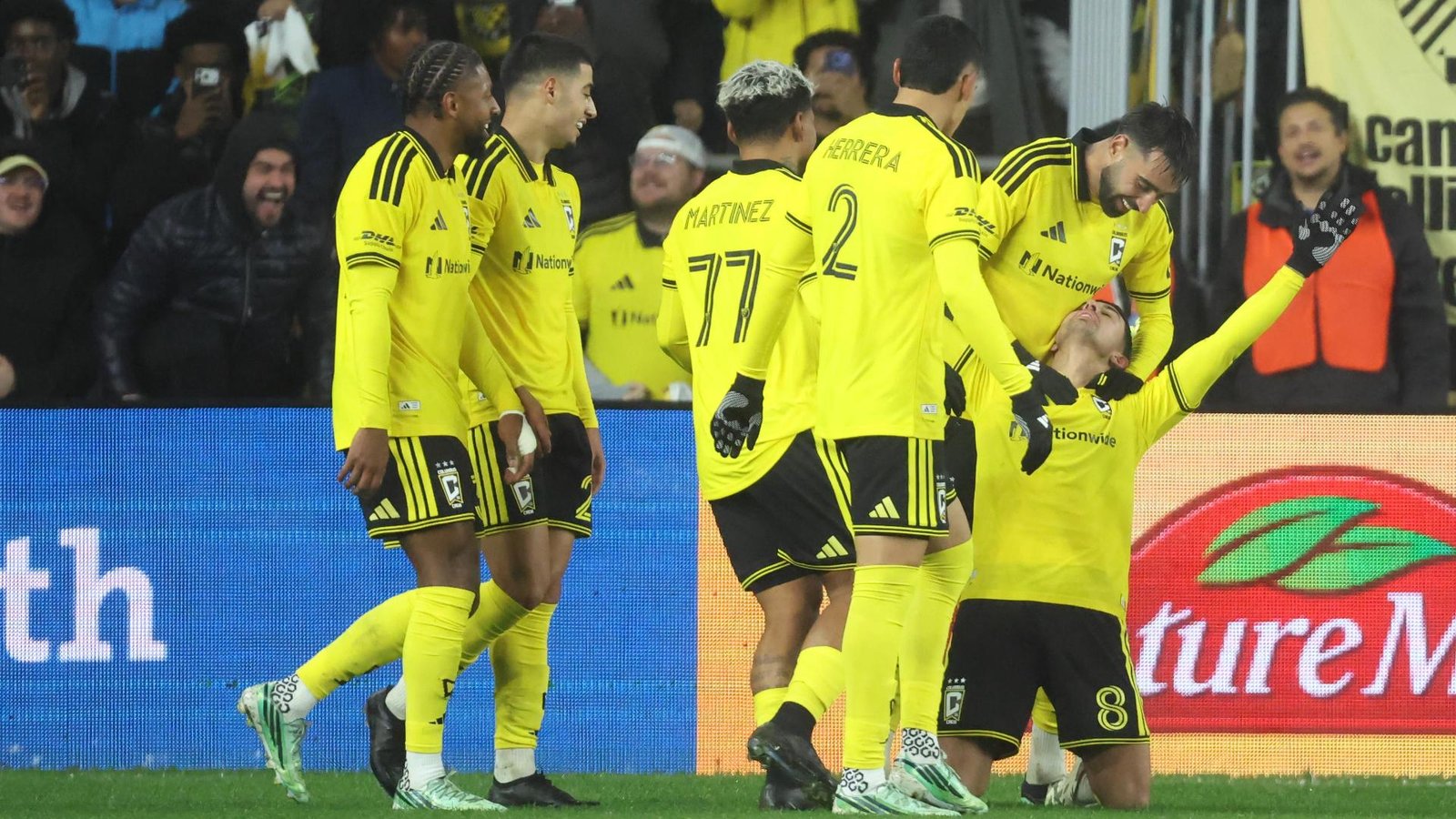
Inter Miami‘s attempt to defend their MLS Cup title has ended in a disappointing first-round playoff exit against Columbus Crew. Despite having Lionel Messi and a star-studded squad, the reigning champions were unable to overcome their opponents, losing both matches of the best-of-three series and bringing their 2026 campaign to an abrupt conclusion.
A stoppage-time winner from Santiago Rodríguez sealed Columbus Crew’s victory in the second game at Scott’s Miracle-Gro Field in Ohio. The Crew had already secured a 3-0 victory in the opening match before following it up with a 1-0 win, completing a 2-0 series sweep.
Inter Miami’s players appeared stunned when the final whistle confirmed their elimination, while Messi quickly headed towards the locker room as Columbus celebrated. The result was particularly disappointing given the expectations surrounding a team built around some of football’s biggest names.
Forward Luis Suárez had acknowledged the importance of the second match before kickoff, making it clear that elimination would represent a failure to meet the club’s ambitions.
“It’s clear that at a club like this, we have an obligation to win, getting eliminated on Friday would be a disappointment, and that’s how we should see it,” Suárez said on Wednesday before the match.
Head coach Cristian “Kily” González shared the disappointment but argued that his team had done enough to deserve a better outcome. He pointed to the decisive mistake in the closing moments as the moment that ended Miami’s playoff campaign.
“Ultimately, a single mistake on the final play is what knocked us out. I’m leaving feeling very sad and disappointed, we all are,” González said in the post-match news conference.
González also questioned the fairness of the result, believing Inter Miami had created the clearer scoring opportunities throughout the match.
“Obviously, after this defeat, which, in my view, was completely unfair in the last minute, I feel the team rose to the occasion and deserved to win throughout the entire match. We created the clearest scoring opportunities. But that’s football for you. Naturally, we are feeling a profound sense of sadness and disappointment.”
However, the defeat exposed deeper problems that had affected Inter Miami throughout the season. Three coaching changes in seven months made it difficult for the team to establish consistent tactics, partnerships and a clear identity on the pitch.
Three coaches in seven months disrupted Inter Miami’s season
Inter Miami began the 2026 campaign under Javier Mascherano, who returned for a second season with the responsibility of continuing the club’s progress and competing for major trophies. One of the early priorities was the Concacaf Champions Cup, but the team failed to progress after drawing twice against Nashville SC in their Round of 16 series.
The elimination came during a period of significant adjustment. Inter Miami had entered a new era following the departures of experienced players Jordi Alba and Sergio Busquets. Mascherano was therefore required to develop new partnerships while integrating signings and adjusting the team’s attacking approach.
The defensive lineup changed between the two matches against Nashville. In the opening game, Micael partnered Maximiliano Falcón in central defence, with Sergio Reguilón operating at left-back. For the second leg a week later, Gonzalo Luján came into the centre-back position, while Noah Allen took over at left-back.
There were also changes in the attacking setup. Mascherano initially benched Suárez and used Germán Berterame as the central striker. The frequent adjustments reflected the challenge of finding a settled combination, but they also raised questions about the team’s consistency.
In April, Mascherano unexpectedly resigned as head coach, forcing the club into another transition. Sporting director Guillermo Hoyos took over as interim manager, beginning the second coaching chapter of Miami’s season.
Guillermo Hoyos briefly revived Inter Miami’s momentum
Hoyos brought a different approach and made immediate changes to the starting lineup. Suárez returned to the attack as a regular starter, while Berterame moved towards the wings. Ian Fray also replaced Facundo Mura at right-back.
The changes initially produced encouraging results. Inter Miami recorded six wins, one loss and one draw across eight matches, collecting 19 of a possible 24 points. The team also scored 26 goals during that run, creating the impression that it had found fresh momentum under its interim coach.
However, injuries and new arrivals once again forced changes to the starting lineup. Hoyos struggled to maintain consistency as the season progressed, and the team’s results eventually deteriorated.
A five-match winless streak brought another coaching change, with Cristian “Kily” González taking charge. It was the third managerial chapter of the campaign, but the appointment did not completely resolve the team’s problems with rotation and consistency.
González continued to make significant changes to his starting lineup. Between the two matches of the playoff series against Columbus, he introduced Riquelme Fillipi, Matías Galarza and Fricio Caicedo. One particularly notable decision was leaving Suárez out to accommodate Fillipi, who had not featured in the opening playoff match.
These repeated changes made it difficult for Inter Miami to build stable combinations at a crucial stage of the season. The team had individual quality, but its collective structure remained a concern.
Inter Miami’s growing dependence on Lionel Messi
One of the biggest issues highlighted by the playoff elimination was Inter Miami’s reliance on Messi to create and finish attacking opportunities. The constant changes in coaching and team selection prevented the club from developing a consistent identity, increasing the pressure on its captain to produce decisive moments.
Messi delivered outstanding individual numbers during the regular season, finishing with 26 goals and 17 assists. His performances helped Inter Miami reach second place in the Eastern Conference standings and earned him the 2026 Golden Boot.
However, the team’s results were considerably less convincing when Messi played without scoring. Across 17 matches in all competitions in which he featured but failed to find the net, Inter Miami recorded only three victories, alongside six defeats and eight draws.
The pattern became particularly noticeable against Columbus Crew. In the opening match, the opposition restricted Messi to just two shots on goal. Columbus continued its aggressive defensive approach in the second game, using multiple defenders to limit the Argentine’s space and influence.
Messi managed two shots during the 90 minutes of the second match, with neither finding the target. His teammates appeared to struggle to create effective attacking opportunities when they could not get their captain into dangerous positions.
González acknowledged that opponents were paying particular attention to Messi and argued that Miami needed to develop alternative attacking options.
“We rely heavily on Leo, and that area is one of the most heavily guarded parts of the opponent’s half. The opposition makes a concerted effort to cover the spaces where Leo is constantly moving,” González said after the match.
He added that the team needed to explore different areas of the pitch rather than depending so heavily on Messi to generate attacking opportunities.
“Naturally, we need to look for more options elsewhere so that Leo can get involved in the play at the perfect moment.”
Columbus’ defensive strategy demonstrated how opponents could reduce Miami’s attacking threat by limiting Messi’s influence. When the Argentine was unable to create or finish chances, the team struggled to find another reliable source of goals.
Inter Miami face major decisions ahead of the 2027 season
The first-round exit leaves Inter Miami with a demanding offseason. The club must assess its squad, resolve contractual situations and develop a more consistent approach before returning to competition in 2027.
One of the major priorities will be preparing for the Concacaf Champions Cup. Inter Miami qualified for the upcoming competition after finishing third in the Supporters’ Shield standings during the MLS regular season.
The tournament remains particularly important because it is the major trophy Messi has yet to win with Inter Miami. The club will have another opportunity to pursue that target, but it will need to address the weaknesses exposed during the playoff series.
The front office must also make decisions concerning loan arrangements and contracts that have expired. Suárez’s contract ended after the final whistle on Friday, although the Uruguayan confirmed that discussions with the club were ongoing in an effort to find a solution for the upcoming season.
Lionel Messi and Inter Miami need a fresh direction
Inter Miami’s elimination against Columbus Crew was not simply the result of one late mistake. The defeat came after a season marked by managerial instability, frequent lineup changes and an attacking structure that often relied heavily on Messi’s individual brilliance.
The club’s three coaching chapters produced different periods of progress, but none managed to establish the consistency required to defend the MLS Cup title. Columbus exposed those weaknesses by restricting Messi and taking advantage of a decisive opportunity in the closing moments.
With the 2027 MLS season and Concacaf Champions Cup scheduled to begin in February, Inter Miami have a limited period to regroup. The challenge will be to build a stronger collective identity, reduce their dependence on Messi and create a more settled team capable of competing for trophies throughout the next campaign.
For breaking news and live news updates, like us on Facebook or follow us on Twitter and Instagram. Read more on Latest Football on thefoxdaily.com.






COMMENTS 0