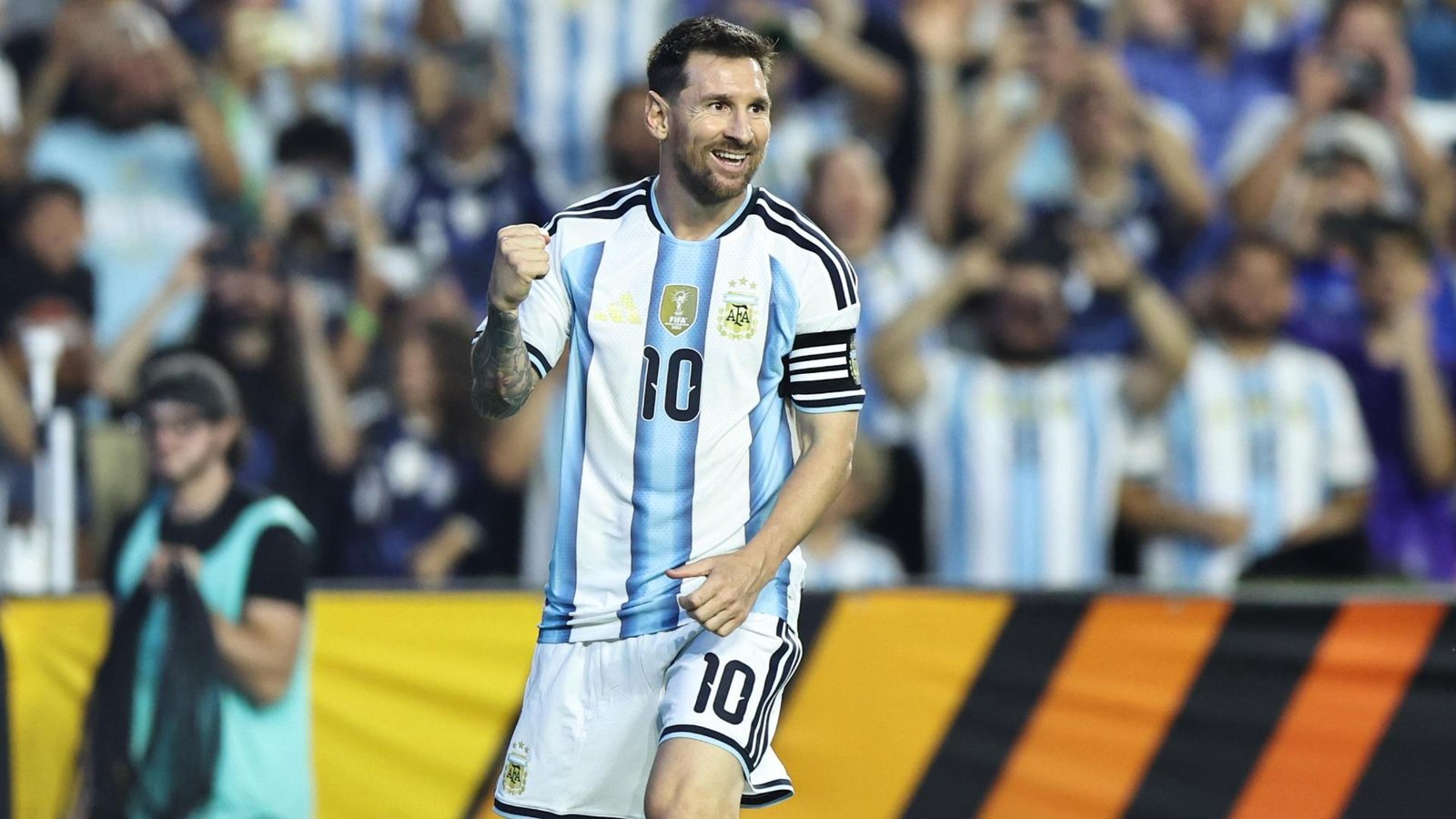
Lionel Messi’s latest appearance for argentina in their 3-0 friendly win over Iceland has done far more than just add another goal to his legendary career. It has reignited global debate around his fitness, leadership role, and influence heading into what could be his final FIFA World Cup appearance.
The 38-year-old World Cup-winning captain returned from a minor hamstring strain to come off the bench and score a penalty, helping Argentina close their final warmup match in convincing fashion. But beyond the scoreline, Messi’s post-match comments — especially his admission of “arriving with discomfort” — offer deeper insight into the physical and psychological challenge of extending elite performance at the highest level.
With the FIFA World Cup 2026 approaching, Argentina’s form, mentality, and squad balance are under intense scrutiny. And once again, Messi remains at the center of everything.
Background: Injury Concerns and Carefully Managed Comeback
Messi’s build-up to this match was far from smooth. Just weeks earlier, he suffered a minor strain and muscle overload in his left hamstring during Inter Miami’s MLS fixture against the Philadelphia Union. At 38, even minor muscular issues become significant strategic concerns rather than routine setbacks.
Argentina’s medical and coaching staff opted for caution, resting him in the previous international fixture against Honduras. The decision reflected a broader philosophy: preserving Messi for major tournaments rather than overexposing him in friendlies.
When he finally entered the pitch against Iceland in the 70th minute, the atmosphere shifted instantly. Even in limited minutes, Messi’s presence reshaped Argentina’s attacking structure, pressing rhythm, and psychological confidence.
Match Timeline: How Messi Turned a Friendly Into a Statement
| Minute | Event | Impact |
|---|---|---|
| 8’ | Valentín Barco scores | Early control for Argentina |
| 70’ | Messi enters the pitch | Tactical shift in Argentina’s attack |
| 72’ | Messi penalty goal | Immediate psychological dominance |
| 87’ | Thiago Almada scores | Match sealed at 3-0 |
What stands out is not just Messi scoring, but the timing. Within two minutes of returning to action, he converted a penalty — a moment that symbolically erased doubts about his physical condition and competitive sharpness.
For opponents, such efficiency is the real warning: even a restricted Messi remains decisive.
Why Messi’s “Discomfort” Comment Matters More Than the Goal
After the match, Messi openly admitted that he “arrived with this discomfort” and needed time to shake off fear surrounding the injury. This rare transparency highlights an important shift in modern elite Football: veteran players now manage not just injuries, but psychological caution around injuries.
At his age, Messi is no longer just recovering physically — he is also managing risk perception. A slight hesitation in sprinting, a guarded movement in acceleration, or reduced defensive pressing can all influence team dynamics.
Yet his ability to still perform at decisive moments shows why Argentina continue to build their system around him, even in transition phases.
Argentina’s Tactical Evolution Around an Aging Genius
Under Lionel Scaloni, Argentina have developed a more balanced structure that does not rely solely on Messi’s playmaking. Instead, the system now distributes creative responsibility across midfield and wide attacking zones.
Players like Thiago Almada and Valentín Barco are not just supporting characters — they are becoming structural pillars in Argentina’s next generation attack.
However, Messi remains the “gravity center” of the team. Even when he is not fully fit, defenders adjust positioning, midfielders alter passing lanes, and tactical spacing shifts whenever he enters the pitch.
This dual reality — a transitioning team still orbiting its greatest player — is both Argentina’s biggest strength and their biggest long-term challenge.
Record-Breaking Moment: Oldest Goalscorer in Argentina History
Messi’s penalty did more than extend Argentina’s lead. It made history. At 38 years, 11 months, and 14 days, he officially became Argentina’s oldest-ever goalscorer, surpassing Ángel Labruna’s long-standing record.
This milestone reflects a broader transformation in modern football longevity. Advances in sports science, recovery protocols, and individualized training have allowed elite athletes to extend peak performance far beyond previous generational limits.
But Messi’s case is unique — not just because of age, but because he remains decisive in high-pressure international contexts, not just ceremonial appearances.
Comparison: Messi vs Other Late-Career Legends
Football history is filled with great players who extended their careers into their late 30s, but very few maintained influence at World Cup level.
Unlike many legends who transitioned into secondary roles, Messi continues to impact games directly. This separates him from most historical comparisons, including late-career forwards who relied more on positioning than creative orchestration.
Even cristiano Ronaldo’s late-career international performances, while statistically impressive, often differ in tactical role — with Portugal using him more as a finishing focal point, whereas Argentina still rely on Messi as a hybrid creator-finisher.
This difference is crucial when evaluating World Cup impact rather than club-level statistics.
Group Stage Outlook: Argentina’s Path in FIFA World Cup 2026
Argentina have been placed in Group J alongside Algeria, Austria, and Jordan. On paper, this is a manageable group for the reigning champions, but World Cup history repeatedly shows that “comfortable groups” often produce unexpected tactical challenges.
Teams like Algeria and Austria bring physical intensity and structured defensive blocks, which can limit space for creative players like Messi. Jordan, meanwhile, often thrives in counter-attacking setups that punish positional risks.
For Argentina, the challenge is not qualification — it is momentum building without over-reliance on Messi’s minutes.
Psychological Factor: Messi’s Leadership Beyond Goals
One of the most under-discussed aspects of Messi’s presence is psychological leadership. His statement — “it’s a winning group that always wants more” — reflects a cultural identity Argentina have built since their 2022 World Cup triumph.
This mentality shift is significant. Earlier generations of Argentina squads often struggled with consistency under pressure. The current team, however, displays emotional stability and collective belief even when facing adversity.
Messi’s leadership here is less about shouting instructions and more about setting behavioral standards: composure, patience, and execution under pressure.
Real-World Impact: Why This Friendly Matters More Than It Looks
On the surface, a 3-0 friendly win against Iceland might appear routine. But in reality, it serves as a diagnostic tool for Argentina’s World Cup readiness.
Key takeaways include:
- Messi is fit enough to contribute but still requires workload management
- Argentina’s younger players are increasingly decisive in attack
- The team maintains strong tactical cohesion even with squad rotation
- Set-piece reliability remains a critical advantage
These factors together suggest Argentina are not just defending champions — they are evolving champions.
Prediction: How Messi’s Role Will Evolve in the Tournament
If current patterns continue, Messi is unlikely to play every minute of the group stage. Instead, Argentina may adopt a phased usage strategy — conserving him for knockout rounds where match-deciding moments matter most.
This approach mirrors modern tournament management seen in elite international football, where star players are strategically preserved rather than continuously deployed.
However, Messi’s efficiency means even reduced minutes can produce maximum impact. A single pass, set-piece, or penalty situation can still define matches at this level.
Conclusion: A Familiar Story With a New Chapter
Lionel Messi’s return against Iceland is not just another friendly appearance — it is a reminder that elite football narratives rarely follow linear decline. Instead, they evolve.
Despite physical discomfort, Messi continues to deliver decisive performances, break records, and shape Argentina’s identity heading into the FIFA World Cup 2026.
The bigger question is no longer whether Messi can still perform — but how Argentina can best structure themselves around a legend who refuses to fade quietly.
If the Iceland match is any indication, Argentina are not just preparing for a tournament. They are preparing for one last historic run led by a player who still bends games to his will, even when his body demands caution.
For breaking news and live news updates, like us on Facebook or follow us on Twitter and Instagram. Read more on Latest Sports on thefoxdaily.com.






COMMENTS 0