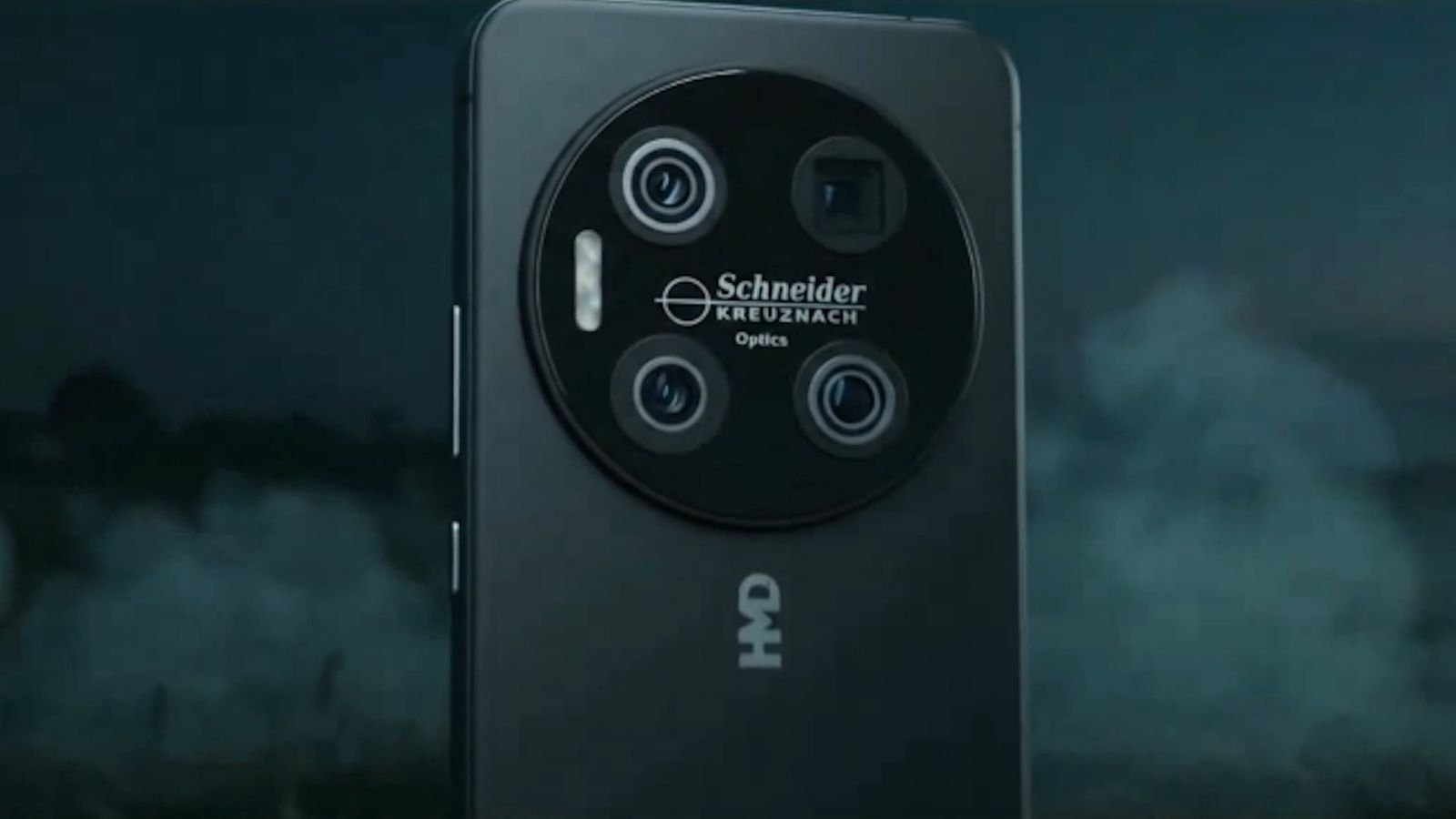
HMD is preparing to bring back one of the most recognisable names in Nokia’s smartphone photography history. The company has officially teased a new PureView-branded smartphone featuring a large circular quad-camera module and unexpected Schneider-Kreuznach Optics branding. The teaser suggests that HMD wants to put camera performance at the centre of its upcoming device, potentially including a periscope-style telephoto camera. Although the company has not revealed the phone’s specifications, price or launch date, the return of PureView is already generating interest among Nokia enthusiasts and mobile photography fans.
HMD Officially Teases a New PureView Smartphone
The new teaser offers the first glimpse of an upcoming HMD smartphone carrying the PureView name. The branding previously appeared on some of Nokia’s most ambitious camera phones, including the Nokia 808 PureView and Lumia 1020, which helped establish the company as an important player in mobile photography.
Finnish technology publication SuomiMobiili first spotted the promotional clip after an HMD employee shared it on the company’s discussion forum. The employee reportedly suggested that the device could arrive very soon, although no specific announcement date was provided.
The short video initially displays the PureView name before revealing the rear design of the smartphone. Its most noticeable feature is a prominent circular camera island that occupies a significant portion of the upper rear panel.
The device also carries HMD branding underneath the camera module instead of the traditional Nokia logo. This suggests that the company intends to revive the PureView identity under its own smartphone brand rather than introduce another Nokia-branded handset.
While the teaser does not reveal the phone’s front design, display or overall dimensions, the camera arrangement makes its photography-focused positioning immediately apparent.
Four Camera Openings Hint at a Periscope Zoom Camera
The circular camera module contains four visible camera openings alongside an elongated LED flash. Although HMD has not confirmed the function of individual cameras, one rectangular opening has attracted particular attention because it could indicate the presence of a periscope-style telephoto system.
Periscope cameras use folded optical components to redirect light through the smartphone’s body. This arrangement allows manufacturers to include longer optical zoom capabilities without making the device excessively thick.
The technology has become increasingly important in premium smartphones because it allows users to photograph distant subjects with more detail than conventional digital zoom can provide. It can be particularly useful for wildlife photography, concerts, sporting events, architecture and travel pictures.
If HMD includes a genuine periscope telephoto camera, it could give the upcoming PureView phone a useful advantage in long-distance photography. However, the rectangular opening is only a visual clue at this stage. The company has not confirmed the camera configuration, optical zoom range or sensor specifications.
The remaining camera openings are also unidentified. It is possible that the phone will combine several focal lengths and imaging sensors, but the teaser does not provide enough information to establish how the complete camera system works.
Schneider-Kreuznach Optics Could Replace the Traditional Zeiss Connection
Perhaps the biggest surprise in HMD’s teaser is the Schneider-Kreuznach Optics branding printed in the centre of the circular camera island. The inscription points towards a potential partnership with the German optics manufacturer, marking a possible change from the Zeiss association connected with earlier PureView smartphones.
Founded in 1913, Schneider-Kreuznach has a long history in optical engineering and is particularly recognised for its professional photographic and cinema lenses. Its involvement could help HMD position the new smartphone as a camera-focused product with an emphasis on optical performance.
However, the exact nature of the relationship remains unclear. The branding does not establish whether Schneider-Kreuznach is responsible for lens design, optical engineering, image quality tuning or a broader part of the smartphone’s imaging system.
That distinction matters because smartphone photography depends on much more than the company name printed beside the cameras. Lens quality, sensor size, image processing, stabilisation and computational photography all influence the final result.
HMD will need to demonstrate how the potential collaboration improves real-world photography rather than relying solely on the recognition associated with an established optics manufacturer.
PureView First Appeared on the Nokia 808 in 2012
The return of PureView is particularly significant because the name has a strong connection with Nokia’s camera-phone innovations. The branding made its debut on the Nokia 808 PureView in 2012, a smartphone that attracted worldwide attention for its 41-megapixel camera sensor.
At the time, smartphone cameras generally offered much lower resolutions. Nokia took a different approach by combining a large sensor with advanced image processing to capture detailed photographs.
One of the device’s most notable features was pixel oversampling. Instead of simply using every sensor pixel independently, the technology combined information from multiple pixels to produce a cleaner final image.
This approach helped improve image quality when photographs were saved at lower resolutions. It also provided additional flexibility when users wanted to crop images without immediately losing too much detail.
Modern smartphones use related pixel-binning techniques to combine information from multiple sensor pixels. Today’s implementations are considerably more advanced, but the Nokia 808 PureView remains an important milestone in the development of computational smartphone photography.
Nokia Lumia 1020 Took PureView Photography Further
Following the Nokia 808, the PureView name appeared on another iconic camera phone: the Nokia Lumia 1020, launched in 2013.
The Lumia 1020 also featured a 41-megapixel camera sensor and focused heavily on delivering detailed photographs. Its imaging system allowed users to capture high-resolution pictures and use oversampling techniques to create more manageable images.
The device became especially popular among photography enthusiasts because of its distinctive camera hardware and dedicated imaging features. Its large circular camera assembly also made it visually different from most smartphones available at the time.
The Lumia 1020 helped strengthen the reputation of PureView as a technology-focused camera brand rather than simply a marketing label. It demonstrated Nokia’s willingness to experiment with larger sensors and specialised imaging hardware even when those decisions resulted in unusual smartphone designs.
That history gives HMD’s latest teaser additional importance. Fans will naturally compare the upcoming device with Nokia’s previous camera-focused smartphones, particularly if the company positions it as a new flagship photography product.
HMD Previously Revived PureView With the Nokia 9 PureView
HMD acquired the PureView trademark in 2018 and brought it back to the smartphone market the following year with the Nokia 9 PureView.
The device attracted attention for its unusual five-camera rear arrangement. Instead of using a conventional combination of wide-angle and telephoto cameras, Nokia experimented with multiple sensors working together to capture additional image information.
The idea was to combine information from different cameras to improve the final photograph, particularly in areas such as detail, exposure and depth information. The approach represented another attempt to differentiate a smartphone through computational photography.
However, the complex camera system also demonstrated how difficult it can be to translate ambitious imaging hardware into a consistently excellent user experience. Camera performance depends on software optimisation as much as the number of sensors installed inside a phone.
The upcoming HMD device appears to take a different approach, with four visible camera openings and a possible periscope telephoto lens. Its apparent Schneider-Kreuznach connection also distinguishes it from the previous PureView models associated with Zeiss branding.
What the New PureView Phone Could Mean for Smartphone Photography
HMD’s decision to revive PureView suggests that the company sees an opportunity to attract consumers who prioritise photography when choosing a smartphone. The brand already has a recognisable history, but modern buyers will expect considerably more than a high-resolution camera or an impressive-looking lens arrangement.
A successful camera-focused smartphone needs to perform reliably in different conditions. Daylight photography, low-light images, portraits, video recording and long-range zoom all place different demands on the camera hardware and software.
A potential periscope camera could improve distant photography, while a capable primary sensor might help deliver better detail and dynamic range. Additional cameras could provide ultra-wide photography or other specialised features, although HMD has not confirmed their purposes.
The image-processing system will also be important. Modern smartphone cameras rely heavily on computational photography to manage noise, exposure, colour reproduction and image sharpening. Even expensive optical components cannot compensate for weak software processing.
HMD will therefore need to show how its hardware and software work together. Camera samples, independent testing and detailed specifications will provide a much clearer picture of whether the new PureView phone can live up to the reputation of its predecessors.
HMD PureView Smartphone: Expected Features and Confirmed Details
The teaser confirms the return of PureView branding and provides a clear look at the rear camera design. However, most of the technical specifications remain undisclosed.
| Feature | Available Information |
|---|---|
| Smartphone brand | HMD |
| Camera branding | PureView |
| Rear camera design | Large circular camera module |
| Camera openings | Four visible openings |
| Telephoto camera | Possible periscope-style design, not confirmed |
| Optics branding | Schneider-Kreuznach Optics |
| Flash | Elongated LED flash |
| Rear logo | HMD branding |
| Camera sensors | Not announced |
| Processor and display | Not announced |
| Launch date | Not officially confirmed |
| Price and availability | Not announced |
These details show that HMD is still keeping important information about the device under wraps. In particular, there is no confirmation of the main camera’s resolution, sensor manufacturer, optical stabilisation or the zoom capabilities of the suspected periscope camera.
Will HMD Launch the New PureView Phone in India?
Indian smartphone buyers may also be interested in the upcoming device because HMD already has a presence in the country’s smartphone market. However, the company has not confirmed whether the new PureView-branded handset will arrive in India.
Its availability could depend on HMD’s regional launch strategy and the market segment in which the company intends to position the device. If it is a premium camera-focused smartphone, pricing will be particularly important in India, where buyers have several established alternatives across different price categories.
For potential buyers, the most important details will include the camera specifications, processor, software support, battery capacity and final retail price. A strong camera system could attract photography enthusiasts, but the complete package will determine whether the device offers competitive value.
Until HMD provides an official announcement, an Indian launch date and expected price remain unknown. The teaser should not be treated as confirmation of availability in any particular market.
PureView Return Arrives During HMD’s 10th Anniversary Year
The teaser also arrives as HMD celebrates its 10th anniversary in 2026. The timing makes the return of PureView particularly interesting because the company is revisiting a name that represents an important part of Nokia’s smartphone history.
HMD has built much of its identity around the Nokia mobile legacy while gradually developing its own brand. Reviving PureView could help it connect with consumers who remember Nokia for its distinctive camera phones and willingness to experiment with mobile imaging technology.
However, a familiar brand name also creates expectations. Nokia’s earlier PureView devices became memorable because they introduced unusual camera hardware and innovative imaging techniques. HMD will need to offer meaningful improvements if it wants the new phone to earn a similar reputation.
What Happens Next?
HMD’s latest teaser confirms that PureView is returning to the smartphone market, but several important questions remain unanswered. The company has not revealed the phone’s complete camera specifications, processor, display, price or official launch date.
The potential Schneider-Kreuznach partnership is one of the most interesting aspects of the announcement. If the collaboration involves meaningful optical engineering and camera development, it could give the new device a distinctive identity in an increasingly competitive smartphone photography market.
The possible periscope telephoto camera is another feature worth watching. Long-range optical zoom has become an important capability in premium smartphones, and its inclusion could help HMD position the device as a serious photography-focused handset.
For now, the return of PureView is an encouraging development for Nokia fans and mobile photography enthusiasts. The Nokia 808 PureView and Lumia 1020 established the brand’s reputation, while the Nokia 9 PureView showed HMD’s willingness to experiment with unconventional camera systems.
Whether the new smartphone can match that legacy will depend on its actual hardware, image processing and real-world camera performance. HMD has promised more details soon, so the upcoming announcement should reveal whether this is simply a nostalgic revival or the beginning of a new chapter for PureView photography.
For breaking news and live news updates, like us on Facebook or follow us on Twitter and Instagram. Read more on Latest Technology on thefoxdaily.com.






COMMENTS 0