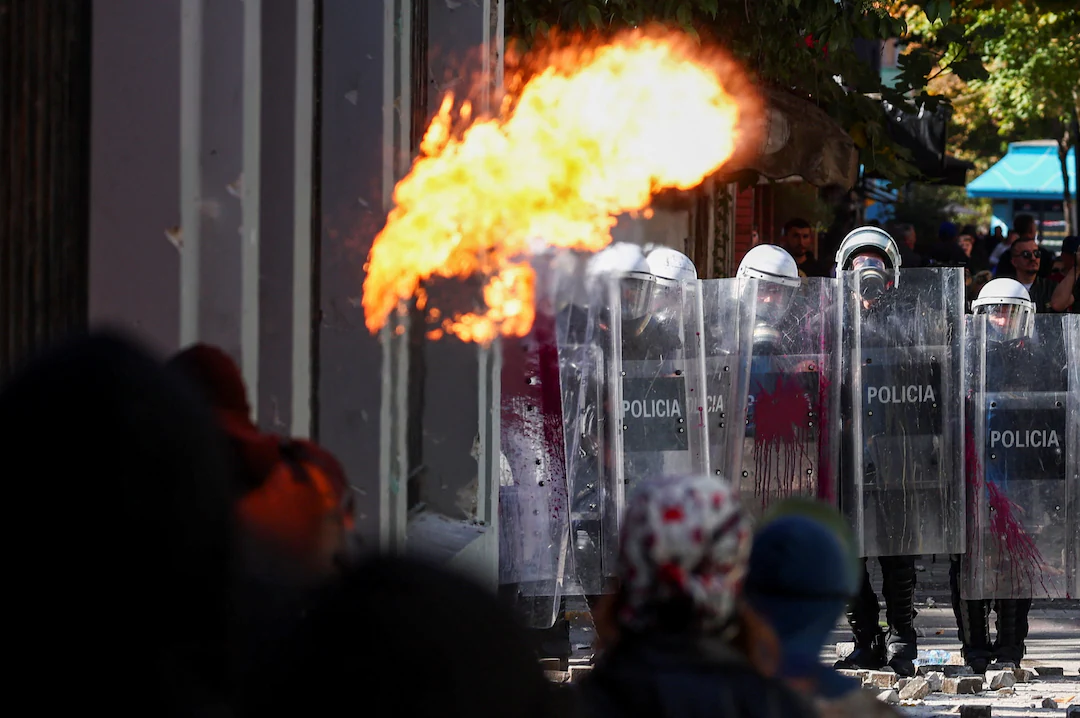
Police in Albania fired what appeared to be rubber bullets at protesters in the capital, Tirana, on Saturday, October 17, as mass student demonstrations demanding Prime Minister Edi Rama’s resignation entered their fifth day. The reported use of rubber ammunition marks an escalation in confrontations between demonstrators and security forces, with clashes continuing in the centre of the city.
Video footage reviewed by Reuters showed police firing a shotgun towards crowds gathered outside the education ministry. Reuters reporters found rubber pellets at the scene, and pellets struck two Reuters journalists and several protesters, leaving round marks. The incident added to concerns over the handling of demonstrations that have involved attacks on government buildings, banks and police officers.
Albanian police chief Skender Hita did not deny the use of rubber bullets when questioned at a news conference on Saturday. He said the measures used by police had been applied in a limited manner, while announcing that seven officers had been suspended and were facing disciplinary investigations for allegedly exceeding their authority and failing to respect proportionality.
The protests have been fuelled by public anger over perceived government corruption, unemployment and poor education standards. They have also attracted support from people who believe their concerns were ignored during earlier demonstrations against a luxury coastal development backed by Jared Kushner, the son-in-law of US President Donald Trump.
The unrest represents a major political challenge for Rama, who secured a fourth term in office last year. Despite mounting pressure, the prime minister has said he will not step down, insisting that his government respects students’ right to protest while defending its mandate to lead Albania towards European Union membership.
Albania protests: Police use rubber bullets amid clashes
Saturday’s confrontation outside Albania’s education ministry highlighted the increasingly tense relationship between demonstrators and police. According to Reuters footage and reporting, officers fired what appeared to be rubber bullets towards crowds during clashes in central Tirana.
Reuters reporters found rubber pellets on the ground, and pellets struck two journalists working for the news agency as well as several protesters. The impacts reportedly left round marks, providing further evidence of the use of rubber ammunition during the confrontation.
The reported incident came after several days of unrest in the capital. Demonstrators had burned government buildings and banks and thrown rocks at police, while security forces responded with tear gas and water cannon.
The competing actions have intensified the confrontation, raising questions about public order, the use of force and the authorities’ response to demonstrations driven by broader dissatisfaction with the government.
Police chief Hita addressed the issue during a news conference but did not explicitly deny that rubber bullets had been used.
“All means that were used were employed in a limited manner, including the most recent ones,” Hita said.
His remarks came as authorities faced pressure to explain how officers had responded to the crowds. The suspension of seven officers for alleged misconduct indicates that the police response is also subject to internal scrutiny, although Hita did not identify the specific incidents that led to the disciplinary investigations.
Seven Albanian police officers suspended over protest response
Albanian police chief Skender Hita said seven officers had been suspended and were facing disciplinary investigations over allegations that they exceeded their authority and failed to follow the principle of proportionality when dealing with protesters.
The principle of proportionality concerns whether the force used by authorities is appropriate to the circumstances. Its importance becomes particularly evident during public demonstrations, when police may need to respond to violence while protecting the rights and safety of people who are protesting peacefully.
Hita did not specify which incidents had led to the suspensions. The announcement therefore does not establish whether the officers’ disciplinary cases were directly connected to the reported use of rubber bullets or to other actions during the demonstrations.
Police have condemned the unrest and called for calm, while the government has also urged an end to violence. However, the reported injuries and the escalation outside the education ministry have added to the pressure on authorities to explain their approach to managing the protests.
The distinction between peaceful demonstrators and individuals involved in violence is also central to the wider dispute. The protests have included a range of grievances, and the actions of some participants do not necessarily represent everyone taking part in the demonstrations.
More than 1,000 people arrested during Albania unrest
Hita said that 1,067 people had been arrested and 388 had been criminally prosecuted in connection with the unrest. Scores of police officers and protesters have been injured, according to the report.
The figures indicate the scale of the authorities’ response as demonstrations have continued across central Tirana. Arrests and criminal proceedings have accompanied clashes involving protesters, police and public buildings.
However, arrest and prosecution figures should be distinguished from convictions. The available information does not establish the final legal outcomes of the cases or specify how many of those arrested were accused of particular acts of violence.
The high number of arrests also illustrates the challenge facing the government as it attempts to restore public order without further inflaming public anger. The reported use of rubber bullets, the suspension of police officers and the continuing demonstrations have made the handling of the unrest a central issue for the authorities.
Why Albanian students are demanding Prime Minister Edi Rama’s resignation
The student demonstrations have been fuelled by dissatisfaction with perceived corruption, a shortage of jobs and concerns about the quality of education. These grievances have brought students and other demonstrators into the streets, turning the protests into a broader challenge to the government.
For some participants, the demonstrations reflect frustration that political leaders have failed to deliver meaningful improvements despite years in office. Others have linked their anger to concerns about economic opportunities and the future facing young people in Albania.
Juri Taullahu, a 22-year-old medical student, described the demonstrations as a response to years of dissatisfaction with the government.
“It’s been 13 years of corruption and 13 years of doing nothing and empty promises. So the jar is filled and we are here for our rights,” Taullahu said on Saturday.
His remarks capture the frustration expressed by some protesters, who argue that longstanding problems have not been adequately addressed. The allegation of corruption is a central theme of the demonstrations, although the protesters’ claims should be distinguished from findings established through legal proceedings.
Rama’s administration has faced corruption scandals, adding to public scrutiny of the government. The unrest also reflects wider questions about employment, education and confidence in political institutions.
Although the protests began around demands associated with students and public services, the participation of people angered by other government decisions has widened the movement’s reach. This broader support makes the demonstrations a challenge that extends beyond education policy alone.
Rama refuses to step down as protests intensify
Prime Minister Edi Rama has rejected calls for his resignation, maintaining that his government has a clear mandate to continue governing. He won a fourth term last year, and the current demonstrations pose a significant test of his administration amid growing public anger.
On Saturday, Rama said his government respected students and their right to protest. He also defended his administration’s responsibility to protect citizens, ensure justice and continue pursuing Albania’s goal of joining the European Union.
“My responsibility is even clearer during these difficult times … to protect our citizens, guarantee justice, and move Albania forward together with this governing majority, which holds a very clear mandate: to see Albania in the European Union by 2030,” Rama said in a Facebook post.
The statement presents EU membership as a central objective of the government’s programme. Rama’s administration is seeking to advance Albania’s accession process while responding to domestic concerns about corruption, public services and economic opportunities.
His refusal to resign leaves the immediate political dispute unresolved. Protesters are demanding a change in leadership, while Rama has insisted that his government retains the mandate to pursue its agenda.
Whether the demonstrations lead to policy changes, further political confrontation or renewed negotiations remains uncertain. The government’s response to the protests and its handling of the underlying grievances are likely to remain important as the unrest continues.
Kushner-backed luxury resort triggered earlier protests in Albania
The current demonstrations have also drawn support from people who felt their concerns were ignored during a summer of largely peaceful protests against a luxury coastal development backed by Jared Kushner, the son-in-law of US President Donald Trump.
The proposed development became controversial after villagers in southern Albania told Reuters in July that their land had been wrongfully sold for the project. The dispute raised concerns about land ownership and the circumstances surrounding the transfer of property for a major coastal investment.
Reuters later reported that the man who sold the land was wanted by prosecutors on suspicion of drug trafficking. His lawyer denied the accusations.
Reuters found no evidence of wrongdoing by Kushner, who was not directly involved in the villagers’ dispute. The distinction is important because the controversy surrounding the land transaction does not, by itself, establish misconduct by the investor associated with the development.
The coastal project nevertheless became a focus of public dissatisfaction. For some demonstrators, the dispute reinforced broader concerns about transparency, accountability and whether the interests of local communities receive adequate protection when large development projects are proposed.
The summer protests also provided a backdrop for the current demonstrations. People who believed their earlier concerns had been ignored have joined a wider movement that now includes demands relating to corruption, employment and education.
Corruption allegations and organised crime complicate Albania’s EU ambitions
Albania’s political unrest comes as the country seeks to advance its bid for European Union membership. The government has set a target of joining the bloc by 2030, while corruption allegations and concerns about organised crime remain significant issues in the country’s political and institutional environment.
Rama’s administration has been dogged by corruption scandals. Analysts have also described Albania as a hub for gangs seeking to launder money generated through drug and weapons trafficking, complicating the country’s efforts to join the EU.
These concerns are relevant to the accession process because membership involves more than meeting political targets or completing negotiations. Candidate countries must also address institutional standards, the rule of law and the capacity of public bodies to tackle corruption and organised crime.
The current demonstrations add another layer of pressure by showing that public confidence in governance remains a contentious issue. Protesters’ allegations do not automatically establish individual criminal responsibility, but the scale of the unrest underlines the political importance of addressing concerns about accountability and public services.
Along with Montenegro, Albania is leading the EU accession process among Balkan countries, according to the report. Rama has presented the goal of membership by 2030 as a central priority, while critics have raised concerns about the government’s record and the problems facing ordinary citizens.
The challenge for Albania is to continue its European integration efforts while dealing with domestic demands for greater accountability and improvements in public services. The protests have brought those issues into sharper focus.
Albania’s unrest reflects wider protests across Europe
Albania’s demonstrations are unfolding alongside growing street protests elsewhere in Europe, where students and other groups have mobilised around concerns about public services, living costs and economic opportunities.
In France, student protests demanding more teachers and better facilities have spread into a broader wave of unrest. The demonstrations illustrate how concerns initially associated with education can become connected to wider public dissatisfaction.
Spain has also experienced protests against high rents and a lack of housing, prompting the government to call a snap election, according to the report.
The situations in France, Spain and Albania have different political and economic backgrounds, and the protests should not be treated as identical movements. However, they share a broader context in which public frustration over living conditions, services and government decisions has prompted people to take to the streets.
In Albania, the demonstrations have centred on corruption allegations, employment, education and dissatisfaction with the government. The additional controversy surrounding the coastal development has helped draw in people whose grievances extend beyond the original student demands.
What happens next in Albania’s student protests?
The immediate outlook remains uncertain as protesters continue to demand Rama’s resignation and authorities seek to restore public order. The reported use of rubber bullets, the injuries sustained by demonstrators and police officers, and the suspension of seven officers have intensified scrutiny of the response to the unrest.
The government has condemned violence and called for calm, while Rama has maintained that his administration has a mandate to continue governing and pursue EU membership. Protesters, meanwhile, have continued to voice frustration over corruption, jobs and education.
The number of arrests and criminal prosecutions reported by police indicates that the authorities have taken extensive enforcement action. However, the longer-term resolution of the crisis will also depend on whether the government addresses the grievances that have helped sustain the demonstrations.
The controversy surrounding the Kushner-backed coastal project remains part of the wider context, particularly for people who believe their concerns about land and development were not adequately addressed. At the same time, the current movement has expanded into a broader expression of dissatisfaction with governance and public services.
For Albania, the protests present a challenge on two fronts: managing immediate security concerns while maintaining public confidence in its institutions and continuing its EU accession ambitions. The coming days will show whether the demonstrations lead to further confrontation, changes in the government’s approach or a broader effort to address the concerns raised by protesters.
For breaking news and live news updates, like us on Facebook or follow us on Twitter and Instagram. Read more on Latest World on thefoxdaily.com.



COMMENTS 0