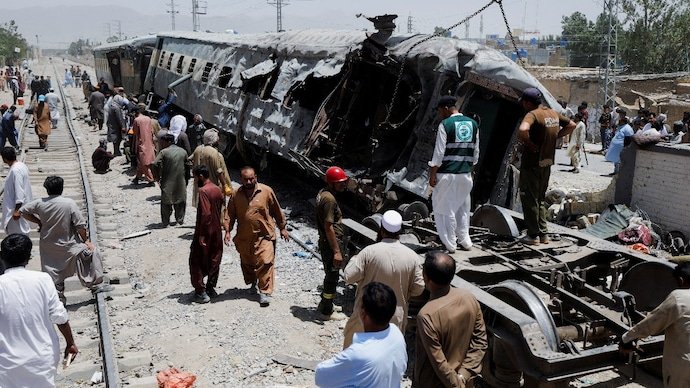
A fresh wave of violence has shaken Pakistan’s troubled Balochistan province after the banned separatist outfit Baloch Liberation Army (BLA) claimed responsibility for a deadly attack targeting a military shuttle train near Quetta Cantonment.
According to the group, the attack killed 82 Pakistani soldiers and injured more than 120 others. While Pakistan’s military has not officially confirmed those casualty figures, the incident has already intensified concerns about the deteriorating security environment in the province and the growing operational capabilities of Baloch insurgent groups.
The attack reportedly took place near Chaman Phatak on the outskirts of Quetta Cantonment railway station one of the most strategically sensitive military zones in Balochistan. The BLA said the operation involved its elite “Majeed Brigade” suicide unit along with its intelligence wing, known as “ZIRAB”.
The separatist group claimed the strike followed months of surveillance and intelligence gathering targeting Pakistani military transport systems in the region.
Whether or not the casualty figures are eventually verified, the attack marks another significant escalation in the long-running insurgency that has plagued Balochistan for decades.
What Happened Near Quetta Cantonment?
According to the statement released by the BLA, the attack targeted a military shuttle train allegedly transporting Pakistani Army personnel near Quetta Cantonment.
The group claimed a suicide attacker struck the train around 8 am local time, causing massive casualties among soldiers, officers and recruits onboard.
The BLA also alleged that Pakistan’s military had quietly shifted to more secretive troop transportation methods after previous attacks on railway infrastructure and military convoys in Balochistan.
Pakistan’s military has not publicly confirmed the BLA’s account or the number of casualties claimed by the insurgent outfit.
However, the absence of immediate official clarification has further fueled speculation across regional media and Social Media platforms.
Why Balochistan Remains Pakistan’s Most Volatile Region
Balochistan, Pakistan’s largest province by land area, has remained at the center of separatist violence and insurgency movements for decades.
The province is rich in:
- Natural gas reserves
- Mineral resources
- Copper and gold deposits
- Strategic trade corridors
- Ports connected to the Arabian Sea
Despite its natural wealth, many Baloch nationalist groups argue that local populations have remained politically marginalized and economically underdeveloped.
Separatist outfits such as the BLA accuse the Pakistani state of exploiting Balochistan’s resources while suppressing nationalist movements through military operations.
Islamabad strongly rejects those accusations and considers groups like the BLA terrorist organizations responsible for attacks on civilians, security personnel and infrastructure projects.
The Rise of the Baloch Liberation Army
The Baloch Liberation Army has emerged as one of the most prominent separatist militant groups operating in Pakistan.
The organization seeks greater autonomy and in some factions, outright independence for Balochistan.
Over the years, the BLA has evolved from a relatively localized insurgent movement into a more sophisticated militant network capable of conducting:
- Suicide bombings
- Railway sabotage
- Ambushes on military convoys
- Attacks on Chinese projects
- Urban assaults in major cities
The group’s “Majeed Brigade” has particularly gained attention for carrying out high-profile suicide attacks.
Pakistan, along with several countries, officially designates the BLA as a terrorist organization.
Why Railway Infrastructure Has Become a Major Target
One of the most notable trends in the Baloch insurgency is the increasing focus on transportation and Logistics infrastructure.
Railways, highways and military transport routes have become symbolic and strategic targets.
There are several reasons for this:
- Military mobility depends heavily on secure transport routes
- Railway attacks create nationwide psychological impact
- Infrastructure sabotage disrupts economic activity
- Such attacks attract massive media attention
- Remote terrain makes security difficult
In recent years, insurgent groups in Balochistan have repeatedly targeted railway tracks, trains and security convoys.
The latest claimed attack near Quetta appears to fit that broader pattern.
The Strategic Importance of Quetta
Quetta is not just the capital of Balochistan it is one of Pakistan’s most sensitive military and geopolitical centers.
The city sits close to the Afghan border and functions as a key military hub for operations in western Pakistan.
Quetta Cantonment, in particular, hosts significant military infrastructure and logistical facilities.
An attack near such a location carries symbolic value for insurgent groups because it directly challenges the perception of state control and military dominance.
Even limited operational success near Quetta Cantonment generates significant psychological and political impact.
Balochistan and the China-Pakistan Economic Corridor (CPEC)
The violence in Balochistan has also gained international attention because of the china-Pakistan Economic Corridor (CPEC), one of Beijing’s flagship Belt and Road Initiative projects.
Many major CPEC investments pass through Balochistan, including:
- Gwadar Port
- Road infrastructure
- Energy projects
- Transport corridors
- Industrial developments
Baloch separatist groups have repeatedly targeted Chinese interests and workers, accusing Islamabad and Beijing of exploiting regional resources without benefiting local populations.
This has transformed the insurgency from a domestic security issue into a broader geopolitical concern.
| Key Issue | Why It Matters |
|---|---|
| Baloch Insurgency | Challenges Pakistan’s internal security |
| CPEC Projects | Critical to China’s regional economic strategy |
| Quetta Security | Major military and logistics hub |
| Railway Attacks | Disrupt troop movement and infrastructure |
| Regional Stability | Impacts South Asian security dynamics |
Pakistan’s Security Challenge Is Growing More Complex
One major reason attacks in Balochistan continue to concern analysts is the evolving nature of insurgent tactics.
Earlier phases of the insurgency largely focused on hit-and-run ambushes in remote areas.
Today, militant groups increasingly demonstrate:
- Improved intelligence gathering
- Better operational coordination
- Sophisticated propaganda operations
- Suicide attack capabilities
- Urban targeting strategies
The BLA’s claim that the attack followed “extensive surveillance” reflects this shift toward more organized and intelligence-driven operations.
That evolution creates serious challenges for Pakistan’s security establishment.
The Information War Matters Too
Modern insurgencies are no longer fought only on battlefields.
They are also fought through information warfare.
Groups like the BLA increasingly use:
- Social media
- Video propaganda
- Rapid claim statements
- Psychological messaging
- International media attention
Large casualty claims whether independently verified or not are part of that strategy.
The objective is not only military disruption but also psychological pressure on the state and public perception.
In this case, the claim of 82 soldiers killed immediately amplified the global visibility of the attack.
Why Casualty Numbers Often Become Contested
One recurring feature of insurgent conflicts worldwide is the discrepancy between militant claims and official state figures.
Militant organizations often inflate casualty numbers to project strength and attract attention, while governments sometimes release more conservative assessments during ongoing investigations.
This makes independent verification especially important.
At the time of reporting, Pakistan’s military had not officially confirmed the numbers claimed by the BLA.
However, even without verification, the attack itself highlights the continued volatility of Balochistan and the persistence of separatist violence in the province.
The Human Cost Behind the Conflict
Beyond military and political calculations, the Conflict in Balochistan continues to impose a severe human cost on ordinary civilians.
Decades of insurgency and counterinsurgency operations have contributed to:
- Displacement
- Economic underdevelopment
- Fear and insecurity
- Political polarization
- Civilian casualties
Local communities often find themselves trapped between militant violence and aggressive security responses.
That cycle has made long-term stabilization increasingly difficult.
Could Violence Escalate Further?
Security analysts increasingly warn that the insurgency in Balochistan may enter a more dangerous phase if underlying political grievances remain unresolved.
Several factors could contribute to further escalation:
- Economic inequality
- Cross-border instability
- Regional militant networks
- Strategic competition involving China
- Weak political reconciliation efforts
The targeting of military transportation systems also suggests insurgent groups may continue prioritizing high-impact symbolic operations designed to embarrass the state.
That could force Pakistan to significantly expand military deployments and surveillance operations across the province.
International Implications of the Attack
The instability in Balochistan carries implications beyond Pakistan’s borders.
The province sits at the crossroads of several strategic regional interests involving:
- China
- Iran
- Afghanistan
- The Arabian Sea
- Global trade corridors
Any sustained escalation in violence could impact:
- Regional energy routes
- CPEC investments
- Cross-border trade
- Counterterrorism cooperation
- South Asian security dynamics
That is one reason attacks in Balochistan continue attracting international attention despite often receiving less global coverage than conflicts elsewhere.
Conclusion
The BLA’s claimed attack on a Pakistani military train near Quetta represents more than a single act of violence. It highlights the enduring instability in Balochistan, the growing sophistication of separatist insurgent tactics and the broader geopolitical pressures shaping the region.
While Pakistan’s military has not officially confirmed the casualty figures claimed by the BLA, the incident has already reignited concerns about security vulnerabilities around key military infrastructure and transport systems.
The attack also underscores a deeper reality:
Decades after the insurgency began, Balochistan remains one of South Asia’s most unresolved and volatile conflict zones.
Without meaningful political engagement, economic inclusion and long-term stabilization efforts, analysts warn that the cycle of violence may continue with consequences extending far beyond Pakistan’s borders.
For breaking news and live news updates, like us on Facebook or follow us on Twitter and Instagram. Read more on Latest World on thefoxdaily.com.





COMMENTS 0