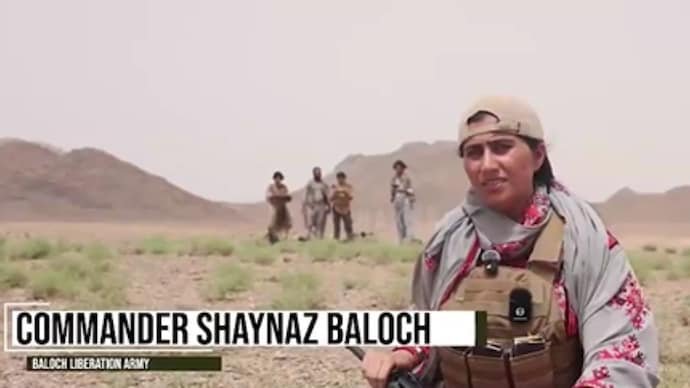
The Baloch Liberation Army (BLA) has released what is being described as its first-ever video featuring a female commander, marking a significant development in the long-running insurgency in Pakistan’s Balochistan province.
The 11-minute video, circulated through the group’s media wing “Hakkal,” features a commander identified as Shaynaz Baloch addressing both the people of Balochistan and the broader media. In her message, she claimed that the Baloch “freedom struggle” had entered a new phase and urged greater public support for the separatist movement.
While militant groups across South Asia and the Middle East have occasionally used women in operational or propaganda roles, the BLA’s public projection of a female commander represents a major shift in its communication strategy. Until now, the organisation’s public identity has been overwhelmingly centered around male fighters, commanders and armed operations.
The timing of the video is equally significant. It comes amid rising separatist violence, intensified counterinsurgency operations by Pakistani security forces and growing concerns over instability in Balochistan a province critical to Pakistan’s security, energy infrastructure and regional connectivity ambitions.
Why the BLA’s Female Commander Video Matters
At first glance, the video may appear to be a symbolic propaganda exercise. However, analysts who study insurgent movements often view such messaging shifts as indicators of deeper strategic changes.
The BLA’s decision to publicly showcase a female commander could serve several purposes simultaneously:
- Expanding recruitment and support networks
- Projecting ideological resilience
- Rebranding the insurgency’s public image
- Demonstrating adaptability under military pressure
- Generating media attention beyond Pakistan
- Appealing to younger demographics
Militant organisations frequently evolve their propaganda during periods of operational stress or political transition. The emergence of a female commander in official messaging may indicate the BLA is attempting to reshape perceptions both domestically and internationally.
In modern insurgencies, narrative warfare can be almost as important as battlefield operations.
Who Is Shaynaz Baloch?
Very little independently verified information is currently available about Shaynaz Baloch.
The BLA’s media apparatus has projected her as the group’s first publicly acknowledged woman commander or “freedom fighter.” In the video, she states that Baloch women are no longer confined to traditional roles and are actively participating in the separatist movement.
Her emergence is symbolically powerful because women have historically remained less visible in the armed leadership structures of Baloch separatist groups, even though women have participated politically and socially in Baloch nationalist activism for years.
The video appears carefully designed to communicate discipline, ideological commitment and organizational continuity despite growing counterinsurgency pressure from Pakistani authorities.
The Conflict in Balochistan: A Long and Violent History
To understand the significance of the BLA’s latest move, it is important to understand the broader conflict in Balochistan.
Balochistan is Pakistan’s largest province by land area but remains sparsely populated and economically underdeveloped compared to other regions. The province is strategically crucial because it borders Iran and Afghanistan and hosts Gwadar Port, a centerpiece of the china-Pakistan Economic Corridor (CPEC).
For decades, separatist groups have accused Islamabad of political marginalization, economic exploitation and heavy-handed security policies.
Pakistan’s government, however, views groups like the BLA as militant organizations threatening national security and territorial integrity.
| Key Factor | Why It Matters in Balochistan |
|---|---|
| Natural Resources | Province rich in gas, minerals and strategic assets |
| Gwadar Port | Critical for regional trade and CPEC projects |
| Geographic Position | Borders Afghanistan and Iran |
| Separatist Insurgency | Long-running armed resistance movements |
| Counterinsurgency Operations | Frequent military and intelligence operations |
| Regional Stability | Important for South Asian security dynamics |
The ASF Officer Claim Adds Another Layer of Tension
The release of the female commander video coincided with another high-profile claim by the BLA the alleged detention of a senior officer from Pakistan’s Airport Security Force (ASF).
The group claimed that Deputy Director and Commanding Officer Waseem Ahmed was intercepted in Kalat district during what it described as an intelligence-based operation conducted by its “ZIRAB” intelligence wing.
According to the BLA, the operation relied on confidential intelligence regarding the officer’s movements.
Pakistani authorities have not officially confirmed or denied the claim, but reports indicate that the officer had indeed gone missing during official travel in the region.
If verified, the incident would represent a major propaganda victory for the group because it demonstrates operational reach against state security personnel.
It also highlights a recurring challenge for Pakistani authorities: maintaining control over transport corridors and remote districts in Balochistan where insurgent groups often exploit difficult terrain and local networks.
Pakistan’s Counterinsurgency Operations Are Intensifying
The latest developments come shortly after Pakistani authorities announced a major intelligence-based operation in Balochistan.
According to provincial officials, security forces killed 35 militants and arrested several senior commanders during a multi-day operation near Quetta earlier this month.
The operation followed a fresh wave of attacks across the province, including:
- Rocket attacks in Quetta
- Assaults on transportation routes
- Sabotage targeting infrastructure
- Destruction of bridges in Mastung district
These incidents illustrate how insurgent groups continue targeting infrastructure and mobility networks a strategy designed to disrupt governance, create insecurity and undermine investor confidence.
Pakistan’s security establishment has repeatedly emphasized that counterterrorism operations will continue aggressively across the province.
The Strategic Importance of Balochistan Is Growing
One reason the Balochistan conflict attracts increasing international attention is the province’s rising geopolitical importance.
Balochistan sits at the center of several major regional dynamics:
- China’s Belt and Road Initiative
- CPEC infrastructure projects
- Energy transit routes
- Maritime access in the Arabian Sea
- Cross-Border Security concerns
- Iran-Afghanistan-Pakistan regional dynamics
Gwadar Port, in particular, has become strategically important for Pakistan and China.
For Islamabad, the port represents economic opportunity and regional connectivity. For Beijing, it provides potential access routes that reduce dependence on vulnerable maritime chokepoints.
Separatist groups, however, often portray these projects as benefiting external powers while excluding local populations from meaningful economic gains.
The Role of Women in Insurgent Movements Is Changing Globally
The BLA’s public use of a female commander also reflects a broader trend seen in insurgent and militant movements globally.
Over the past two decades, several armed groups have increasingly involved women in operational, logistical and propaganda roles.
In some cases, women have been used strategically because:
- They attract greater media attention
- They challenge state security assumptions
- They expand recruitment pools
- They create powerful symbolic narratives
- They project ideological commitment
However, experts caution against interpreting such appearances as evidence of broader gender equality within insurgent organizations.
Often, these moves are tactical and image-driven rather than indicators of structural transformation.
Information Warfare Is Becoming Central to Modern Insurgencies
One major insight competitors are missing is that modern insurgencies increasingly operate as media wars as much as armed conflicts.
Groups like the BLA understand that videos, social media messaging and symbolic narratives can amplify their influence far beyond their actual battlefield strength.
The release of a professionally framed video featuring a female commander is likely intended to:
- Shape public perception
- Increase media visibility
- Counter state narratives
- Boost morale among supporters
- Signal operational continuity
This mirrors tactics used by insurgent movements globally, where propaganda and perception management are now integrated into broader strategic planning.
Could Violence in Balochistan Escalate Further?
The current trajectory suggests the conflict may become more volatile in the near term.
Several factors could contribute to escalation:
- Increased counterinsurgency pressure
- Targeted attacks on infrastructure
- Political instability
- Regional geopolitical tensions
- Competition over strategic projects
The challenge for Pakistan is balancing security operations with long-term political and economic stabilization.
Purely military approaches often suppress insurgent activity temporarily but may not fully address underlying grievances driving unrest.
At the same time, insurgent groups face operational pressure from sustained security crackdowns and intelligence operations.
The International Dimension Cannot Be Ignored
Although the conflict is primarily internal to Pakistan, Balochistan’s strategic geography gives it international relevance.
China closely monitors developments because of its investments in CPEC and Gwadar. Regional powers remain concerned about border security and militant spillovers. Western governments track the situation due to counterterrorism concerns and broader South Asian stability.
Any major escalation in Balochistan could have implications for regional trade corridors, energy routes and foreign investment projects.
Conclusion: The BLA’s Messaging Shift Signals a New Phase in the Conflict
The Baloch Liberation Army’s decision to publicly feature a female commander for the first time marks more than just a propaganda milestone.
It reflects how the insurgency is adapting its communication strategy during a period of intensified conflict and growing geopolitical attention on Balochistan.
The emergence of Shaynaz Baloch, combined with the group’s claims regarding the detention of a senior ASF officer, signals an effort to project strength, resilience and operational relevance despite mounting counterinsurgency operations.
At the same time, Pakistan’s security forces appear determined to intensify efforts against separatist networks, setting the stage for continued confrontation.
As Balochistan becomes increasingly important in regional Geopolitics, energy connectivity and strategic competition, developments inside the province are likely to attract even greater international scrutiny in the months ahead.
The conflict is no longer just a local insurgency story. It has become intertwined with broader questions about regional security, infrastructure politics, information warfare and the future stability of South Asia.
For breaking news and live news updates, like us on Facebook or follow us on Twitter and Instagram. Read more on Latest World on thefoxdaily.com.




COMMENTS 0