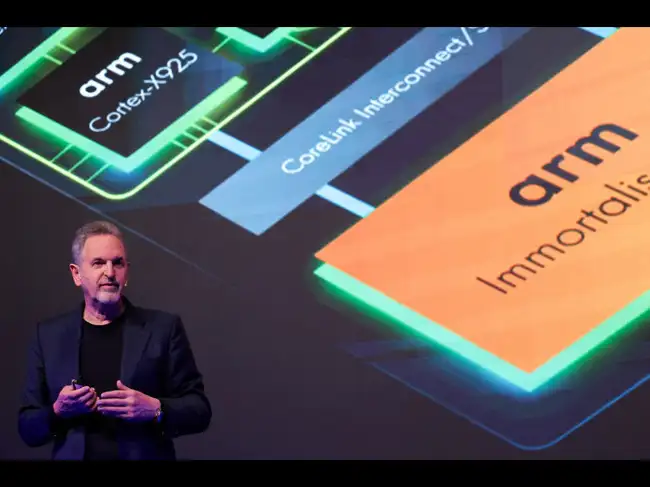
Nvidia is facing one of the most consequential leadership transitions in its history after co-founder Jensen Huang resigned as president and chief executive officer on November 12, 2026. The departure has triggered speculation about who could take charge of the Artificial Intelligence chipmaker, with Arm Holdings CEO Rene Haas emerging as one of the potential candidates.
According to a Financial Times report cited by Reuters, Nvidia’s board has approached Haas as part of its search for a permanent chief executive. His name has attracted attention because he previously spent seven years at Nvidia, where he served as vice president and general manager of the company’s computing products business.
However, Haas has not been appointed as Nvidia’s next CEO. The company has named Chief Financial Officer colette Kress as interim chief executive while its board considers internal and external candidates. Nvidia has not publicly confirmed a final successor.
The possibility of Haas moving from Arm to Nvidia is particularly interesting because the two companies occupy important but different positions in the Semiconductor Industry. Nvidia has become a central supplier of processors and accelerated computing systems for artificial intelligence, while Arm develops processor architecture and technology used across smartphones, computers, data centres and other connected devices.
Haas’s experience with both businesses could make him an interesting candidate as Nvidia considers its next phase of growth.
Why Is Rene Haas Being Considered for the Nvidia CEO Position?
The interest in Rene Haas is closely connected to his previous experience at Nvidia and his current leadership position at Arm.
Before becoming Arm’s chief executive, Haas worked at Nvidia for approximately seven years, from 2006 to 2013. During that period, he served as vice president and general manager of the computing products business.
His responsibilities included leading one of Nvidia’s major business areas, giving him direct experience with the company’s products, commercial operations and internal structure.
That background is important because Nvidia is not an ordinary technology company undergoing a routine executive transition. It is a major supplier of the processors and computing platforms used to train and operate advanced artificial intelligence systems.
A new chief executive would need to understand the company’s hardware strategy, software ecosystem, customer relationships and competitive position.
Haas already has familiarity with Nvidia’s business from his earlier career. His subsequent experience leading Arm has also given him responsibility for managing a major semiconductor company through significant strategic and financial changes.
Did Nvidia Officially Offer Rene Haas the CEO Job?
No confirmed appointment or formal job offer to Haas had been announced in the available reports.
Reuters reported on November 13, citing the Financial Times, that Nvidia’s board had approached Haas as a possible successor to Huang. The report described him as one of several candidates being considered.
There is an important distinction between being approached, being considered and receiving a formal appointment.
Nvidia’s November 12 announcement confirmed that Colette Kress would serve as interim CEO while the board searched for a permanent successor. The company also indicated that it would consider both internal and external candidates.
Consequently, Haas should currently be described as a reported potential candidate rather than Nvidia’s incoming chief executive.
Who Is Rene Haas? A Look at Arm Holdings CEO’s Background
Rene Haas is an American technology executive with more than 35 years of experience in semiconductors and computer systems.
He became chief executive officer of Arm in February 2022, succeeding Simon Segars. Before taking the top position, Haas held several senior leadership responsibilities at the company, including president of its Intellectual Property Products Group.
His career has included engineering, product development, commercial operations, strategic alliances and executive management.
This combination of technical and business experience is particularly relevant in the semiconductor industry, where executives must understand both the underlying technology and the commercial relationships that determine how products reach customers.
Haas has also worked with companies beyond Nvidia and Arm, including Scintera Networks and Tensilica.
Rene Haas’s Education and Professional Experience
Haas holds a Bachelor of Science degree in Electrical and Electronics Engineering from Clarkson University. He also completed an executive education programme at Stanford University’s Graduate School of Business.
His educational background reflects a combination of engineering knowledge and business leadership preparation.
Over more than three decades, he has worked across several areas of the semiconductor industry, gaining experience in applications engineering, product development, sales, marketing and strategic management.
Arm’s official leadership biography highlights his role in shaping the company’s technology strategy and expanding its presence across different computing markets.
Rene Haas’s Career Journey: From Nvidia Executive to Arm CEO
Understanding Haas’s career progression helps explain why his name has emerged during Nvidia’s leadership search.
2006–2013: Seven Years at Nvidia
Haas joined Nvidia in 2006 and worked at the company for approximately seven years.
He eventually became vice president and general manager of the computing products business, an important division within Nvidia.
His work involved leading a business responsible for a significant part of the company’s computing product operations.
This experience gave him an understanding of Nvidia’s organisational structure and its approach to developing and commercialising computing technologies.
Although Nvidia has changed considerably since Haas left, his earlier experience could provide useful institutional familiarity if he were to return in an executive leadership position.
2013–2017: Joining Arm and Taking Commercial Leadership Roles
Haas joined Arm in October 2013 as vice president of strategic alliances.
His responsibilities expanded over the following years. In 2015, he became executive vice president and chief commercial officer, taking responsibility for global sales and marketing.
These positions placed him at the centre of Arm’s relationships with semiconductor companies, technology manufacturers and other commercial partners.
Arm’s business model depends heavily on licensing its processor designs and intellectual property to companies that develop their own chips and products.
Managing these relationships requires an understanding of technology licensing, customer requirements and long-term industry partnerships.
2017–2022: Leading Arm’s IP Products Group
In January 2017, Haas became president of Arm’s Intellectual Property Products Group.
During his five years leading the division, he worked on expanding its focus towards specialised solutions for different markets.
Arm’s technology is used in a wide range of products, including smartphones, embedded devices, automotive systems and data-centre processors.
Under Haas’s leadership, the division focused on developing a more diversified product portfolio and increasing investment in the Arm software ecosystem.
This period also involved preparing the company for changes in the semiconductor industry’s competitive environment.
2022–Present: Becoming Arm’s CEO
Arm appointed Haas as chief executive officer on February 8, 2022.
His appointment followed Simon Segars’s departure after approximately 30 years with the company.
One of the major developments during Haas’s leadership was Arm’s return to public markets through its September 2023 Nasdaq listing.
The initial public offering became an important milestone for the semiconductor company and gave investors another way to participate in the growth of processor architecture and computing technology.
Arm has also expanded its strategic ambitions beyond its traditional intellectual property licensing model, increasing its focus on computing subsystems and production silicon.
Arm vs Nvidia: Why Rene Haas’s Experience Matters
Although Arm and Nvidia operate in the semiconductor industry, their business models are different.
Understanding this distinction helps explain why Haas’s experience could be relevant to Nvidia’s future leadership.
Arm’s Business Model: Processor Architecture and Licensing
Arm develops processor architectures and intellectual property that other companies use to design semiconductor products.
Instead of manufacturing every chip itself, Arm traditionally generates revenue by licensing its technology and collecting royalties when customers incorporate that technology into their products.
Its architecture is widely used in smartphones and other power-efficient computing devices.
Arm-based processors are also increasingly important in data centres, automotive systems, personal computers and artificial intelligence infrastructure.
This business model allows Arm to work with a broad range of semiconductor manufacturers and technology companies without competing directly with every customer in the same way a chip manufacturer might.
Nvidia’s Business Model: GPUs and Accelerated Computing
Nvidia operates differently.
The company develops graphics processing units, computing platforms, networking technologies and software used in artificial intelligence, scientific research, gaming and other demanding applications.
Its GPUs have become particularly important for training and running large artificial intelligence models.
Nvidia’s CUDA software platform is another major part of its competitive position because it provides developers with tools to build and optimise applications for the company’s computing hardware.
The company’s business therefore depends not only on processor performance but also on software, networking, systems integration and relationships with cloud service providers and enterprise customers.
Key Differences Between Arm and Nvidia
- Primary business: Arm focuses on processor architecture and semiconductor intellectual property, while Nvidia develops GPUs and accelerated computing platforms.
- Revenue model: Arm traditionally earns licensing fees and royalties, while Nvidia generates revenue through the sale of computing products, systems and related technologies.
- Customer relationships: Arm works with companies designing their own chips, while Nvidia sells computing products and platforms to businesses, cloud providers and other customers.
- AI strategy: Both companies are involved in AI infrastructure, but they approach the market through different technologies and business models.
- Market position: Arm’s architecture is widely used across computing devices, while Nvidia has established a major position in AI accelerators and high-performance computing.
Haas’s experience leading Arm gives him a perspective on semiconductor architecture, technology partnerships and the economics of the chip industry.
Those areas are relevant to Nvidia as the company continues expanding beyond individual graphics processors into complete AI computing systems.
What Happened to Jensen Huang? Why Did Nvidia’s CEO Resign?
Jensen Huang’s resignation on November 12, 2026, followed a period of intense scrutiny surrounding reports of extramarital relationships and allegations involving a woman suspected by US intelligence officials of having links to Chinese intelligence.
The controversy became a major issue for Nvidia after reports raised questions about Huang’s personal relationships, potential security concerns and the company’s exposure to geopolitical risks.
Huang had also acknowledged being unfaithful to his wife in a statement published by Nvidia.
The company’s board had announced an independent investigation into reporting that its founder had been the target of a foreign intelligence effort.
However, the allegations involving suspected Chinese intelligence activity should be treated carefully. Suspicion is not proof, and the available reports did not establish that the woman had been conclusively identified as a Chinese spy.
On November 12, Nvidia announced that Huang had resigned as president, CEO and a member of the board, effective immediately.
His departure ended more than three decades of leadership at the company he co-founded in 1993.
Colette Kress Becomes Interim Nvidia CEO
Following Huang’s resignation, Nvidia appointed its chief financial officer, Colette Kress, as interim chief executive.
Kress joined Nvidia in September 2013 and has served as executive vice president and CFO since then.
Her responsibilities have included overseeing the company’s financial organisation during a period of extraordinary growth in demand for AI computing infrastructure.
She will continue serving as CFO while taking on the interim CEO position.
Nvidia’s board has said that it will consider internal and external candidates before selecting a permanent successor.
The appointment of Kress provides continuity during the transition, but it does not mean that she has been confirmed as the permanent replacement for Huang.
Why Rene Haas Could Be an Interesting Choice for Nvidia
If Haas eventually becomes Nvidia’s CEO, he would bring a combination of previous company experience and external executive leadership.
Several factors explain why his name has attracted attention.
He Already Understands Nvidia’s Business
One advantage Haas could offer is his previous experience inside Nvidia.
He spent seven years at the company, including time leading its computing products business.
Although the company has evolved substantially since his departure, familiarity with its culture, products and business operations could make the transition easier than it might be for an executive with no previous connection to Nvidia.
He Has Experience Running a Major Semiconductor Company
Leading Arm has given Haas experience managing a publicly listed semiconductor technology business with global customers and complex commercial relationships.
Arm’s return to public markets in 2023 was a significant corporate milestone during his leadership.
His experience with investors, strategic partnerships and technology development could be relevant to Nvidia’s next phase.
He Understands the Importance of CPU Technology in AI
Artificial intelligence infrastructure is not built entirely around GPUs.
Modern AI data centres also require central processing units, networking equipment, memory systems, storage and other components to operate efficiently.
Arm’s processor architecture has an important position in the wider CPU ecosystem, and Nvidia has been expanding its own CPU and integrated computing ambitions.
Haas’s understanding of processor architecture could therefore be relevant as Nvidia develops increasingly integrated computing platforms.
What Challenges Would Rene Haas Face If He Joined Nvidia?
Becoming Nvidia’s CEO would involve considerably more than managing a successful semiconductor company.
The next chief executive would inherit a business operating at the centre of the global artificial intelligence industry, with major commercial opportunities and significant strategic challenges.
Maintaining Nvidia’s AI Leadership
Nvidia has built a strong position in AI computing through its GPUs, software ecosystem and integrated systems.
Maintaining that position will require continued investment in hardware development, software tools, networking and data-centre infrastructure.
Competitors are investing heavily in alternative AI accelerators, while major cloud providers are developing their own chips.
A new CEO would need to protect Nvidia’s existing advantages while preparing the company for changes in computing requirements.
Managing US-China Technology Restrictions
Semiconductor exports to China have become a major geopolitical issue for American technology companies.
Nvidia’s products and its access to international markets have been affected by US export controls and national security considerations.
Huang previously argued for maintaining access to important international markets, including China, while navigating American regulatory restrictions.
The next CEO will have to manage these commercial and political considerations carefully.
Maintaining Relationships With Major Customers
Nvidia supplies technology to some of the world’s largest cloud computing providers, technology companies and AI developers.
These customers depend on reliable product delivery, software support and predictable technology roadmaps.
Any leadership transition must therefore preserve confidence among customers, employees, suppliers and investors.
Continuing Innovation Without Jensen Huang
Huang was closely associated with Nvidia’s corporate identity and product strategy.
His leadership style involved substantial attention to engineering, product development and long-term technological direction.
A successor would need to establish credibility with Nvidia’s engineering organisation while maintaining the company’s innovation culture.
This could be one of the most important challenges facing any permanent replacement.
Who Else Could Replace Jensen Huang at Nvidia?
Rene Haas is not the only name being discussed in connection with Nvidia’s leadership transition.
Reuters reported that the board was considering both internal and external possibilities. Other names mentioned in succession discussions include Nvidia executive Ian Buck, AMD CEO Lisa Su, Micron CEO Sanjay Mehrotra, Marvell CEO Matt Murphy, Apple hardware chief Johny Srouji and former Apple CEO Tim Cook.
These executives have different professional backgrounds, making the succession process a choice between different leadership experiences rather than simply identifying someone with the closest connection to Huang.
Internal candidates could offer familiarity with Nvidia’s technology roadmap and organisational structure. External executives could bring different management approaches and experience from other technology businesses.
However, being mentioned in media reports does not establish that an individual has received an offer or is actively pursuing the position.
What Would Rene Haas’s Appointment Mean for Arm Holdings?
If Haas were to leave Arm for Nvidia, Arm would also face an important leadership transition.
Haas has been a central figure in the company’s strategy since becoming CEO in 2022.
His leadership has coincided with Arm’s return to public markets, expansion into data-centre computing and efforts to broaden its business beyond traditional processor intellectual property licensing.
A departure could require Arm’s board to identify a successor capable of maintaining those strategic priorities.
It could also raise questions about the future direction of Arm’s production silicon ambitions and its relationships with major semiconductor customers.
For now, however, Haas remains Arm’s chief executive, and no confirmed announcement has established that he will leave the company.
What Happens Next in Nvidia’s CEO Succession?
The next important development will be the outcome of Nvidia’s board-level search for a permanent chief executive.
Colette Kress is currently responsible for providing interim leadership while the company continues its operations and prepares for its next phase.
Several factors could influence the board’s final decision, including leadership experience, technical knowledge, familiarity with Nvidia’s business and the ability to manage relationships with customers, regulators and investors.
Haas’s previous experience at Nvidia and his current position at Arm make him a notable potential candidate. However, the reported approach does not guarantee that he will receive an offer or accept the position.
The board will also need to consider how a new CEO would maintain Nvidia’s product development schedule and its position in the rapidly changing AI computing market.
Rene Haas and Nvidia CEO Succession: Key Facts
- Current position: Chief Executive Officer of Arm Holdings.
- Experience: More than 35 years in semiconductors and computer systems.
- Previous Nvidia role: Vice President and General Manager of Computing Products.
- Time at Nvidia: Approximately seven years, from 2006 to 2013.
- Joined Arm: October 2013.
- Became Arm CEO: February 2022.
- Major achievement: Led Arm during its return to public markets through its 2023 Nasdaq IPO.
- Nvidia succession status: Reportedly approached as a potential candidate, according to a Financial Times report cited by Reuters.
- Current Nvidia interim CEO: Colette Kress.
- Permanent successor: Not officially announced.
Rene Haas has emerged as an important name in the search for Nvidia’s next chief executive because of his previous experience at the company and his leadership of Arm. His more than three decades in the semiconductor industry provide a combination of engineering, commercial and executive experience that could be relevant to Nvidia’s future.
Nevertheless, the succession process remains unresolved. Colette Kress is leading Nvidia on an interim basis, while the board evaluates possible permanent candidates. Whether Haas eventually returns to Nvidia will depend on the board’s decision and his own willingness to leave Arm.
For the semiconductor industry, the larger question is how Nvidia will maintain its position in artificial intelligence computing after the departure of the executive who led the company for more than 30 years. The identity of its next CEO could influence not only Nvidia’s corporate strategy but also the direction of competition across the global AI chip market.
For breaking news and live news updates, like us on Facebook or follow us on Twitter and Instagram. Read more on Latest World on thefoxdaily.com.






COMMENTS 0