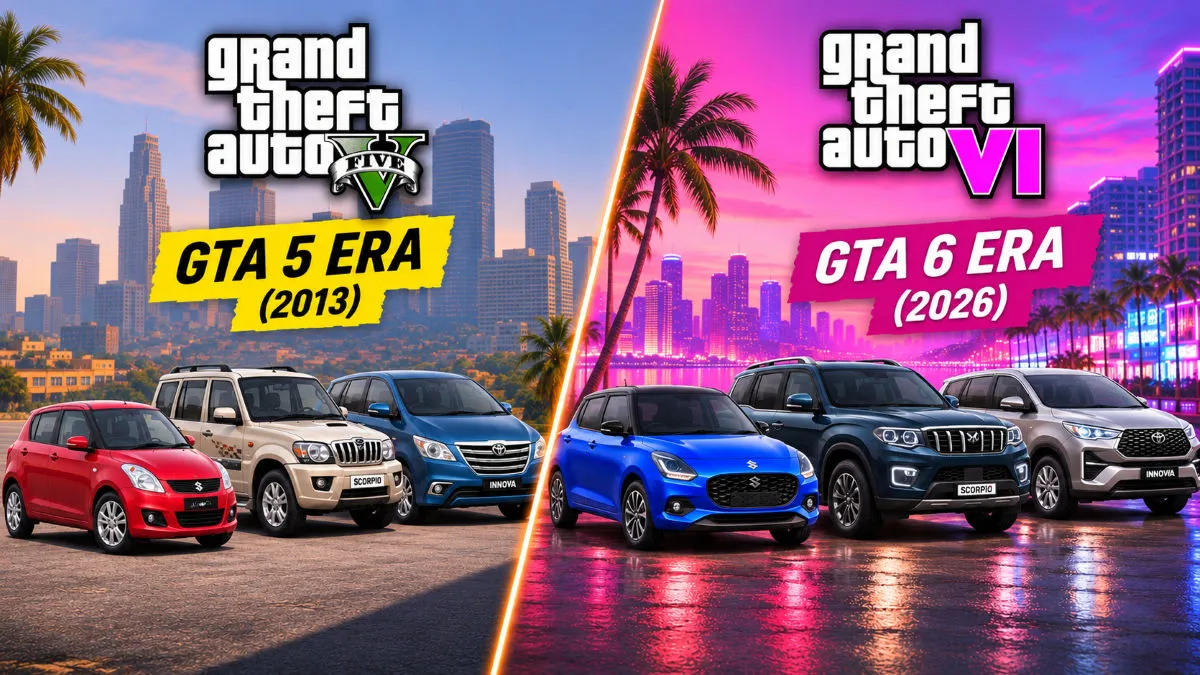
More than a decade separates the release of Grand Theft Auto 5 and GTA 6, and the Indian automobile industry has changed considerably during this period. From the Maruti Swift and Dzire to the Toyota Innova and Mahindra Thar, several familiar cars have undergone major transformations in design, technology, performance and powertrains. While some have evolved into completely different products, others have retained much of their original character.
With GTA 6 bringing players back to Vice City in a new avatar, we decided to look at how 10 popular Indian cars have changed between the two games. Here’s a comparison of what buyers could get in 2013, when GTA 5 arrived, and what these nameplates offer in 2026.
1. Maruti Suzuki Dzire: From Swift-Based Sedan To A Distinct Model
When GTA 5 was released in 2013, the Maruti Suzuki Dzire was in its second generation and was still known as the Swift Dzire. Its styling was closely related to the Swift hatchback, with a boot added to create a compact sedan. It was a practical choice for buyers looking for an affordable family car with a spacious cabin and a relatively large boot.
Fast-forward to 2026, and the Dzire is now in its fourth generation. It has moved away from its earlier Swift-inspired appearance and developed a more distinct identity. The latest model features a redesigned exterior, a more modern cabin and additional equipment, including a sunroof.
Despite these changes, the Dzire continues to focus on the qualities that made it popular in the first place: fuel efficiency, practicality, comfortable everyday driving and value for money. It remains one of Maruti Suzuki’s important models in the Indian market.
2. Toyota Innova To Innova Hycross: A Major Transformation
The Toyota Innova has been one of India’s most popular MPVs for more than two decades. Back in 2013, buyers could get the first-generation Innova, which used a traditional body-on-frame construction. Its spacious cabin, dependable diesel engine and reputation for durability made it a popular choice among private buyers, fleet operators and families.
Today, the Innova nameplate has evolved significantly. The Innova Hycross represents a major departure from the original formula, moving to a monocoque platform and introducing a strong-hybrid powertrain alongside a petrol option.
The change has also brought a more modern design, improved cabin technology and a greater focus on comfort. While the original Innova was known for its rugged construction and straightforward approach, the Hycross offers a more premium experience. The transformation shows how Toyota has adapted the nameplate to changing customer expectations without giving up its focus on practicality.
3. Honda City: From A Sporty Sedan To A More Technology-Focused Package
In 2013, the Honda City was in its third-generation avatar in India. It was known for its refined petrol engine, comfortable rear seats, sophisticated styling and strong brand appeal. The sedan was particularly popular among buyers who wanted a comfortable family car with an enjoyable driving experience.
Today, the Honda City is in its fifth generation. It has grown more sophisticated in terms of design, cabin equipment and safety technology. The current-generation model also introduced a strong-hybrid powertrain, giving buyers an alternative to the conventional petrol version.
Although competition in the midsize sedan segment has become tougher, the City continues to rely on its established strengths. A comfortable cabin, refined driving experience and reputation for reliability remain central to its appeal. Its evolution reflects the wider shift towards more efficient powertrains and technology-rich interiors.
4. Mahindra Thar: From A Barebones Off-Roader To A Lifestyle SUV
The Mahindra Thar was a very different proposition in 2013. The first-generation model followed a relatively simple formula, with a three-door body, rugged underpinnings and strong off-road capabilities. Its design drew heavily from the classic Jeep-inspired vehicles that formed the foundation of Mahindra’s off-road heritage.
The older Thar came with a basic cabin, limited creature comforts and a 2.5-litre CRDe diesel engine. Its appeal was largely focused on enthusiasts who wanted a capable off-roader rather than a comfortable everyday vehicle.
The modern Thar has changed that considerably. The second-generation model brought a more contemporary design, improved cabin quality, additional safety equipment and more powerful engine options. It also became considerably more usable on regular roads while retaining its off-road capabilities.
The Thar’s wider appeal has also resulted in the introduction of additional body styles and powertrain choices over time. While the original model was primarily an enthusiast-oriented vehicle, the newer Thar has become a lifestyle SUV that attracts a much broader audience.
5. Maruti Suzuki Swift: Same Fun Character, New Powertrain
The Maruti Suzuki Swift was already an enthusiast favourite when GTA 5 arrived in 2013. The second-generation hatchback was powered by a 1.2-litre K-Series petrol engine, while buyers could also choose a 1.3-litre diesel engine. Its compact dimensions, responsive handling and relatively light weight made it a popular choice among younger buyers.
In 2026, the Swift is in its fourth generation. It retains the familiar compact hatchback proportions and sporty character, but its design and cabin have evolved considerably. The latest model also receives updated equipment and safety features.
One of the biggest mechanical changes is under the bonnet. The current Swift uses a 1.2-litre three-cylinder Z-Series petrol engine instead of the older four-cylinder K-Series unit. The diesel option has also been discontinued.
While the powertrain has changed, the Swift continues to focus on easy driving, practicality and fuel efficiency. Its evolution shows how Maruti Suzuki has adapted the hatchback to changing emission requirements and buyer preferences while retaining its familiar identity.
6. Tata Safari Storme To New Safari: From Body-On-Frame SUV To Premium Family Vehicle
The Tata Safari has a special place in India’s automotive history. When GTA 5 was released, buyers could choose the Safari Storme, which followed the traditional body-on-frame SUV formula. It offered rugged construction, a powerful diesel engine and the option of four-wheel drive on select versions.
The Safari Storme was particularly popular among buyers who valued its imposing road presence and ability to handle difficult road conditions. Its straightforward cabin and robust mechanical package reflected the SUV expectations of that period.
The modern Tata Safari is a very different vehicle. It is based on a monocoque platform and focuses more on cabin comfort, technology and everyday usability. It is offered with a front-wheel-drive layout rather than the traditional four-wheel-drive setup of the older Safari.
The newer model brings a more contemporary exterior, a feature-rich cabin and improved road manners. It has also become Tata Motors’ flagship internal-combustion SUV, representing the brand’s shift towards more premium and technology-focused vehicles.
7. Renault Duster: From India’s Compact SUV Pioneer To A New-Generation Model
The Renault Duster was one of the most influential compact SUVs in the Indian market. In 2013, it was available with petrol and diesel engine options, along with an all-wheel-drive version in select configurations. Its comfortable ride quality, rugged appearance and practical cabin helped it establish a strong following.
The Duster played an important role in popularising the compact SUV format in India. It offered buyers an alternative to traditional hatchbacks and sedans while providing the higher seating position and ground clearance associated with SUVs.
After a long absence from the Indian market, the Duster nameplate has returned in a new-generation avatar in 2026. The latest model adopts a more modern design, an updated interior and a greater emphasis on technology and comfort. Its powertrain direction has also changed, with turbo-petrol and hybrid options replacing the older diesel-focused approach.
The new Duster therefore represents a major change from the original model. However, its core identity as a practical SUV remains an important part of its appeal.
8. Mahindra Scorpio To Scorpio N: A New Generation With A More Premium Approach
In 2013, the Mahindra Scorpio was available in its facelifted first-generation form. It had already established itself as a popular SUV thanks to its rugged construction, commanding driving position and torquey diesel engines. Its distinctive vertical rear tail-lamps became one of the most recognisable elements of its design.
The Scorpio N, introduced much later, represents a substantial generational change. It features a more modern platform, updated styling, a significantly improved cabin and a wider range of equipment. Buyers can choose between petrol and diesel engines, with four-wheel drive available on selected diesel variants.
The newer SUV is more comfortable and refined than its predecessor, while retaining the strong road presence associated with the Scorpio nameplate.
However, buyers who prefer the older model’s traditional character can still consider the Scorpio Classic. It retains much of the original design and overall formula, with updates to meet modern requirements and improve refinement.
9. Toyota Fortuner: Evolution Without Losing Its Rugged Character
The Toyota Fortuner was already a popular full-size SUV when GTA 5 arrived in 2013. The first-generation model offered body-on-frame construction, a commanding driving position and a reputation for durability. Its combination of road presence and ruggedness made it a favourite among buyers looking for a premium SUV.
The current-generation Fortuner has retained much of that original character while becoming more modern. It features updated styling, a more spacious and better-equipped cabin, and a more powerful 2.8-litre diesel engine. A mild-hybrid system has also been introduced in certain markets and versions.
Although the Fortuner has received several updates over the years, its overall formula remains familiar. It continues to focus on rugged construction, strong performance and a premium SUV experience rather than moving towards a completely road-focused design.
10. Mahindra Bolero: The One That Has Changed The Least
Among the 10 vehicles on this list, the Mahindra Bolero is perhaps the one that has remained closest to its original formula. In 2013, it was already known for its boxy styling, rugged construction and straightforward approach to motoring.
Even in 2026, the Bolero continues to focus on similar qualities. Its exterior design has received minor updates over the years, while the cabin and equipment have also been revised to meet changing requirements. The familiar upright shape and practical approach, however, remain largely unchanged.
The Bolero uses a 1.5-litre diesel engine and continues to appeal to buyers who prioritise durability and straightforward functionality over premium features. Its continued presence in the market shows that not every successful nameplate needs a complete transformation to remain relevant.
Our Take: Indian Cars Have Come A Long Way In 13 Years
The period between GTA 5 and GTA 6 has seen a major transformation in the Indian automobile industry. Cars that were once focused primarily on basic comfort, performance and practicality now offer significantly more technology, safety equipment and powertrain choices.
The Toyota Innova’s move to a monocoque platform and strong-hybrid technology, the Mahindra Thar’s transformation into a lifestyle SUV and the Tata Safari’s shift towards a premium family-oriented package are some of the biggest examples of this change.
At the same time, models such as the Maruti Swift, Honda City and Toyota Fortuner have managed to retain their familiar identities while adapting to modern expectations. The Mahindra Bolero, meanwhile, remains a reminder that a simple and rugged formula can still have a place in today’s market.
Ultimately, the newer versions offer better technology, more comfort and improved safety features, but older models continue to hold a special place among enthusiasts. Which of these 10 cars do you think has evolved the most since 2013?
For breaking news and live news updates, like us on Facebook or follow us on Twitter and Instagram. Read more on Latest Automobile on thefoxdaily.com.





COMMENTS 0