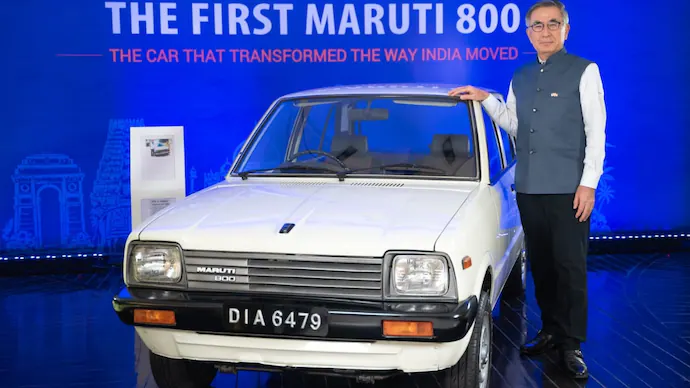
The Maruti 800, India’s first mass-market car, has received international recognition for its contribution to the country’s automotive history. The iconic hatchback has become the first and only Indian vehicle to win the FIVA World Vehicle Heritage Award, recognising its role in transforming personal mobility and making car ownership accessible to millions of households.
Announced by the Fédération Internationale des Véhicules Anciens (FIVA) on November 16, the award places the Maruti 800 among 21 historically and culturally significant vehicles recognised around the world. The inaugural awards celebrate vehicles that have influenced society, industrial development and national identity.
Unlike conventional automotive awards that often focus on performance, luxury, rarity or collectability, the FIVA World Vehicle Heritage Award recognises the wider historical and cultural importance of vehicles. The Maruti 800 was selected alongside vehicles from countries such as the US, Brazil, Germany, France, Austria and Slovenia. It is the only Indian vehicle among the 21 awardees.
Maruti 800: The Car That Changed India’s Automotive Landscape
Introduced in December 1983, the Maruti 800 marked a major turning point in India’s passenger vehicle industry. Developed through a partnership between the Government of India and Suzuki Motor Corporation, the compact hatchback brought modern and relatively affordable personal transportation within reach of a much larger section of the population.
Before its arrival, car ownership in India was limited by high prices, long waiting periods and a relatively small selection of models. A personal car was often considered a luxury rather than an everyday necessity for middle-class families.
The Maruti 800 changed that perception. Its compact dimensions, accessible pricing and practical design made it suitable for Indian families, while its popularity spread from major cities to smaller towns. For many households, buying a Maruti 800 became a milestone and a symbol of economic progress.
The model’s influence went beyond its sales performance. It helped create demand for personal cars, encouraged the growth of dealerships and service networks, and contributed to the development of India’s automotive component manufacturing industry.
Over its production life, more than 2.9 million Maruti 800 units were manufactured. The model also helped establish India as an important manufacturing and export base for Suzuki, with international shipments beginning in 1987.
Maruti Suzuki Chairman Highlights The Car’s Contribution To India
Speaking about the global recognition, Maruti Suzuki India chairman R.C. Bhargava highlighted that the Maruti 800’s contribution extended well beyond the automobile industry.
He pointed to the car’s role in demonstrating India’s ability to manufacture high-quality engineering products at a time when the country’s domestic manufacturing capabilities were often questioned. The Maruti 800 became an important example of how large-scale production could deliver modern products to Indian consumers.
Bhargava also highlighted the wider economic impact of the motorisation movement. The growth of the automobile industry generated millions of employment opportunities across manufacturing, dealerships, servicing and supporting industries.
Greater access to reliable personal transportation also helped more women participate in economic activities by making daily travel more convenient. This social impact is an important part of why the Maruti 800’s heritage extends beyond its status as a successful small car.
From A Domestic Bestseller To An International Export Story
The Maruti 800’s importance was not restricted to the Indian market. Its success also contributed to Suzuki’s international manufacturing strategy and helped establish India as a production base for vehicles intended for overseas markets.
According to Suzuki Motor Corporation president Toshihiro Suzuki, exports of the Maruti 800 began in 1987. Hungary, France and Belgium were among the early international destinations for the hatchback.
Suzuki also highlighted the scale of the model’s manufacturing journey. Production initially began at around 40,000 cars annually in India. Over the following three decades, the Maruti 800’s cumulative production crossed 2.9 million units.
The manufacturing ecosystem developed during this period helped lay the foundation for India’s emergence as a major automobile production and export hub. Over the years, Maruti Suzuki expanded its operations and international reach significantly.
Today, Maruti Suzuki exports more than 400,000 vehicles annually to over 120 countries. This growth reflects the development of India’s automotive manufacturing capabilities and the global importance of the production base established over several decades.
Why The FIVA World Vehicle Heritage Award Matters
FIVA is an international non-profit federation dedicated to historic vehicles and works as a non-governmental partner of UNESCO. Its World Vehicle Heritage Awards have been introduced to recognise the broader historical significance of vehicles and their influence on the societies in which they were developed and used.
The awards take a different approach from conventional automotive honours. Instead of focusing primarily on technical specifications, market value, performance or exclusivity, they recognise vehicles that have made a meaningful contribution to everyday life, industrial progress and cultural identity.
The inaugural edition selected 21 vehicles from different countries, with the Maruti 800 representing India. Its inclusion is particularly significant because the hatchback was not a rare luxury vehicle or an exclusive collector’s model. Its importance came from its widespread popularity and the impact it had on ordinary households.
By recognising the Maruti 800, FIVA has acknowledged that automotive heritage is not limited to expensive classics or historically significant sports cars. Vehicles that changed everyday transportation and influenced the economic development of a country can also hold an important place in global automotive history.
Maruti 800: More Than Just A People’s Car
For millions of Indian families, the Maruti 800 represented their first experience of owning a car. It became a familiar sight on roads across the country and remained an important part of the market for decades.
Its legacy can be measured not only through the more than 2.9 million units manufactured but also through the changes it helped bring to India’s automobile industry. It made personal mobility more accessible, strengthened domestic manufacturing and contributed to the country’s growing presence in international automotive markets.
The FIVA World Vehicle Heritage Award gives international recognition to that contribution. The Maruti 800 may no longer be in production, but its influence on Indian mobility and manufacturing continues to be remembered.
For a car that helped put millions of Indians behind the wheel, becoming the first Indian vehicle to receive this global heritage honour is a fitting recognition of its place in history.
For breaking news and live news updates, like us on Facebook or follow us on Twitter and Instagram. Read more on Latest Automobile on thefoxdaily.com.





COMMENTS 0