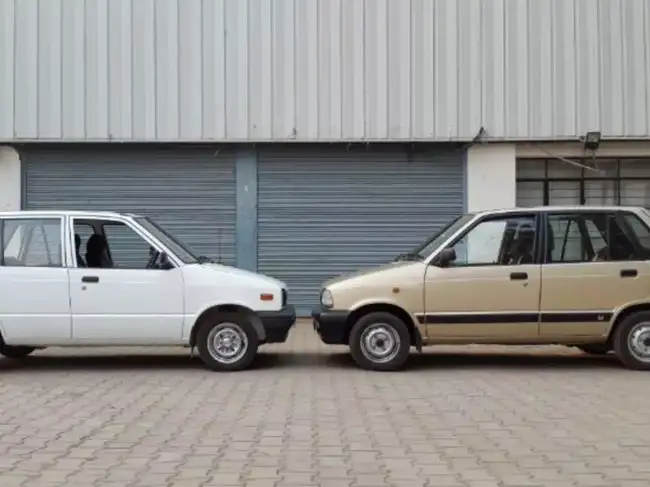
The Maruti 800 has earned another place in Indian automotive history after becoming the first Indian vehicle to receive the FIVA World Vehicle Heritage Award. The honour recognises the car’s remarkable contribution to India’s automotive heritage and its role in changing how millions of people experienced personal mobility.
Launched in 1983, the Maruti 800 quickly became one of India’s most recognisable cars. It was more than just an affordable hatchback; for countless middle-class families, owning one represented independence, progress and the fulfilment of a long-held dream. Over its production lifetime, Maruti Suzuki sold more than 27 lakh units, making it one of the most influential cars in the country’s history.
The FIVA recognition celebrates this lasting legacy. Even years after production ended, the Maruti 800 remains an important part of India’s collective automotive memory, with many examples still cherished by enthusiasts and owners.
Maruti 800 Becomes the First Indian Vehicle to Win the FIVA Heritage Award
The FIVA World Vehicle Heritage Award acknowledges vehicles that have made a meaningful contribution to automotive history and heritage. The Maruti 800’s selection reflects its importance in shaping India’s passenger vehicle market and making car ownership accessible to a much wider section of society.
Before the Maruti 800 arrived, owning a car was beyond the reach of many Indian households. The market offered limited choices, and cars were often viewed as expensive possessions. The arrival of the 800 introduced a different approach: a compact, practical and relatively affordable car designed for everyday Indian families.
Its influence extended beyond sales figures. The model helped create a stronger culture of personal car ownership and encouraged more people to consider a four-wheeler as a practical part of family life. Its long production run and popularity across generations made it a familiar sight on Indian roads.
How Maruti 800 Changed India’s Automobile Industry
The Maruti 800 played a major role in transforming India’s passenger car industry. When it was introduced in December 1983, the Indian market was very different from what it is today. Car buyers had relatively few options, and personal vehicles were not as accessible to middle-income families.
Maruti Udyog, established through a partnership between the Indian government and Japan’s Suzuki Motor Corporation, aimed to bring modern and affordable cars to the country. The Maruti 800 became the company’s defining product and helped establish a new benchmark for small cars.
Its compact dimensions made it suitable for crowded urban roads, while its straightforward design and practical cabin appealed to families looking for everyday transportation. The car also introduced many Indian buyers to a more modern ownership experience.
As demand increased, Maruti expanded its manufacturing and sales network. The company’s growing presence helped develop the wider automotive ecosystem, including dealerships, service centres and component suppliers. The success of the 800 also strengthened the position of small, fuel-efficient hatchbacks in India’s car market.
Over time, the model became a common choice for first-time car buyers. It helped establish the idea that a reliable personal car did not have to be a luxury purchase. That shift in consumer expectations remains one of its most important contributions.
Maruti 800 Bookings, Launch Price and First Delivery
The Maruti 800’s arrival in 1983 was a major event for India’s automobile industry. Its launch attracted considerable attention because it promised a modern car at a price that was more accessible than many alternatives available at the time.
The first Maruti 800 was delivered on December 14, 1983, to Harpal Singh in New Delhi. The delivery became an important moment in the history of Indian car manufacturing, marking the beginning of a new era for the country’s small-car market.
The original model was priced at around Rs 47,500 at launch. This positioning helped the car appeal to buyers who wanted to move from two-wheelers or public transport to personal four-wheel mobility.
Its launch generated strong interest, and demand soon became a defining feature of the model’s early years. For many families, booking a Maruti 800 was the first step towards owning a car. The vehicle’s popularity eventually turned it into a household name.
Why Maruti 800 Became India’s Favourite People’s Car
The Maruti 800 succeeded because it offered a combination of affordability, compact dimensions and everyday practicality. It was designed to serve ordinary families rather than appeal only to buyers looking for premium features or high performance.
Affordable Personal Mobility
One of the biggest reasons behind its success was its relatively accessible price. The Maruti 800 gave middle-class families an opportunity to own a car without moving into a much more expensive segment. For many first-time buyers, it was their introduction to personal four-wheel mobility.
Compact Size for Indian Roads
Its small footprint made the car convenient in cities where narrow streets and limited parking spaces were common. The compact design also made it approachable for drivers who were buying their first car.
Practical and Familiar Design
The Maruti 800 focused on the essentials. It offered seating for a small family, straightforward controls and a layout suited to everyday commuting. Rather than relying on complicated technology, it built its reputation around usability.
A Strong Ownership Legacy
The car became widely recognised for its relatively simple mechanical design and accessible maintenance. Maruti’s expanding service and dealership network further supported its popularity. Over the years, the 800 became a familiar choice for families, first-time drivers and people looking for an uncomplicated city car.
More Than 27 Lakh Units Sold
The Maruti 800’s lifetime sales crossed 27 lakh units, demonstrating the scale of its popularity. Its success was not limited to one generation of buyers. Many families owned the model for years, while others remembered it as their first experience of travelling in a family car.
Why Maruti 800 Production Ended in 2014
Despite its enormous popularity, the Maruti 800 eventually became difficult to sustain in a rapidly changing automobile market. Production ended in 2014, more than three decades after the car’s introduction.
One of the major reasons was the introduction of stricter emission regulations. The Maruti 800’s older engineering platform made it increasingly challenging to meet newer regulatory requirements while keeping the vehicle competitively priced.
Changing customer expectations also played an important role. Indian buyers were increasingly looking for better safety equipment, improved comfort, more modern styling and additional features. The small-car segment had evolved considerably, with newer models offering updated technology and improved overall packages.
Maruti Suzuki gradually shifted its attention towards newer products, including models designed to meet changing regulations and consumer preferences. The Alto, which had already become an important entry-level offering, took over much of the role previously associated with the 800.
Although production stopped, the Maruti 800 did not disappear from India’s roads or automotive culture. Many owners continued maintaining their cars, while collectors and enthusiasts preserved examples as reminders of an important period in the country’s motoring history.
Maruti 800’s Legacy Goes Beyond Sales Figures
The FIVA World Vehicle Heritage Award highlights why the Maruti 800 deserves recognition beyond its commercial success. Its importance lies in the way it changed the relationship between Indian families and personal transportation.
For one generation, it was the first family car. For another, it was the vehicle in which they learned to drive or experienced their first road trip. Its familiar shape became part of everyday life across cities and towns.
With more than 27 lakh units sold and a production history spanning over three decades, the Maruti 800 remains one of the most significant vehicles ever made in India. Becoming the first Indian vehicle to receive the FIVA World Vehicle Heritage Award gives formal recognition to a car that had already secured a special place in the country’s history.
For breaking news and live news updates, like us on Facebook or follow us on Twitter and Instagram. Read more on Latest Automobile on thefoxdaily.com.






COMMENTS 0