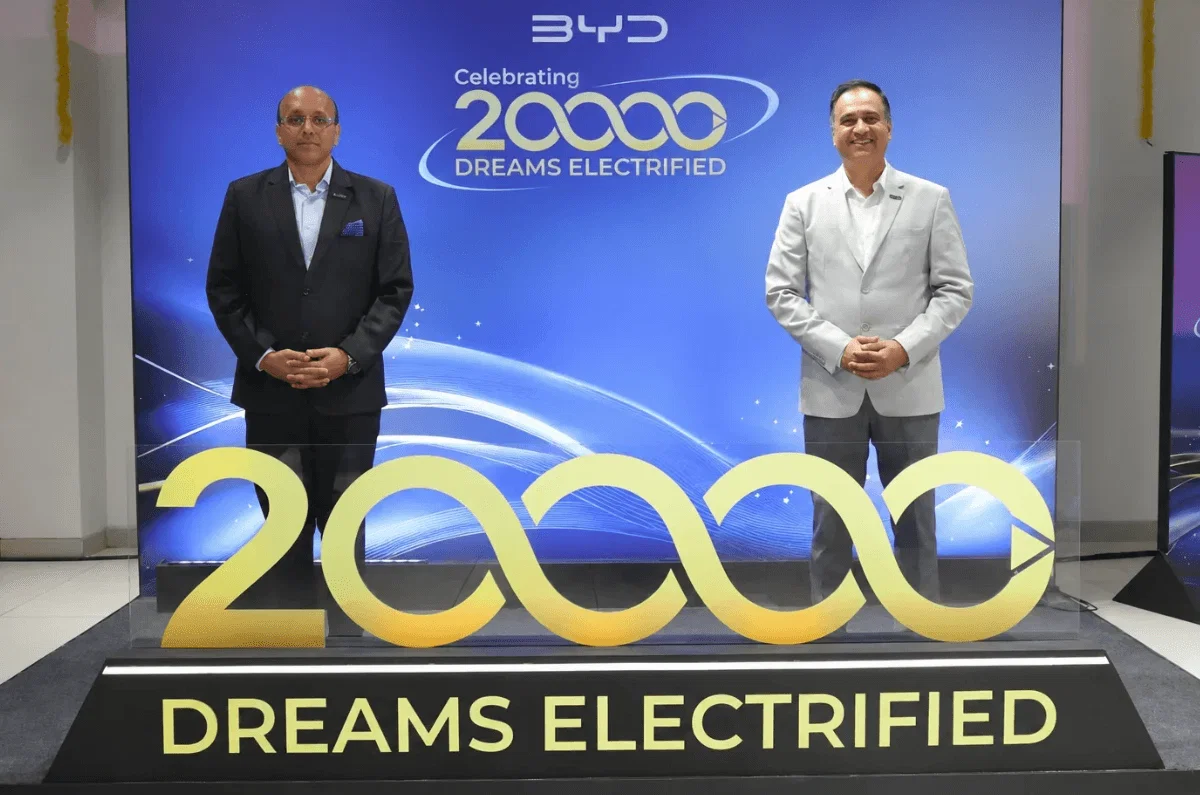
BYD has crossed the 20,000-unit sales milestone in India, marking an important achievement for the Chinese electric vehicle manufacturer. The company reached 10,000 deliveries in September 2025, meaning it has doubled its cumulative sales in just over a year.
The milestone comes as BYD continues to expand its presence in the Indian market through a growing product portfolio and dealership network. The company currently operates 51 showrooms across 40 cities, giving customers access to its Electric Vehicles in several major markets.
BYD has also expanded its ambitions in India’s luxury vehicle space by introducing its premium brand, Denza. The brand recently made its Indian debut with the launch of the D9 and Z9 GT, adding another dimension to the company’s presence in the country.
BYD’s India Journey: From Electric Buses To Passenger Cars
BYD entered the Indian market in 2007, initially focusing on commercial electric buses. Its early presence was centred on providing electric mobility solutions for public transportation rather than private passenger vehicles.
The company moved into India’s passenger electric vehicle segment in 2021 with the launch of the e6 electric MPV. The model marked BYD’s first major step towards establishing itself as a passenger vehicle manufacturer in the country. It was later replaced by the eMax 7, which continues to be part of the brand’s current portfolio.
Over the years, BYD has introduced additional electric models to appeal to different customer requirements. Its current passenger vehicle lineup includes the Atto 3, Seal, eMax 7 and Sealion 7. These models cover different body styles and price segments, ranging from an electric MPV to premium electric SUVs and a sporty electric sedan.
BYD’s Current Car Lineup In India
BYD currently offers four passenger vehicle models in India. Each targets a different set of buyers, helping the company build a broader presence in the country’s growing electric vehicle market.
- BYD Atto 3: An electric SUV that introduced many Indian buyers to the brand’s passenger vehicle range.
- BYD Seal: An electric sedan positioned towards buyers looking for performance, technology and a premium cabin experience.
- BYD eMax 7: An electric MPV that replaced the earlier e6 and caters to buyers looking for a more spacious family-oriented vehicle.
- BYD Sealion 7: A premium electric SUV that expands the company’s offering in the higher-end EV segment.
The four-model portfolio gives BYD a presence across multiple passenger vehicle categories. Rather than depending on a single electric SUV or sedan, the company has gradually expanded its range to address different customer needs.
BYD Continues To Import Its Cars Into India
Despite reaching the 20,000-unit milestone, BYD currently imports all its passenger cars sold in India. The company has not established local manufacturing for its passenger vehicle lineup, with its models arriving as completely built-up (CBU) units.
Importing fully assembled vehicles can influence their final prices because of the duties and other costs associated with bringing them into the country. This can make it challenging for an imported EV brand to compete with manufacturers that have local production facilities.
Given the government’s stance on the matter, BYD may continue selling completely built-up models in India. Its future growth will therefore depend not only on expanding its product range and dealership network but also on how competitively it can position its imported vehicles.
BYD To Launch Seal U As Its First Plug-In Hybrid In India
BYD has also confirmed plans to introduce the Seal U in India. The model will be an important addition to the company’s portfolio as it will become its first plug-in hybrid vehicle in the country.
Unlike a conventional hybrid, a plug-in hybrid vehicle combines an internal combustion engine with an electric motor and a battery that can be charged externally. This allows it to cover certain journeys using electric power while retaining an engine for longer trips.
The Seal U could help BYD reach buyers who are interested in electrified mobility but are not yet ready to switch to a fully electric vehicle. Its arrival would also broaden the company’s powertrain offerings beyond the battery-electric models currently available in India.
However, details such as the Indian-specification powertrain, equipment, pricing and launch timeline have not been specified in the supplied announcement.
Denza Adds A New Luxury Dimension To BYD’s India Plans
Alongside its mainstream BYD lineup, the company has introduced Denza as its luxury brand in India. The brand’s arrival with the D9 and Z9 GT signals an effort to enter a more premium part of the market.
The D9 and Z9 GT give Denza two distinct products for its Indian debut. Their introduction also reflects BYD’s broader strategy of using different brands and product categories to reach customers with varying requirements.
The luxury brand’s progress in India will depend on factors such as pricing, customer experience, product availability and the development of its sales and service network. Its launch adds another layer to BYD’s plans, although the company will need to establish Denza’s identity among Indian luxury car buyers.
What The 20,000-Unit Milestone Means For BYD
Crossing 20,000 cumulative sales is a significant step for BYD in a market where electric passenger vehicles are still developing. The fact that the company doubled its earlier 10,000-unit milestone in just over a year indicates that it has continued to build its customer base.
Its network of 51 showrooms across 40 cities is another important part of this expansion. A wider retail presence can improve customer access to the brand, make vehicle discovery easier and support the ownership experience.
However, BYD still faces challenges in a competitive Indian market. Local manufacturers have expanded their electric vehicle offerings, while established international brands are also introducing new electric models. Imported vehicle pricing and the availability of charging infrastructure remain important considerations for potential buyers.
The introduction of the Seal U and the expansion of the Denza brand could give BYD additional opportunities to attract customers. At the same time, its existing Atto 3, Seal, eMax 7 and Sealion 7 will remain central to its passenger vehicle presence.
What’s Next For BYD In India?
BYD’s next phase in India will be shaped by product expansion, network development and its approach to the country’s regulatory environment. The confirmed Seal U launch will bring plug-in hybrid technology to its Indian portfolio, while Denza’s arrival gives the company an opportunity to explore the luxury segment.
For now, the 20,000-unit milestone underlines the progress BYD has made since entering India’s passenger EV market in 2021. Whether it can maintain that momentum will depend on how effectively it addresses pricing, customer expectations and competition from established manufacturers.
With four passenger vehicle models already on sale, a growing showroom network and further products planned, BYD is looking to strengthen its position in India’s evolving electric mobility market.
For breaking news and live news updates, like us on Facebook or follow us on Twitter and Instagram. Read more on Latest Automobile on thefoxdaily.com.






COMMENTS 0