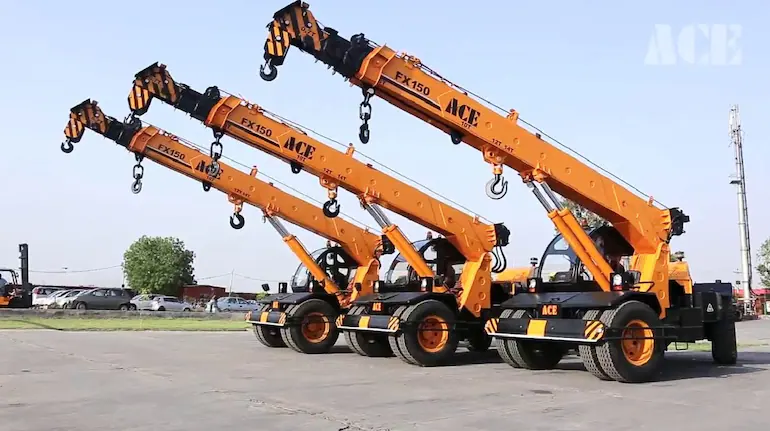
Shares of Action Construction Equipment (ACE) surged 8% on November 26 after the Union Cabinet approved an Rs 11,000-crore scheme to strengthen India’s Construction and Infrastructure Equipment (CIE) manufacturing ecosystem. The government initiative aims to expand domestic production, reduce dependence on imported machinery and help Indian manufacturers become more competitive in the global market.
The scheme is particularly significant for companies involved in manufacturing construction machinery and infrastructure equipment. It targets seven categories of equipment that are currently fully or largely dependent on imports, including tunnel boring machines, off-highway trucks, excavators, cranes, loaders, piling rigs and drilling machines.
At 12:15 pm on November 26, Action Construction Equipment shares were trading 8% higher at Rs 1,286.90 apiece. Shares of Sanghvi Movers also gained 1.5% to trade at Rs 382.45.
Why Action Construction Equipment Shares Are Rising
The immediate trigger for the rally in Action Construction Equipment shares was the Cabinet’s approval of the Rs 11,000-crore CIE manufacturing scheme. The programme is designed to encourage domestic companies to manufacture advanced construction and infrastructure equipment and their components in India.
Action Construction Equipment operates in the construction equipment Manufacturing Sector, making the government’s initiative relevant to the broader industry in which the company participates. The scheme could create opportunities for manufacturers as domestic production capacity expands and demand for locally manufactured machinery increases.
However, the Cabinet’s approval does not automatically translate into additional orders or higher earnings for individual companies. The actual benefit to manufacturers will depend on their eligibility, investment plans, production capabilities and ability to secure a share of the demand generated by the expanding infrastructure sector.
The market’s positive response reflects expectations that government support for domestic manufacturing could improve the industry’s long-term growth prospects.
Government Approves Rs 11,000-Crore Scheme for CIE Industry
Information and Broadcasting Minister Ashwini Vaishnaw announced the Cabinet’s decision after the meeting. He said the scheme would run for eight years, beginning in FY2026-27, with the objective of developing indigenous manufacturing capacity in advanced construction and infrastructure equipment.
According to the government, India already has the world’s third-largest CIE industry. The sector had a market size of approximately Rs 97,000 crore in FY2024-25. Despite its scale, around 45% of the Indian market depends on imports, highlighting the opportunity to expand domestic manufacturing.
The scheme seeks to address this dependence by supporting manufacturers of equipment and components that are currently sourced substantially from overseas markets. It is also intended to strengthen the country’s industrial capabilities and position India as a more important participant in the global CIE market.
The government expects the industry to grow significantly over the coming years, supported by infrastructure development, including investments in roads and ports, as well as expansion in the housing sector.
India’s CIE Market Could More Than Double by FY2030
According to the official statement, India’s construction and infrastructure equipment industry is projected to more than double in size, reaching approximately Rs 2,28,100 crore by FY2029-30.
This projected expansion reflects the expected growth in demand for machinery used in major infrastructure and construction projects. Equipment such as excavators, cranes, loaders and drilling machines plays an important role in road construction, port development, mining-related activities and other large-scale projects.
As infrastructure activity expands, demand for advanced machinery is also likely to increase. A larger domestic manufacturing base could help Indian companies participate more actively in this growth while reducing reliance on imported equipment.
Nevertheless, the projected market size is a government estimate rather than a confirmed outcome. Its achievement will depend on infrastructure investment, project execution, demand conditions and the ability of manufacturers to expand production capacity.
Seven Equipment Categories Targeted Under the Scheme
The scheme focuses on seven categories of construction and infrastructure equipment that are fully or largely imported into India. These categories have been selected to encourage domestic production in areas where the country has an opportunity to strengthen its manufacturing capabilities.
- Tunnel boring machines: Used for constructing underground tunnels for transport and infrastructure projects.
- Off-highway trucks: Heavy-duty vehicles used in demanding industrial and construction environments.
- Excavators: Machinery used for digging, earthmoving and site preparation.
- Cranes: Equipment used to lift and move heavy materials at construction and infrastructure sites.
- Loaders: Machinery used for handling and transporting materials.
- Piling rigs: Equipment used to install foundations for buildings and infrastructure structures.
- Drilling machines: Machinery used for drilling operations across construction and infrastructure applications.
By targeting these categories, the government aims to encourage manufacturers to develop domestic capabilities in technically demanding equipment segments. This could gradually strengthen the local supply chain and reduce exposure to disruptions in international machinery markets.
Scheme to Operate in Phases Until FY2033-34
The Rs 11,000-crore programme will be implemented over eight years, with separate phases for setting up manufacturing facilities, distributing incentives and settling eligible payments.
The first two years, covering FY2026-27 and FY2027-28, will serve as the gestation period. During this phase, manufacturers will have time to establish production facilities and prepare their operations to meet the scheme’s requirements.
This will be followed by a five-year incentive disbursement period from FY2028-29 to FY2032-33. The final year, FY2033-34, will be used to settle incentives linked to incremental sales recorded during FY2032-33.
The phased structure is intended to give companies time to make manufacturing investments before the incentive payments begin. It also links government support to incremental sales, rather than providing incentives without reference to actual business activity.
Two Components: Sales-Linked Incentives and Testing Facility Grant
The scheme has two main components: a sales-linked incentive programme for eligible manufacturers and a grant for establishing a dedicated CIE testing facility in India.
1. Sales-Linked Incentives for Manufacturers
Under the first component, approved applicants will receive incentives based on the incremental sales value of eligible construction and infrastructure equipment and components.
The programme covers two categories of applicants: eligible original equipment manufacturers (OEMs) and component manufacturers. This structure is designed to support both companies producing finished machinery and businesses supplying the parts required to manufacture that equipment.
The graded incentive rates will range from 13% to 8% of incremental sales value over a five-year period. Linking incentives to additional sales is intended to encourage companies to expand production and increase the domestic supply of eligible equipment.
For component manufacturers, the inclusion of a separate category could help strengthen the domestic supply chain. A stronger component ecosystem is important because the ability to manufacture finished machinery locally also depends on the availability, quality and reliability of essential parts.
2. Grant of Up to Rs 375 Crore for a Dedicated Testing Facility
The second component provides for a state-of-the-art, dedicated CIE testing facility in India. The government will offer a grant of up to Rs 375 crore in the form of Viability Gap Funding to support its establishment.
Testing infrastructure is important for manufacturers because construction equipment must meet technical, performance and safety requirements. A dedicated facility could provide domestic companies with access to testing capabilities within the country, supporting product development and quality assessment.
It could also help reduce the need to depend on testing facilities outside India. The government has identified the facility as an important part of its effort to improve the domestic manufacturing ecosystem.
China’s Export Controls Highlight the Importance of Domestic Manufacturing
The scheme comes amid concerns about India’s dependence on imported machinery and the potential risks associated with disruptions in international supply chains.
Last month, China announced new export controls on key machinery, including tunnel boring machines. Such restrictions could adversely affect India’s infrastructure development if access to essential equipment becomes more difficult.
Tunnel boring machines are used in major underground construction projects, making their availability important for infrastructure development. Greater domestic manufacturing capacity could help India reduce its exposure to external supply restrictions over time.
However, building domestic production capabilities in advanced machinery is a complex process. It requires investment in technology, skilled workers, component supply chains, research and development, and quality-control systems. Government incentives may support this transition, but manufacturers will also need to demonstrate that locally produced equipment can meet the performance and reliability requirements of large infrastructure projects.
What the Scheme Could Mean for Action Construction Equipment
The Cabinet’s approval has drawn attention to companies operating in India’s construction equipment industry, including Action Construction Equipment. The company’s share-price movement indicates that investors are assessing the potential implications of the policy announcement for the sector.
In the longer term, a larger domestic CIE market could create opportunities for equipment manufacturers. If infrastructure investment continues to expand and domestic production becomes more competitive, manufacturers may benefit from a broader addressable market.
The scheme’s support for both original equipment manufacturers and component suppliers could also encourage greater investment across the manufacturing value chain. This may help improve the availability of locally produced equipment and parts.
For Action Construction Equipment, however, the precise financial impact will depend on the company’s participation in eligible categories, its qualification under the scheme and its ability to increase sales. The announcement alone does not establish the scale or timing of any additional revenue or profit contribution.
Investors will therefore need to monitor further details about the scheme’s implementation, eligibility conditions and the response from equipment manufacturers before assessing its company-specific impact.
What Investors Should Watch Next
Following the initial market reaction, several developments will be important in determining whether the policy announcement translates into sustained growth for India’s CIE manufacturers.
- Scheme implementation: The Ministry of Heavy Industries will play a central role in implementing the programme. Operational guidelines and eligibility conditions will clarify how companies can participate.
- Manufacturing investments: Companies’ decisions to establish or expand production facilities will indicate how quickly the industry responds to the incentives.
- Domestic component supply: The development of local suppliers will be important for reducing import dependence and improving the competitiveness of Indian-made machinery.
- Infrastructure demand: Growth in roads, ports, housing and other projects will influence the demand for construction equipment.
- Sales and earnings: Actual incremental sales and financial performance will ultimately determine the commercial benefits for individual manufacturers.
The government’s Rs 11,000-crore initiative represents a major policy push for India’s construction and infrastructure equipment manufacturing sector. By combining sales-linked incentives with support for testing infrastructure, the programme aims to address both production capacity and the supporting ecosystem required for advanced machinery.
For Action Construction Equipment and other industry participants, the announcement has created positive expectations. Whether those expectations translate into stronger business performance will depend on execution, investment and the pace at which domestic manufacturers can compete with imported equipment.
For breaking news and live news updates, like us on Facebook or follow us on Twitter and Instagram. Read more on Latest Business on thefoxdaily.com.






COMMENTS 0