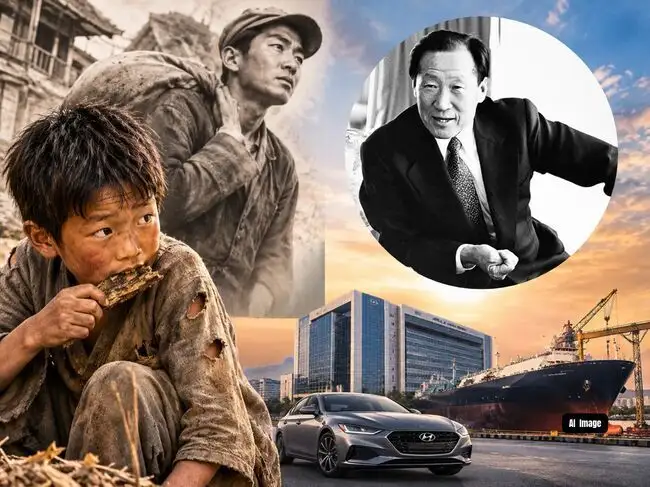
From surviving childhood hunger by eating tree bark and grass roots to building one of South Korea’s most influential business empires, Chung Ju-yung’s life was a remarkable journey of ambition, setbacks and determination. Born into a poor farming family, he left home as a teenager in search of a better future. His early business ventures faced repeated failures, but he continued to take risks and explore new opportunities.
Chung eventually founded Hyundai, a business group that expanded into construction, automobiles and shipbuilding. At a time when South Korea was still developing its industrial capabilities, he pursued projects that many considered too ambitious. His efforts helped shape several major sectors of the country’s economy and established Hyundai as a globally recognised name.
Chung Ju-yung’s Childhood Was Marked by Poverty and Hunger
Chung Ju-yung was born on November 25, 1915, in Tongcheon County, Gangwon Province, an area that is now part of North Korea. He was the eldest son in a large farming family that struggled to make ends meet. His father worked in agriculture, while his mother contributed to the household through demanding domestic and farm-related work.
Growing up in a poor rural household meant that food and money were often scarce. The family depended heavily on farming, making its livelihood vulnerable to difficult weather and poor harvests. Accounts of Chung’s early life describe severe hunger, including periods when he and his family had to eat tree bark and grass roots to survive.
Despite the difficult circumstances, Chung developed an early interest in education. He attended elementary school and wanted to continue studying, with the ambition of becoming a teacher. However, his family could not afford further education, and his father expected him to remain in the village and work on the family farm.
Chung did not want poverty to determine the course of his life. He believed that working outside the village could offer better opportunities, even though leaving home meant going against his father’s wishes. His early experiences of hardship would later influence his approach to business, particularly his willingness to work long hours and take on difficult assignments.
He Ran Away From Home Several Times
As a teenager, Chung repeatedly attempted to leave his village in search of employment. He wanted to earn money independently rather than spend his life working on the family farm. His first attempts were unsuccessful because his father found him and brought him back home.
One of his early escapes involved selling the family’s only cow to finance his journey. The money helped him travel towards Seoul, where he hoped to find work. However, his father eventually tracked him down, and Chung had to return to the village.
He made further attempts to leave, but each journey brought new difficulties. His family responsibilities and the pressure to continue farming remained significant obstacles. Consecutive poor harvests also made the family’s financial situation more difficult.
Eventually, Chung managed to leave home permanently as a young man. He travelled towards Seoul and took up various low-paying jobs. His work included carrying construction materials, working at a port and taking up other labour-intensive assignments.
These jobs exposed him to different industries and helped him understand the value of discipline, practical skills and persistence. He later found employment at a rice shop, where his hard work and reliability impressed the owner. He eventually gained responsibility for managing the shop’s operations.
The experience proved important because it gave him an opportunity to understand business management, customer relationships and financial transactions. It also helped him save money and develop the confidence to establish a business of his own.
His First Businesses Failed, but He Refused to Quit
Chung’s first major business venture was a rice shop that he acquired after gaining the owner’s trust. He worked to develop the business, but the venture did not survive the economic restrictions imposed during Japanese colonial rule. Rice rationing policies forced the shop to close, leaving him without the business he had worked hard to build.
Rather than abandon entrepreneurship, Chung looked for another opportunity. In 1940, he borrowed money and opened an automobile repair shop in Seoul. At the time, South Korea did not have a large automobile industry, and the business was a considerable risk for a young entrepreneur with limited experience in the sector.
The repair shop initially offered a new source of income, but another setback arrived quickly. A fire destroyed the business less than a month after it opened. Chung lost his investment and was left with debt, forcing him to begin again.
He later established another automobile repair business. However, the Korean War created further disruption. His business assets were lost amid the conflict, and he had to restart his professional life once again.
These failures were not isolated incidents. Chung faced changing government policies, war-related destruction, limited capital and an uncertain business environment. Yet he continued to search for opportunities rather than treating each setback as the end of his entrepreneurial journey.
His experience in automobile repair and civil engineering eventually provided the foundation for the businesses that would become the Hyundai Group. The repeated need to rebuild also strengthened his ability to operate under pressure and make decisions in difficult circumstances.
Construction Gave Birth to the Hyundai Empire
Chung’s major breakthrough came through construction. In 1946, he established Hyundai Motor Service as an automobile repair business. A year later, in 1947, he founded Hyundai Civil Works, which became the starting point for Hyundai’s expansion into construction and infrastructure.
The name Hyundai is associated with the idea of modernity. Chung wanted to build businesses that could contribute to the modernisation of South Korea, a country facing enormous economic and infrastructure challenges after decades of colonial rule and war.
In 1950, his automobile service and civil works businesses were brought together to establish Hyundai Engineering & Construction. The company gradually became involved in major infrastructure projects, including roads, bridges, dams and power facilities.
The Korean War had left much of the country’s infrastructure damaged. Reconstruction created demand for companies capable of delivering large engineering and construction projects. Hyundai took on work that helped support the rebuilding process and expanded its technical and operational capabilities.
One important part of Chung’s strategy was to move beyond small domestic projects. He recognised that the construction business could face limitations if it depended entirely on the local market. Hyundai therefore pursued opportunities overseas, including projects in the Middle East and Southeast Asia.
The company’s involvement in the Pattani-Narathiwat Expressway project in Thailand marked an important step in South Korea’s overseas construction activity. Hyundai’s international expansion helped it gain experience in large-scale infrastructure work and strengthened its position in the global construction industry.
Another major project was the Jubail Industrial Port in Saudi Arabia. The contract, valued at approximately $930 million, was a significant achievement for Hyundai and South Korea’s construction industry. It demonstrated that a Korean company could compete for major international engineering projects.
Construction therefore became more than just one of Hyundai’s business activities. It provided the organisational experience, financial opportunities and technical capabilities that helped Chung expand into other capital-intensive industries.
He Entered the Automobile Business to Build a Korean Car Brand
Although Chung had started his business career in automobile repair, he wanted Hyundai to become more than a company that serviced vehicles. He believed South Korea needed its own automobile manufacturing industry and that domestic companies should develop the ability to produce vehicles rather than depend entirely on foreign manufacturers.
Hyundai Motor Company was established in December 1967. The move represented a major shift from repairing cars to manufacturing them. However, developing a competitive automobile business was not easy. South Korea had limited experience in large-scale vehicle production, and Hyundai needed technology, engineering expertise and manufacturing capabilities.
In its early years, Hyundai worked with overseas partners to develop its manufacturing operations. The company initially produced vehicles using foreign technology and expertise while building its own engineering knowledge.
A major milestone arrived in 1976 with the introduction of the Hyundai Pony. It became the first mass-produced Korean passenger car and an important step towards developing a domestic automobile industry.
The Pony also represented Chung’s broader ambition: to establish a Korean car brand that could eventually compete in international markets. Developing a vehicle under the Hyundai name required more than setting up an assembly line. It involved building production systems, improving engineering capabilities and establishing a supply network.
Over time, Hyundai expanded its manufacturing operations and strengthened its position in the automobile market. The company eventually became one of South Korea’s best-known industrial names, with a presence in markets across the world.
Chung’s decision to enter automobile manufacturing was closely connected to his belief that industrial development required companies to move into more advanced activities. For him, building cars was not simply another commercial opportunity; it was part of a wider effort to strengthen South Korea’s manufacturing capabilities.
Nobody Believed He Could Build a Shipyard in South Korea
One of the most ambitious decisions in Chung’s career was entering shipbuilding. During the early 1970s, South Korea had limited experience in constructing large commercial vessels. Establishing a shipyard capable of producing massive oil tankers required substantial financing, specialised technology and skilled workers.
Chung nevertheless believed shipbuilding could become a major industry for South Korea. He saw an opportunity to expand Hyundai into heavy manufacturing and create a business capable of serving international shipping companies.
In 1971, he travelled to the United Kingdom to secure financial support for the proposed shipyard. He approached foreign banks with plans for a large shipbuilding facility at Ulsan, even though Hyundai had not yet built such a facility or completed a large commercial vessel.
One of the most frequently recalled episodes from the negotiations involved a photograph of the proposed shipyard site at Mipo Bay and a Korean 500-won banknote featuring the country’s historic Turtle Ship. Chung used the image and the historical reference to explain his confidence in Korea’s potential to build ships.
He also secured orders for two very large crude carriers from Greek shipowner George Livanos. Winning the orders before the shipyard was operational was a crucial step in convincing financiers that the project had commercial potential.
Hyundai began construction of the Ulsan shipyard in March 1972. The company faced the enormous challenge of building the shipyard and the first vessels at the same time. It also entered into technical cooperation arrangements with British shipbuilding companies to obtain the expertise required for the project.
In 1973, Hyundai Shipbuilding & Heavy Industries was established. The shipyard and the first two tankers were completed in 1974, marking a major achievement for the company. The project demonstrated that South Korea could develop large-scale shipbuilding capabilities despite its limited experience in the sector.
The decision carried considerable risk. Hyundai had to manage financing, technology transfer, construction deadlines and the training of workers. The company also faced disruption from the global oil crisis, which affected demand and created difficulties around some vessel orders.
Nevertheless, the Ulsan project became the foundation for Hyundai’s expansion in shipbuilding. Hyundai Heavy Industries grew into a major global shipbuilder, contributing to South Korea’s emergence as an important centre of the international shipbuilding industry.
From a Poor Runaway to One of South Korea’s Richest Businessmen
Chung Ju-yung’s business journey extended far beyond automobiles, construction and shipbuilding. Under his leadership, Hyundai expanded into several other areas, including engineering, heavy industries, petrochemicals and trading. The group became one of South Korea’s major industrial conglomerates and played a significant role in the country’s economic transformation.
His influence also extended beyond business. Chung was involved in efforts to secure the 1988 Summer Olympics for Seoul and later took part in initiatives aimed at improving relations between South Korea and North Korea. In 1992, he entered politics and contested South Korea’s presidential election as a candidate of the United People’s Party.
Chung died on March 21, 2001, at the age of 85. By then, he had become one of the most prominent business figures in South Korean history. His legacy continued through the companies and industrial sectors that developed under his leadership.
His rise from a poor farming household to the founder of a major industrial group was not the result of one successful business decision. It involved several stages of rebuilding, learning and expansion. The rice shop failed, the automobile repair business was destroyed by fire, and war forced him to start over. Each setback was followed by another attempt to establish a sustainable business.
Chung’s story also reflects the wider transformation of South Korea during the second half of the 20th century. The country moved from poverty and post-war reconstruction towards becoming a major manufacturing and export economy. Companies such as Hyundai were part of that industrial expansion, investing in infrastructure, vehicles and heavy industries.
His life offers a striking example of how entrepreneurial ambition can intersect with a country’s economic development. The boy who once struggled to find enough food eventually built businesses that helped put South Korean automobiles, construction services and ships on the global map.
For breaking news and live news updates, like us on Facebook or follow us on Twitter and Instagram. Read more on Latest Business on thefoxdaily.com.





COMMENTS 0