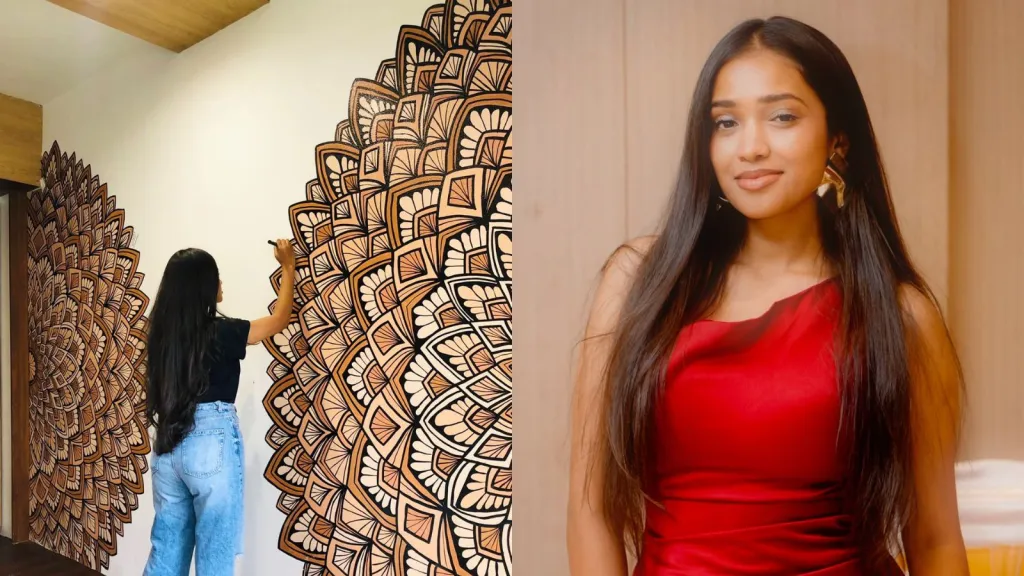
At 26, Pune-based artist Disha Daga has turned a hobby that began in the margins of her college notebooks into a growing professional art practice. Working under the name Disha Draws, she has created intricate mandala designs for a consumer electronics brand, a global automobile manufacturer, an investment firm and Vantara, the wildlife centre in Jamnagar. Her work has also reached the Reserve Bank of India’s Pune office, demonstrating how an interest pursued outside formal art education can develop into a career.
Daga’s journey is not simply about artistic recognition. It also highlights the business realities of working independently as an artist, from finding clients and negotiating fees to managing unpredictable income and protecting time for creativity.
What Are Mandalas, and How Did Daga Discover Them?
A mandala is an intricate arrangement of shapes and patterns that radiate from a central point. The word comes from Sanskrit and means “circle”. In traditional contexts, mandalas represent the universe, while their repeating patterns and symmetrical designs have also become popular in contemporary decorative art.
For Daga, discovering mandalas was largely accidental. In 2016, after completing school and before beginning college, she wanted to explore a hobby other than dance. She came across mehendi designs on Pinterest and began sketching similarly detailed patterns in the back pages of her old accountancy notebooks.
At first, she did not know what these circular designs were called. A Google search introduced her to the term “mandala”, giving a name to the style she had already started exploring.
At the time, Daga was studying at Wadia College while balancing her degree, diploma courses and dance. Although she had never formally studied art, she continued returning to her sketches. The process required patience, concentration and attention to detail, with each new layer building on the patterns already drawn.
What began as an informal creative outlet gradually became an important part of her life. Daga says the practice taught her to slow down and find calm through the act of creating.
A Wall Painting Changed the Course of Her Career
The turning point came in 2020, when the COVID-19 pandemic disrupted education, events and everyday routines. With colleges closed and activities cancelled, Daga began looking for a new way to explore her mandala designs.
After growing tired of working on paper, she decided to paint a mandala directly onto a wall in her home. She shared the finished work online, where it attracted attention from people interested in commissioning similar pieces.
The response introduced her to an opportunity she had not actively pursued. In August 2021, she received her first commercial project. What had started as a personal hobby was beginning to generate professional work.
Daga had not planned to build a career in art. Reflecting on how the opportunity emerged, she says, “I was chosen as a medium at that time.”
Her experience illustrates how sharing creative work online can help artists connect with audiences beyond their immediate social circles. In Daga’s case, a single wall painting helped open the door to paid commissions and a more structured artistic practice.
From Personal Sketches to Corporate and Government Commissions
Daga’s mandala designs have since reached a range of clients, including businesses and institutions. Among her projects is a large painting at the Reserve Bank of India’s Pune office, positioned near the entrance and visible to people entering the building.
Her work has also travelled internationally, reaching Malaysia, Thailand and the United States. Alongside commissioned artwork, she conducts online and offline workshops, which she says have reached more than 25,000 students.
These projects have expanded her work beyond individual commissions, giving her opportunities to create art for different settings and introduce mandala-making to a wider audience.
Her online presence has also grown. Disha Draws has attracted 42,000 Instagram followers, providing a platform through which potential clients and aspiring artists can discover her work.
However, building an audience and securing prominent commissions do not eliminate the uncertainty of independent creative work. For Daga, professional growth has required learning how to manage the practical demands of running an art business alongside the artistic process itself.
The Business Challenges Behind an Independent Art Career
Working as an independent artist can offer creative freedom, but it often comes with an unpredictable income. Daga says her earnings depend on several sources, including commissions, exhibitions, workshops and her ability to reach prospective clients. Periods with fewer projects can therefore be difficult to navigate.
Creating artwork is only one part of the job. Artists must also communicate with clients, promote their work, negotiate fees, manage deadlines and coordinate projects. These responsibilities can consume time and energy that would otherwise be devoted to drawing or painting.
Daga believes artists need to understand the basic principles of business, even if they eventually hire professionals to handle certain responsibilities. Marketing, client relationships and financial planning can influence whether an artistic practice remains sustainable over time.
She also argues that art should be recognised as a profession that deserves fair compensation and financial security, rather than being treated solely as a passion or leisure activity.
Her experience reflects a broader challenge faced by independent creatives: artistic ability alone may not be enough to sustain a career. Building a reliable practice also involves understanding the value of one’s work, communicating that value to clients and managing the financial uncertainty that comes with project-based income.
Why Patience and Mindfulness Matter in Mandala Art
Mandala-making relies on repeated shapes, careful spacing and intricate details. For Daga, the process has been as significant as the finished artwork. Working through multiple layers requires sustained concentration, encouraging her to slow down and focus on the task in front of her.
She describes the practice as one built on patience, precision and mindfulness, adding that it has transformed her life despite her lack of formal art education.
Yet a professional commitment to art does not mean working continuously. Daga has learned to recognise when she needs a break, particularly during periods of creative block.
When she feels unable to deliver the quality expected by a client, she sometimes declines commissions rather than accepting work she cannot complete to her standards. Outside her professional practice, she returns to dance for personal enjoyment, takes herself out for coffee with her iPad or watches something light.
“Your work is not your life,” she says.
Her approach underlines the importance of maintaining boundaries in a profession where creative work and personal identity can easily become intertwined. Taking time away from a project can help preserve the quality of the work and make the practice more sustainable in the long run.
Challenging the Idea That Success Requires a Conventional Career
Daga hopes her journey encourages young people to question the belief that academic achievements and conventional career choices are the only routes to success. Her own experience shows that a skill developed outside a formal educational programme can become the foundation of a professional path.
Her journey did not begin with a business plan or a decision to become an artist. It developed through repeated practice, an online post that attracted attention and a commercial opportunity that emerged during an uncertain period.
That does not mean an independent creative career is free from risk. As Daga’s experience demonstrates, artists must balance the freedom to create with the demands of earning an income, finding clients and managing professional responsibilities.
Her message to young people considering less conventional paths is to build a direction of their own, even when the outcome is uncertain. For those interested in creative careers, her story highlights the value of developing a skill consistently, sharing work with an audience and learning the practical aspects of turning talent into a profession.
A Career Built Without Formal Art Education
From sketching mandalas in the back pages of accountancy notebooks to creating a large painting at the RBI’s Pune office, Disha Daga’s progress has been shaped by curiosity, practice and opportunities she did not initially expect.
Her work for corporate clients, international reach and workshops for thousands of students show how a personal interest can develop into a wider professional practice. At the same time, her reflections on income uncertainty, business responsibilities and creative blocks offer a realistic picture of independent artistic work.
Daga’s journey ultimately challenges the idea that a career must follow a predetermined academic or professional route. Her experience suggests that consistent practice and a willingness to learn can help people develop alternative paths, while patience, financial awareness and personal boundaries remain essential to sustaining them.
Written by Bhagyashri Prajapati, an intern with The Indian Express.
For breaking news and live news updates, like us on Facebook or follow us on Twitter and Instagram. Read more on Latest Business on thefoxdaily.com.


COMMENTS 0