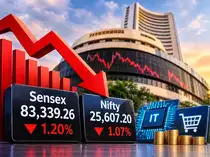
Indian equity markets fell more than 1% on Friday, bringing an end to a four-week winning streak as selling pressure in technology and consumer stocks weighed on benchmark indices. Rising crude oil prices and uncertainty in global markets further affected investor sentiment, triggering a decline in both the Sensex and Nifty.
The market downturn came despite continued buying interest from Foreign Portfolio Investors (FPIs), who remained active in Indian equities. Domestic institutional investors, however, pulled back, highlighting differences in investment activity among major market participants.
The decline interrupted the positive momentum built during November, when Indian equities had recorded gains over several consecutive weeks. The latest session also highlighted how global developments and sector-specific weakness can influence domestic market performance.
Sensex and Nifty Fall More Than 1%
Indian benchmark indices registered losses of more than 1% on Friday as selling pressure spread across key sectors. The decline ended the market’s four-week rally and reduced some of the gains accumulated during November.
The Sensex and Nifty both came under pressure as investors responded to uncertainty in international markets and rising crude oil prices. Weakness in technology and consumer-related stocks contributed to the overall decline.
The correction reflected a shift in market sentiment after several weeks of positive performance. Investors appeared more cautious as external risks and sector-specific selling affected demand for equities.
Although a single session does not necessarily indicate a longer-term change in market direction, the latest decline showed that the recent rally remained vulnerable to changing global conditions.
Technology and Consumer Stocks Weigh on Markets
Technology and consumer stocks were among the major sources of pressure on the domestic market during Friday’s session. Weakness in these sectors contributed to the fall in benchmark indices and affected broader investor sentiment.
Technology stocks can be sensitive to developments in global markets because many Indian IT companies depend on overseas clients and international business conditions. Changes in global economic expectations and investor appetite for technology shares can influence valuations in the domestic market.
Consumer companies, meanwhile, are closely watched for signs of demand and spending trends. Selling pressure in this segment can affect market performance, particularly when several major stocks decline together.
The available market assessment identifies technology and consumer-related weakness as important contributors to Friday’s losses, although it does not specify individual stocks or their respective contributions to the benchmark decline.
Rising Crude Oil Prices Add to Investor Concerns
Higher crude oil prices were another factor weighing on market sentiment. India imports a substantial portion of its crude oil requirements, making the economy sensitive to changes in international energy prices.
When crude prices rise, the cost of energy imports can increase. This may put pressure on the country’s import bill and create concerns about inflation, corporate expenses and the broader economic outlook.
Higher oil prices can also affect companies across sectors. Businesses that depend on fuel, transportation and energy-intensive operations may face increased costs, while the extent of the impact depends on their ability to manage or pass on those expenses.
For equity investors, the combination of rising oil prices and global uncertainty can create additional reasons to reassess risk exposure. This can lead to profit-taking or a reduction in positions, particularly after a sustained market rally.
Global Uncertainty Keeps Investors Cautious
Uncertainty in international markets also contributed to the cautious mood on Dalal Street. Developments in global financial markets can influence investment decisions in India through changes in risk appetite, capital flows and expectations about economic growth.
When investors become less comfortable with global risks, they may reduce exposure to equities or shift towards assets perceived as safer. Such changes in investment behaviour can affect emerging markets, including India.
The latest decline came after four consecutive weeks of gains, making the market particularly sensitive to developments that could encourage investors to book profits. However, the available information does not identify one specific international event as the sole cause of Friday’s fall.
Foreign Portfolio Investors Continue Buying
Foreign portfolio investors remained active buyers of Indian equities even as benchmark indices declined. Their continued participation offered a contrast to the broader market weakness and suggested that foreign investment activity did not move entirely in line with the day’s negative price action.
FPI activity is closely monitored because overseas investors can influence demand for Indian shares and affect market liquidity. Their buying or selling decisions are often shaped by global interest rates, currency movements, valuations and expectations about India’s economic outlook.
However, foreign investor purchases do not guarantee that benchmark indices will rise. Market performance also depends on domestic institutional activity, retail participation, company-specific developments and the distribution of buying and selling across sectors.
Friday’s session demonstrated this difference, with FPIs continuing to buy while the broader market declined by more than 1%.
Domestic Institutional Investors Pull Back
While foreign portfolio investors remained buyers, domestic institutional investors reduced their buying activity. This difference in participation was another notable feature of Friday’s market session.
Domestic institutional investors include entities such as mutual funds, insurance companies and other financial institutions that invest in Indian securities. Their activity is an important component of the domestic equity market because they provide investment demand alongside foreign investors and individual participants.
A pullback by domestic institutions can reduce the support available to the market, particularly when selling pressure is building in major sectors. However, the available information does not provide the exact value of domestic institutional purchases or sales during the session.
The contrasting activity of FPIs and domestic institutions also shows why overall market direction cannot be judged solely by the buying or selling behaviour of one investor category.
Four-Week Market Rally Comes to an End
Friday’s decline interrupted a four-week rally in Indian equities. The positive trend during November had supported investor sentiment, but the latest session showed that the market remained exposed to external pressures and sector-specific weakness.
Markets often experience corrections after periods of sustained gains as investors reassess valuations and adjust their portfolios. Such movements can become more pronounced when global uncertainty or commodity price fluctuations create additional concerns.
The end of the rally does not, by itself, establish that the broader market trend has reversed. Investors will need to assess subsequent trading sessions and developments in corporate and global conditions to understand whether the decline represents a temporary correction or the beginning of a more prolonged period of weakness.
What Investors May Watch in the Coming Sessions
Market participants are likely to monitor crude oil prices, global financial market developments and institutional investment flows for signals about the direction of Indian equities.
The performance of technology and consumer stocks will also remain important after their contribution to Friday’s decline. A recovery in these sectors could help improve sentiment, while continued weakness may keep pressure on the benchmark indices.
Investors will additionally track the balance between foreign and domestic institutional activity. Continued FPI buying could provide support, but its impact will depend on the scale of those inflows and whether domestic investors return to the market.
For now, Friday’s more-than-1% decline marks a pause in the recent market rally. Rising crude oil prices, global uncertainty and selling in technology and consumer stocks outweighed continued foreign investor buying, leaving the Sensex and Nifty under pressure. Market volatility may persist as investors respond to changing international conditions and shifts in institutional flows.
For breaking news and live news updates, like us on Facebook or follow us on Twitter and Instagram. Read more on Latest Business on thefoxdaily.com.





COMMENTS 0