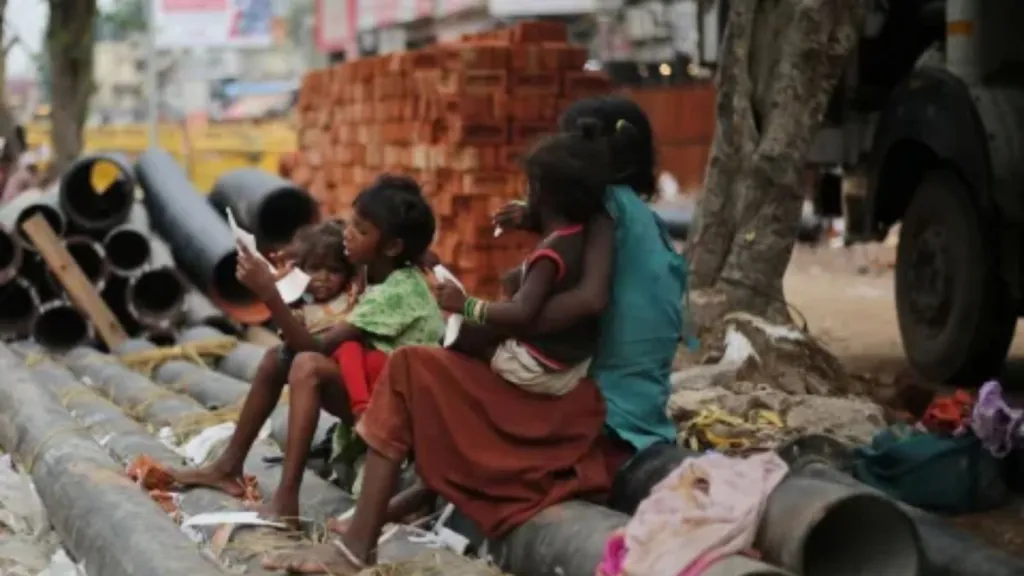
Extreme poverty in India declined to 2.6% in 2023, compared with 5.3% in 2022-23, according to the World Bank. The latest estimate represents a significant reduction from 27.1% in 2011, indicating substantial progress in improving living standards over the past decade.
The World Bank measures extreme poverty using a threshold of less than $3 per person per day in 2021 Purchasing Power Parity (PPP) terms. While the decline reflects a major improvement in monetary poverty, the organisation cautioned that Economic Inequality and geographical concentration of poverty remain important challenges.
In its latest Poverty & Equity Brief, released on Friday, the World Bank said India had recorded one of the fastest reductions in poverty globally over the past decade, across both monetary and non-monetary measures.
Extreme Poverty Falls More Than Tenfold Since 2011
India’s extreme poverty rate dropped from 27.1% in 2011 to 2.6% in 2023. The latest figure is more than ten times lower than the level recorded at the beginning of the period.
The decline from 5.3% in 2022-23 to 2.6% in 2023 also indicates that the proportion of people living below the extreme poverty threshold was cut by more than half between the two reported estimates.
The World Bank attributed the broader progress to improvements in Poverty Reduction across monetary and non-monetary dimensions.
“Over the past decade, India has made remarkable progress in reducing poverty across both monetary and non-monetary dimensions, recording one of the fastest poverty declines in the world,” the organisation said in its report.
Finance Minister Nirmala Sitharaman also welcomed the findings in a post on X, saying the government’s “sustained policy efforts are yielding tangible results, strengthening the foundations for inclusive growth and greater economic opportunity”.
Nearly 496 Million People Lifted Above the Lower Middle-Income Poverty Line
The reduction in poverty extends beyond the extreme poverty threshold. The World Bank also tracks poverty using the Lower Middle-Income Country poverty line of $4.20 per person per day.
According to the report, the share of India’s population living below this threshold declined to 16.1% in 2023, compared with 57.7% in 2011. The reduction represents an estimated 496 million people moving above the poverty line.
In 2022-23, the proportion of the population below the $4.20 threshold stood at 23.9%.
The World Bank’s estimates also show differences between rural and urban areas. In 2023, the urban poverty rate under this measure was estimated at 8.6%, while the rural rate was 19.3%.
The figures for males and females were broadly similar, at 15.7% and 16.6%, respectively.
Consumption Inequality Declines, but Wage Gaps Remain
Alongside the reduction in poverty, India’s consumption inequality has also declined, according to the World Bank. The country’s Gini index fell to 23.0 in 2023, compared with 28.8 in 2011-12 and 25.5 in 2022-23.
The Gini index measures inequality on a scale from 0 to 100. A higher value indicates greater inequality, while a lower value reflects a more equal distribution.
However, the World Bank cautioned that the figures may not fully reflect the consumption patterns of wealthier households and could therefore understate the actual level of inequality.
The estimates are based on India’s three most recent Household Consumption Expenditure Surveys, conducted in 2011-12, 2022-23 and 2023-24.
Income disparities also remain pronounced in the labour market. The report noted that median earnings among the top 10% of workers were approximately 13 times higher than those of the bottom 10%.
This suggests that falling poverty and improving consumption equality have not eliminated significant differences in workers’ earnings.
Why the World Bank Uses Purchasing Power Parity to Measure Poverty
The World Bank’s extreme poverty threshold of $3 per day is calculated using 2021 Purchasing Power Parity, rather than simply converting three US dollars into Indian rupees at the prevailing market exchange rate.
Purchasing Power Parity, or PPP, measures the relative purchasing power of different currencies by comparing the cost of goods and services in different countries. It helps account for differences in price levels and makes poverty comparisons across economies more meaningful.
For example, converting $3 directly into rupees using a market exchange rate of approximately Rs 95 per dollar would produce a value of Rs 285. However, that does not necessarily represent the same purchasing power in India as three dollars would in the United States because prices differ between the two countries.
A comparison of Starbucks coffee prices illustrates the difference. A short Caffè Latte in the United States costs $5.85, equivalent to approximately Rs 555 at the cited exchange rate, while the same-sized drink costs Rs 336 in India.
Based on this example, the purchasing power conversion would be approximately Rs 57.4 for every US dollar. This comparison applies only to the particular coffee product and is not a general measure of purchasing power across all goods and services.
According to the World Bank’s International Comparison Program, a partnership involving official statistical agencies worldwide, India’s PPP conversion rate was 20.09 in 2025.
Poverty Is Becoming Increasingly Concentrated in Specific Regions
Despite the national decline in poverty, the World Bank warned that poverty is becoming increasingly concentrated geographically.
Approximately 57% of India’s poor live in a belt stretching from Uttar Pradesh to West Bengal. This concentration highlights the uneven distribution of poverty reduction across the country.
The national poverty rate therefore does not tell the whole story. Regional differences remain significant, and the concentration of poverty in particular parts of India presents a continuing challenge for efforts to improve living standards.
Employment Growth Driven by More Women Entering Paid Work
The World Bank also highlighted changes in India’s labour market. Employment increased by 13.4 crore between 2017 and 2023, nearly twice the increase in the working-age population during the same period.
According to the organisation, much of this employment growth was driven by rural women entering paid work.
However, the report noted that real earnings remained broadly unchanged, with employment growth concentrated in relatively low-productivity activities. This indicates that an increase in the number of people employed has not necessarily translated into stronger wage growth.
The organisation described overall labour market conditions as broadly resilient but pointed to rising youth unemployment as an area of concern.
Youth unemployment increased from 14.6% in the first quarter of 2025-26 to 15.9% during the same three-month period in the following fiscal year, according to the figures cited in the report.
World Bank Expects Poverty to Decline Further by 2028
The World Bank expects poverty in India to continue falling, although at a more gradual pace than in the past decade.
Using the $4.20-per-day Lower Middle-Income Country poverty line, the organisation projects that India’s poverty rate will decline to 14.2% in 2026 and then fall further to 12.1% by 2028.
The bank said it would update these projections as new information becomes available and existing labour market and macroeconomic data are revised.
These estimates are projections rather than confirmed outcomes, and their accuracy will depend on how economic and employment conditions develop.
New Indian Survey Data Has Changed Global Poverty Estimates
India’s household consumption data has also played an important role in revisions to global poverty estimates.
Last year, the World Bank updated its international poverty lines, shifted the base year from 2017 to 2021 and incorporated new household survey information. These changes resulted in a downward revision of 180 million people in the estimated population living below the Lower Middle-Income Country poverty line in 2022.
The World Bank said the revision was primarily driven by new Indian survey data for 2022-23, referring to the country’s Household Consumption Expenditure Survey.
The development demonstrates how updated national data can influence international assessments of poverty and change estimates of the number of people living below global poverty thresholds.
How Many People in India Remain Below Global Poverty Lines?
Although poverty rates have declined, the number of people living below different international poverty thresholds remains substantial because of India’s large population.
For 2023, the World Bank figures cited in the report estimate that:
- $3 per day: Approximately 7.5 crore people lived below the extreme poverty line.
- $4.20 per day: Around 34 crore people lived below the Lower Middle-Income Country poverty line.
- $8.30 per day: Approximately 115 crore people lived below the Upper Middle-Income Country poverty line.
The $8.30 threshold is designed for Upper Middle-Income economies. Since India is not classified as an upper middle-income country, a larger share of its population falls below this higher threshold. The proportion declined to 80% in 2023, from more than 90% in 2011.
India’s Poverty Reduction and the 2047 Development Goal
The World Bank’s latest estimates point to a major reduction in extreme poverty over the past decade. The decline from 27.1% in 2011 to 2.6% in 2023 marks a substantial change in the country’s poverty profile.
However, the report also highlights challenges that remain, including regional concentration of poverty, substantial wage differences, relatively unchanged real earnings and rising youth unemployment.
India aims to become a developed nation by 2047. Sustaining poverty reduction while improving job quality, raising earnings and addressing regional disparities will remain important considerations as the country works towards that goal.
For breaking news and live news updates, like us on Facebook or follow us on Twitter and Instagram. Read more on Latest Business on thefoxdaily.com.






COMMENTS 0