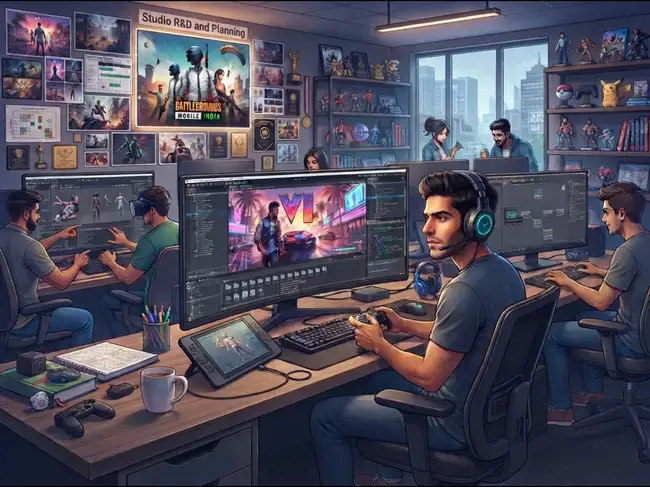
India’s Gaming Industry has built a massive audience, but turning that popularity into globally competitive businesses remains a major challenge. The country’s gaming market had more than 511 million gamers by 2025, highlighting the scale of its digital entertainment ecosystem. However, the industry’s revenue generation remains relatively limited, largely because a significant share of players spend little or no money on games.
The gap between audience size and commercial success reflects deeper structural challenges. Indian gaming studios continue to face difficulties in monetisation, intellectual property ownership, early-stage funding, specialist talent and user acquisition. Building a successful game requires more than creative ideas and technical skills. Studios must also develop valuable original properties, finance production, attract players and retain them long enough to create sustainable revenue.
Global titles such as Grand Theft Auto VI and PUBG illustrate the scale of the international gaming business and the commercial potential of successful intellectual property. For India, the ambition is not simply to produce games for a large domestic audience but to build original franchises that can compete in international markets. Achieving that goal remains an unfinished part of the Make-in-India opportunity.
Monetisation: Millions of Players, but Limited Spending
India’s large gaming audience provides studios with an important starting advantage. More than 511 million gamers represent a substantial potential market for mobile, PC and other digital gaming products. Yet a large player base does not automatically translate into high revenue.
One of the industry’s biggest challenges is low monetisation. Many players are reluctant or unable to spend significant amounts on games, limiting the revenue studios can generate from downloads and active users. This creates a difficult business environment, particularly for companies that need recurring income to fund development, marketing and ongoing updates.
Gaming businesses commonly rely on different revenue models, including paid downloads, in-game purchases, subscriptions, advertising and cosmetic upgrades. However, each model depends on the type of game, player behaviour and willingness to pay. A game may attract millions of users but still struggle commercially if only a small proportion of its audience makes purchases.
Studios must therefore balance accessibility with revenue generation. Introducing too many paid features can discourage players, while relying heavily on advertising may affect the gaming experience. Finding a sustainable balance requires an understanding of user preferences, spending patterns and long-term engagement.
For Indian developers, improving monetisation is essential to building businesses that can support larger production budgets and compete with international studios. Audience growth is valuable, but converting that reach into predictable revenue remains a separate challenge.
IP Ownership: India Makes Games, but Does It Own Them?
Intellectual property ownership is another important issue facing India’s gaming industry. Developing a game and owning the rights to its characters, story, Technology and broader franchise are not necessarily the same thing.
Original intellectual property can become one of a gaming company’s most valuable long-term assets. A successful game franchise can expand through sequels, spin-offs, merchandise, licensing and partnerships. It can also build a recognisable identity that encourages players to return to future releases.
However, studios that primarily work on outsourced development or projects controlled by external publishers may have limited ownership over the intellectual property they help create. While such work can provide revenue and production experience, it may not allow developers to build independent franchises with lasting commercial value.
Creating and retaining original IP requires investment, creative confidence and a willingness to take risks. Studios need the resources to develop distinctive characters, gameplay systems and fictional worlds while retaining control over the rights that could generate future income.
This is particularly important if India wants to move beyond being a development destination for international gaming companies. Building globally recognised Indian franchises would allow domestic studios to participate more directly in the long-term value created by successful games.
Capital: The Prototype Funding Problem
Access to early-stage capital remains a major obstacle for gaming startups. Developing a prototype may require substantial time, technical expertise and financial resources before a studio can demonstrate whether its idea has commercial potential.
This creates a funding gap between the initial concept and a fully developed product. Investors may hesitate to support a game that has not yet demonstrated audience demand, while studios may struggle to produce a convincing prototype without sufficient funding.
The challenge is especially significant because game development is an uncertain business. A technically impressive product does not guarantee commercial success. Studios must test gameplay, refine designs, identify their target audience and establish a realistic production plan before they can confidently scale development.
Limited early-stage funding can force smaller teams to operate with restricted budgets, delay projects or abandon promising ideas. It can also make it harder to hire experienced developers and invest in marketing before launch.
For the sector to mature, financing needs to support different stages of development. Early funding can help teams build prototypes and test concepts, while later investment can support production, distribution and international expansion. Investors also need to understand that gaming projects have development cycles and commercial risks that may differ from those of conventional software businesses.
Talent and Production: Beyond Coding and Art
India has a growing pool of technology and creative professionals, but building a commercially successful game requires a wider range of specialist skills. Coding, animation and visual design are important, yet they represent only part of the production process.
Game studios also need expertise in game design, narrative development, sound engineering, quality assurance, production management, user research and live operations. These functions help turn an initial concept into a polished product that can attract and retain players.
Game design, for example, involves creating the rules, challenges and reward systems that shape the player’s experience. A game may feature impressive graphics but still struggle if its mechanics are repetitive or difficult to understand. Similarly, strong storytelling and sound design can help create a more memorable experience.
Production management is equally important. Large projects require teams to coordinate development schedules, budgets, testing and creative decisions. Without effective management, projects can face delays, rising costs and inconsistent quality.
After launch, studios also need teams capable of maintaining the game, fixing technical problems, introducing updates and responding to player feedback. These responsibilities become particularly important for games designed to operate over extended periods.
Strengthening specialist talent and production capabilities would help Indian studios move towards more ambitious projects. It could also improve their ability to deliver games that meet the expectations of international audiences.
Distribution: Building a Hit Is Only Half the Job
Even a well-designed game can struggle if players do not discover it. User acquisition and retention remain major challenges for Indian gaming studios, particularly those competing against established international publishers with large marketing budgets and recognised franchises.
User acquisition involves attracting new players through advertising, social media, influencer partnerships, app-store visibility and other promotional channels. These activities can become expensive, especially when several games are competing for the same audience.
However, acquiring downloads is only the first step. Studios must also persuade players to return regularly. If users stop playing shortly after downloading a game, marketing expenditure may not translate into sustainable revenue.
Retention depends on several factors, including gameplay quality, performance, regular updates, community engagement and the overall player experience. Developers must understand why users leave and make improvements that encourage them to remain active.
For games that rely on in-app purchases or advertising, long-term engagement can be particularly important. A larger active audience creates more opportunities for monetisation, but only if players continue finding value in the experience.
Distribution also involves choosing the right platforms and markets. Studios must consider whether their games are suited to mobile devices, PCs or consoles, and whether they have the resources to support different technical requirements. Reaching international players can create new opportunities, but it also introduces competition from developers around the world.
Why Global Gaming Franchises Set a High Benchmark
International gaming franchises demonstrate how original intellectual property, large-scale production and long-term audience engagement can combine to create major commercial properties. Games such as Grand Theft Auto and PUBG have established strong identities among players, making them examples of the scale and reach that successful franchises can achieve.
However, building a comparable business requires more than producing a technically competent game. Studios need distinctive concepts, consistent development quality, strong publishing strategies and the financial capacity to support projects over time.
For Indian developers, the opportunity lies in creating games that reflect original creative ideas while meeting global production standards. Local cultural themes and storytelling could provide distinctive material, but international success would still depend on gameplay, technical quality, accessibility and effective distribution.
There is no guarantee that a large domestic audience will automatically produce global hits. Studios must demonstrate that their products can attract players beyond their initial markets and generate enough revenue to support future development.
What India Needs to Build a Sustainable Gaming Industry
India’s gaming industry will need progress across several areas if it is to convert its large user base into a stronger development and publishing ecosystem. Better monetisation models could help studios generate more value from existing audiences, while access to early-stage capital could give promising teams the resources to develop and test original ideas.
Greater emphasis on intellectual property ownership would also help domestic companies build franchises that can generate value over several years. Alongside this, investment in specialist talent, production management and quality assurance could strengthen the industry’s ability to deliver complex projects.
Studios will also need more effective approaches to marketing, distribution and player retention. A successful launch can create visibility, but maintaining an active community requires continuous development and an understanding of changing player expectations.
These challenges are connected. Limited funding can restrict talent recruitment, weak monetisation can reduce the money available for future development, and a lack of IP ownership can limit long-term returns. Addressing only one problem may therefore be insufficient to create sustainable businesses.
Conclusion: A Large Audience, but a Long Road to Global Success
India’s gaming market has established a significant foundation, with more than 511 million gamers by 2025. However, the industry’s ability to turn this audience into sustainable revenue and internationally recognised original franchises remains limited by structural challenges.
Low player spending, questions around intellectual property ownership, inadequate early-stage funding, specialist talent gaps and difficulties in user acquisition and retention continue to affect studios. These issues make it harder for domestic developers to finance ambitious projects and build lasting gaming businesses.
The Make-in-India gaming ambition will depend on whether studios can move beyond developing games for others and establish original properties with long-term commercial potential. India’s large player base offers an opportunity, but turning that opportunity into globally competitive franchises will require sustained investment, stronger production capabilities and successful business models.
For breaking news and live news updates, like us on Facebook or follow us on Twitter and Instagram. Read more on Latest Business on thefoxdaily.com.






COMMENTS 0