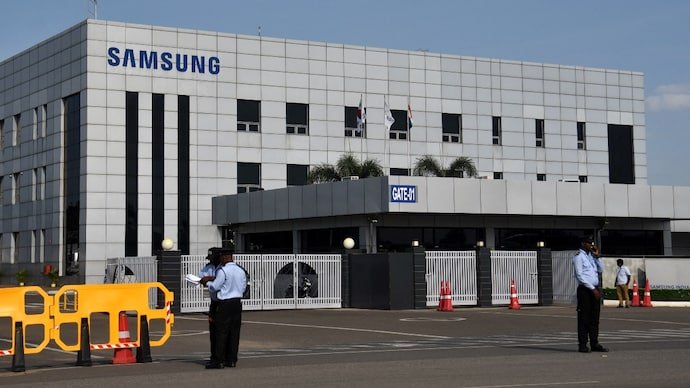
Samsung India has started cutting jobs across its television and home appliance businesses, with around 80 to 100 executives reportedly asked to leave as the electronics giant responds to rising input costs, weaker consumer demand and an ongoing effort to streamline its Indian operations.
The Layoffs are being carried out in batches and are affecting employees at several levels, including director-level executives, headquarters team leaders, branch managers and area managers. The move comes at a challenging point for India’s Consumer Electronics market, where manufacturers are facing higher component costs while shoppers remain sensitive to price increases.
One of the biggest pressures is the sharp increase in memory chip prices, which have more than doubled. The impact is particularly significant for a company whose smartphone business remains its largest revenue generator in India, even though the current round of layoffs is focused on televisions and home appliances.
Samsung is also dealing with a weaker rupee, higher raw-material costs and an estimated 11-12% decline in India’s smartphone volumes. Together, those factors are squeezing margins and forcing the company to reconsider staffing levels and its physical sales organisation.
The restructuring does not indicate that Samsung’s entire India operation is in crisis. The company recorded revenue of more than Rs 1.1 lakh crore in FY25 and a net profit of Rs 11,287 crore. Instead, the latest job cuts point to a more targeted effort to control costs in business categories where growth and profitability are facing greater pressure.
Samsung India has asked 80-100 executives to leave
The first phase of the restructuring has reportedly affected between 80 and 100 executives working in Samsung’s television and home appliance businesses.
The cuts are not limited to junior positions. Directors, headquarters team leaders and managers overseeing branches and geographical areas are among those affected.
According to reports, termination letters have been issued in small batches over recent days. Some affected employees have reportedly been asked to leave without serving their full notice periods.
Samsung is said to be offering a severance package consisting of three months’ salary plus an additional month’s salary for every year of service.
The phased approach indicates that the company is attempting to reduce its workforce while simultaneously reorganising how its sales and distribution operations function in India.
Up to 25% of Samsung’s sales and marketing team could be affected
The initial 80-100 departures may not represent the final scale of the restructuring.
Industry executives cited in reports have suggested that as much as 25% of Samsung’s sales and marketing workforce in the electronics business could ultimately be affected.
That broader estimate includes both direct employees and off-roll workers employed through manpower agencies.
Samsung’s domestic electronics sales organisation is estimated to have around 550-600 executives, separate from the considerably larger sales organisation supporting its smartphone business.
If the higher estimate materialises, the restructuring would represent a substantial change in the way Samsung manages its television and home appliance sales operations.
For now, however, the confirmed job reductions reported publicly remain concentrated in the initial rounds of workforce rationalisation.
Memory chip prices have more than doubled
The most important external pressure facing Samsung is the surge in memory chip costs.
Memory components are fundamental to modern electronics, from smartphones and televisions to computers and other connected devices. When memory prices rise rapidly, manufacturers must decide whether to absorb those increases, raise consumer prices or reduce costs elsewhere.
For Samsung, the situation is particularly unusual because it is itself one of the world’s largest memory-chip manufacturers.
That does not completely shield its consumer-electronics operations from higher prices. Different divisions operate with different economics, and consumer products still need to account for component costs, internal transfer pricing, other materials, logistics, retail margins and intense competition.
The current memory cycle has nevertheless created a difficult Environment for consumer electronics, as strong demand for memory from artificial-intelligence Infrastructure competes with the requirements of traditional electronics manufacturers.
Why AI is indirectly making consumer electronics more expensive
The global growth of artificial intelligence infrastructure has changed the economics of the memory-chip industry.
Data centres require huge quantities of advanced memory, including high-bandwidth memory and other components used alongside powerful AI processors. Semiconductor manufacturers are allocating significant capacity toward higher-value AI-related products.
That can tighten supplies elsewhere and increase costs for conventional consumer electronics.
The effect reaches consumers through several steps: component prices rise, manufacturers face higher production costs, and companies then decide how much of that increase can be passed through to retailers and customers.
Samsung is exposed to both sides of this equation. Its semiconductor business can benefit from strong memory demand, while its consumer businesses may be squeezed by the same increase in component costs.
The contrasting performance illustrates why a company’s semiconductor division can benefit from an industry boom even while its consumer-electronics businesses are cutting costs.
The weak rupee is adding another layer of pressure
Samsung’s Indian operations are also dealing with the impact of a weaker Indian rupee.
The rupee declined by nearly 10% through FY26, increasing the local-currency cost of imported components and other inputs.
For electronics companies, currency movements can be particularly important because many products or components are sourced internationally.
A weaker rupee can therefore raise landed costs even when the underlying dollar price of a component has not changed.
If companies raise retail prices to compensate, consumers may postpone purchases. If they hold prices steady, margins suffer.
Samsung is now facing both pressures at the same time: more expensive components and customers who are less willing to absorb repeated price increases.
India’s smartphone market is also slowing
The broader Indian smartphone market has become another source of concern.
Industry estimates cited in reports indicate that smartphone volumes in India have declined by around 11-12% year on year.
That matters enormously to Samsung because smartphones account for roughly three-fourths of its revenue in India.
Even though the smartphone business has been excluded from the current round of layoffs, weaker volumes in the company’s biggest category can influence the financial performance of the entire India operation.
Lower unit sales can also make fixed costs more difficult to absorb, increasing pressure to improve efficiency across other business units.
Samsung’s smartphone workforce is safe for now
Despite pressure on smartphone sales, the mobile-phone business has not been included in the current layoffs, according to reports.
The reason is strategic: Samsung considers smartphones its core business in India and is expecting the upcoming Diwali festive season to provide a sales boost.
Festive demand is particularly important in India’s consumer electronics market because smartphones, televisions, appliances and other discretionary products often see stronger purchasing activity around Diwali.
Samsung therefore appears to be giving its mobile business more time to recover before considering deeper workforce changes.
That does not mean the division is permanently protected. Future staffing decisions could depend on how volumes, margins and market share develop after the festive period.
Samsung has slipped to third in India’s smartphone market
The pressure on Samsung’s mobile business is visible in its market position.
Counterpoint Research data cited in reports showed Samsung slipping to third place in India’s smartphone market during April-June, down from second place previously.
Vivo led the market, while Oppo moved into second place.
The shift matters because smartphones remain Samsung’s “bread and butter” in India.
Samsung still retains a major presence in premium devices, particularly with its foldable Galaxy products, but the premium segment represents only a small share of overall smartphone volumes.
A strong position in high-end phones can improve margins and brand visibility, but it cannot completely offset weakness across the mass market.
Samsung’s premium phones are performing better
Samsung’s premium Galaxy Fold and Flip smartphones have reportedly received a positive response.
These devices are strategically important because higher-priced smartphones can generate stronger margins and help Samsung differentiate itself from competitors.
However, smartphones priced above Rs 1 lakh account for only around 4% of India’s total smartphone volumes.
That means the premium segment remains too small to determine the performance of Samsung’s overall smartphone business.
The company therefore needs stronger performance across a much broader range of price points if it wants to regain lost market share and improve the economics of its mobile operations.
Samsung has already raised some smartphone prices
Higher component and currency costs are also reaching consumers.
Samsung has raised the prices of some smartphone models by around 5-10%, according to reports.
But price increases can create their own problems.
The All India Mobile Retailers’ Association has reported a sharp decline in consumer footfall amid repeated smartphone price increases, with the reported decline reaching around 40%.
If customers delay upgrades because devices become more expensive, higher prices can partially offset the benefit of raising the price per unit.
This creates a difficult balancing act for Samsung and other manufacturers: protect margins without pricing too many customers out of the market.
Home appliances are feeling the squeeze too
The current layoffs are concentrated heavily in televisions and home appliances, reflecting weaker economics in those businesses.
Home appliances represent roughly 11% of Samsung India’s sales, making the category its second-largest business after smartphones.
The segment has also faced pressure from higher raw-material costs.
Air conditioners are a particular challenge. Samsung has made efforts to expand its presence in the high-value air-conditioner market, but growth has been harder to achieve as consumers remain price-sensitive and competition remains intense.
When higher material costs combine with weaker demand, maintaining a large sales organisation becomes harder to justify.
Why Samsung is reorganising its branch network
The workforce cuts are part of a broader organisational restructuring rather than an isolated round of layoffs.
Samsung is consolidating parts of its physical branch network in India, with several regional offices being merged.
Examples include combinations involving Ranchi and Patna, Delhi and Gurugram, and Punjab and Chandigarh.
The objective is to reduce duplication and simplify the management structure.
When two nearby or overlapping branch operations are combined, some positions naturally become redundant.
Such restructuring can reduce administrative costs, but it can also change how the company manages retailers, distributors and regional sales teams.
Samsung planned to merge TV and appliance sales teams
The company has also been examining changes to the way it manages its television and home appliance sales organisations.
Samsung had proposed combining the sales teams for the two categories as part of an effort to reduce management layers and operating expenses.
That merger has reportedly been postponed until the December quarter.
The delay may reflect the practical difficulty of reorganising teams during the important festive selling period.
Rather than disrupting operations immediately before Diwali, the company may prefer to maintain separate structures through the peak season and complete the organisational changes afterward.
Could Samsung announce more layoffs after Diwali?
The possibility of a second round is one of the most important aspects of the current restructuring.
Industry executives cited in reports expect that another round of manpower rationalisation could take place after Diwali, particularly in television and home appliance operations.
That possibility is not presented as a confirmed company-wide plan, but it shows that Samsung’s cost-cutting process may not be finished.
The post-Diwali review could depend heavily on how consumer demand performs during the festive period.
If sales improve significantly, Samsung may be able to moderate further reductions. If demand disappoints and input costs remain high, additional restructuring could become more likely.
Why Diwali is crucial for Samsung’s India strategy
Diwali is one of India’s most important periods for consumer-electronics purchases.
Consumers often time major purchases around the festive season, while retailers stock up in anticipation of stronger demand.
For Samsung, the upcoming period provides an opportunity to determine whether consumers are willing to absorb higher smartphone and electronics prices.
A stronger festive season could support the company’s decision to protect the mobile workforce while improving volumes across televisions and appliances.
A weaker season could produce the opposite result, increasing pressure to cut costs further.
The next few months will therefore be important not just for quarterly sales but for Samsung’s broader workforce strategy in India.
Samsung India remains a large and profitable business
The workforce reductions should not be interpreted as evidence that Samsung is abandoning India.
The company continues to operate a substantial manufacturing, sales and distribution presence in the country.
Its FY25 financial performance was also strong, with total revenue of approximately Rs 1.1 lakh crore, up 12% year on year, and net profit rising 38% to Rs 11,287 crore.
Those numbers provide important context.
The latest job cuts are taking place inside a business that remains large and profitable. The restructuring is therefore better understood as a response to changing cost structures, category-level performance and management efficiency rather than an indication that Samsung’s Indian operations are collapsing.
Why profitable companies still cut jobs
Layoffs do not necessarily mean that a company is losing money.
A profitable company can still reduce headcount when it expects certain businesses to deliver lower returns, when organisational structures become too expensive or when Technology and changing consumer behaviour reduce the need for particular roles.
In Samsung’s case, the current restructuring appears targeted at improving the economics of specific consumer-electronics categories.
Reducing duplicated management positions and consolidating regional offices can lower recurring costs even if overall company revenue remains strong.
That distinction is important because Samsung’s semiconductor business is benefiting from a powerful global memory cycle at the same time that its consumer businesses are facing pressure.
Samsung’s global business shows the same divide
The challenges in India reflect a broader contrast in Samsung’s global operations.
During the June quarter, the company’s mobile business moved into an operating loss, while consumer electronics remained under pressure.
At the same time, the semiconductor division benefited from strong demand for memory products.
The divergence highlights how different parts of the same multinational company can experience very different economic conditions.
AI-related demand can improve semiconductor profitability while rising memory prices make smartphones and consumer electronics more expensive to manufacture.
Samsung therefore has to manage competing interests within its own business: expanding capacity where semiconductor demand is strongest while protecting margins in consumer-facing divisions.
The unusual position of Samsung as both chipmaker and electronics brand
Few companies illustrate the semiconductor cycle as clearly as Samsung.
Unlike electronics brands that purchase almost all of their memory components from outside suppliers, Samsung has a huge semiconductor operation of its own.
But internal supply does not eliminate the economic impact of changing market prices.
The company’s semiconductor business serves multiple customers and products, while consumer divisions have their own budgets, pricing structures and profitability targets.
Strong chip pricing can therefore boost one part of the organisation without protecting another part from higher costs.
The current restructuring demonstrates why vertical integration does not always eliminate internal economic pressures.
What the layoffs mean for Samsung’s competitors
Samsung’s troubles provide opportunities for rivals in India’s consumer-electronics market.
In smartphones, Vivo and Oppo have already strengthened their positions, while apple remains influential in the premium segment.
In televisions and appliances, Samsung competes with a broad range of domestic and international brands that are also attempting to capture India’s growing consumer market.
If Samsung reduces its sales workforce or consolidates regional operations too aggressively, competitors could attempt to exploit gaps in retailer relationships and distribution coverage.
That makes cost reduction a delicate exercise. Saving money is useful, but losing market presence can make it more expensive to rebuild later.
Could fewer managers make Samsung more efficient?
Samsung’s restructuring suggests that the company believes parts of its sales organisation have become too layered or geographically fragmented.
Consolidating branches and combining teams can reduce management overhead and simplify decision-making.
But there is a trade-off.
A leaner organisation can operate more efficiently, while an overly centralised sales structure may become less responsive to local retailers and consumer trends.
India’s consumer market is highly diverse, with significant differences between metropolitan areas, smaller cities and regional markets.
Samsung will therefore need to ensure that cost savings do not weaken its ability to compete at the ground level.
Why television and appliance sales are under pressure
Televisions and home appliances are mature categories compared with smartphones, meaning consumers do not necessarily replace products every year.
Demand can also fluctuate depending on household income, financing costs and broader consumer confidence.
At the same time, competition has intensified across categories such as televisions, refrigerators, washing machines and air conditioners.
If companies are unable to raise prices enough to compensate for higher components and raw materials, profitability can deteriorate even when sales volumes remain stable.
This makes cost management especially important in mature consumer-electronics categories.
What the restructuring says about India’s electronics market
Samsung’s actions also reveal a broader shift in India’s electronics industry.
The market remains strategically attractive because of India’s large population, rising incomes and expanding demand for consumer technology. But growth does not mean every category or company can expand indefinitely.
Manufacturers now face a more complicated environment involving supply-chain inflation, currency volatility, intense competition and increasingly sophisticated consumers.
Companies must grow while simultaneously protecting margins.
That is forcing multinational manufacturers to scrutinise their Indian cost structures more closely, even when the long-term outlook for the market remains positive.
What Samsung employees and retailers should watch
The coming months could provide important clues about the eventual size of the restructuring.
Employees will be watching whether additional termination letters are issued after the festive season and whether the proposed TV-appliance sales merger moves ahead.
Retailers will be watching whether Samsung maintains adequate regional coverage after branch consolidation.
Consumers will likely see another round of pricing decisions if memory and other input costs remain elevated.
And investors will be watching whether Samsung’s Indian operations can maintain strong revenue and profits while improving the margins of its weaker business categories.
Samsung India layoffs at a glance
| Factor | Current situation |
|---|---|
| Current job cuts | About 80-100 executives asked to leave in initial rounds |
| Primary businesses affected | Television and home appliances |
| Potential wider impact | Up to 25% of electronics sales and marketing staff, according to industry estimates |
| Memory chip prices | More than doubled, increasing cost pressure |
| India smartphone market | Volumes estimated to have declined 11-12% year on year |
| Samsung’s smartphone workforce | Not affected by the current round of layoffs |
| Recent smartphone price increases | Some models reportedly increased by 5-10% |
| Samsung’s FY25 India revenue | About Rs 1.1 lakh crore |
| Samsung’s FY25 India net profit | Rs 11,287 crore |
| Home appliances share | About 11% of Samsung India’s sales |
| Possible next round | Further rationalisation may occur after Diwali, particularly in TV and appliances |
Could the current layoffs spread to smartphones?
For now, the smartphone business appears to be protected because Samsung expects festive demand to improve and considers mobile devices its most important category in India.
But that protection is conditional.
If smartphone volumes remain weak, prices continue rising and Samsung’s market share declines further, the company could eventually be forced to reassess its mobile workforce as well.
The key variable is likely to be profitability rather than sales volume alone.
A strong premium product mix can support margins even when unit volumes decline, while aggressive discounting can produce the opposite outcome.
Samsung’s post-Diwali results will therefore be closely watched.
The bigger question is whether higher costs are temporary
Samsung’s current response also depends on how long the memory-chip price surge lasts.
If memory prices fall substantially after new supply becomes available, some pressure on consumer electronics manufacturers could ease.
If high memory demand from AI infrastructure keeps prices elevated, companies may need to make more permanent changes to their cost structures.
That could mean additional layoffs, greater automation, more outsourcing or further consolidation of sales operations.
The distinction between a temporary cost shock and a lasting shift in the electronics industry will therefore determine whether Samsung’s current restructuring remains a one-off adjustment or becomes part of a larger transformation.
Samsung is protecting the core while cutting around it
The pattern of the current restructuring is revealing.
Samsung is reducing headcount in television and home appliances, consolidating regional offices and reviewing sales structures while leaving the smartphone workforce untouched for now.
That suggests a strategy of protecting the company’s most strategically important business while cutting costs in categories facing greater immediate pressure.
The approach also gives Samsung time to see whether the Diwali season can revive smartphone demand and improve the economics of the wider India operation.
If the strategy works, the company could emerge with a leaner organisational structure without making deeper cuts across its entire business.
If it fails, further rationalisation could follow.
Samsung India faces a difficult balancing act
The latest layoffs underline the increasingly difficult economics of India’s consumer-electronics market.
Samsung remains one of the country’s biggest electronics companies, with enormous revenues, strong brand recognition and an extensive domestic footprint. Yet those advantages do not protect every business line from rising costs and changing consumer behaviour.
Memory prices have more than doubled, the rupee has weakened significantly, smartphone volumes have declined and consumers are facing higher prices. At the same time, Samsung’s television and appliance divisions are dealing with weaker demand and pressure from raw-material costs.
The company is responding by cutting jobs, combining offices and reviewing its sales structure.
The fact that smartphones have been spared for now is equally significant. Samsung is effectively betting on India’s festive season to provide enough demand to justify protecting its most important workforce.
That makes Diwali a critical checkpoint for the company’s next decision.
Samsung’s India restructuring could have a second chapter
The current wave of Samsung India layoffs appears to be part of a broader effort to reshape the company’s cost base rather than a response to a collapse in its overall business.
About 80-100 executives have been asked to leave in television and home appliance operations, while industry estimates suggest the ultimate impact could be considerably larger. Regional branch consolidation and proposed sales-team restructuring add to the picture.
Yet Samsung enters this period from a position of considerable financial strength. Its India revenue and profit remain substantial, while its semiconductor business globally is benefiting from intense memory demand.
The problem is that the forces helping Samsung’s chip business are simultaneously making life harder for its consumer-electronics operations.
That contradiction is at the heart of the current restructuring.
For employees, the key concern is whether more job cuts arrive after Diwali. For retailers, the question is whether a leaner sales network will remain competitive. For consumers, the issue is whether higher component costs will continue to push up electronics prices.
And for Samsung, the challenge is to become leaner without weakening the market presence that helped it build one of India’s largest electronics businesses.
The next few months will show whether the 2026 layoffs are a contained restructuring or the first phase of a much broader overhaul of Samsung’s India operations.
For breaking news and live news updates, like us on Facebook or follow us on Twitter and Instagram. Read more on Latest Business on thefoxdaily.com.






COMMENTS 0